

It's a Strange Place ...
"While cinemas elsewhere may worry about customers toting alcohol, the local drive-in had to ban dynamite. In this town, tempers run thin and everyone packs a blasting cap or two. The Coober Pedy Times rubbed someone the wrong way and found its office firebombed. That case was never solved. Likewise the bombing of the local court magistrate’s office a few years before. Yet neither incident irritated the community, certainly not as much as the fire bombing of Acropolis. "That was the best Greek restaurant in town," sighs one old-timer. "Now, that was a REAL crime. Who could have done such a thing?"
By Ron Gluckman in "Home Under the Range" https://www.gluckman.com/CooberPedy.Australia.html


OPAL GEMS IN AUSTRALIA'S COOBER PEDY
By Anne Gordon published in "The Sunday Sun - Sept 12th 2004


I sensed that this was going to be a travel experience with a difference when the passenger in the front seat of our tiny plane leaned forward and pulled the life belt whistle from behind the pilot’s neck. The pilot fumbled to find it during the delivery of his mandatory safety instructions prior to take-off, the passenger slipped it into his pocket, apparently as a souvenir.
Our 18-seat aircraft was wide enough for one seat on each side of a narrow aisle with a ceiling high enough to accommodate a 5 foot tall adult. I boarded with my cardboard cup of water and two cookies courtesy of the airline. I gathered that it was sufficient to keep us hydrated and satisfied for the 3 hour trip to Australia's Outback. I had to hobble with my head tucked onto my chest to reach my sheepskin covered seat.
We were headed 846 kilometers north of Adelaide to Coober Pedy, a town much like you would expect to find in the American Wild West or at the forefront of a Gold Rush. Here the treasure isn't gold but an equally beautiful material: gem opal.
Here it is hotter than one can imagine and dry beyond belief. Sometimes the soil doesn't experience the relief of even a single raindrop for years. It is in this wasteland that a certain breed of person has settled and thrived. They are the opal miners and their habitat must surely be the place most mysterious, most utterly fascinating in all of Australia. As we approached the runway, rocking and violently reacting to turbulence I marveled at the pure unfettered ugliness of the town. Before us our world spread out like a giant barren table, cobbled and pocked around a strewn field of mining ephemera, rusting, dusty and broken as though set upon by the area's inhabitants, not to operate, but rather in a fit of Aussie madness. Touching down the door opened as though upon a furnace and peeking apprehensively out it was a landscape blown by dusty clouds beneath a sky of searing blue.
If you suffer from self harm, severe depression or psychotic episodes, this is not the place for you. Its a marginal existence on the edge of humanity, made more tolerable for the eccentricity and humor of its residents - tougher than a chewed old rawhide, they live beneath the earth like "Morlocks" (H.G. Wells).
150 million years ago the area where Coober Pedy now stands was an ocean. With climatic change the ocean disappeared and silica was left behind. It dissolved in water and seeped into cracks and crevices in the rock. Decaying organic matter left casts and sometimes that was also filled by silica. As the water evaporated, opal precipitated as a solid that was composed of tiny spheres, arranged where fortunate with some regularity and continuity of the sphere's size.
In precious opal the spheres are regular and light is diffracted and scattered in such a way as to cause that wonderful harlequin of color that opal connoisseurs have come to admire. Larger spheres diffract the longer wavelengths and create a red and orange play of color. Smaller spheres give rise to a blue effect. The greatest value in opal arises where both blue and red are in close proximity in a stone and that's what the miners are here to find.
Coober Pedy, located in the Far North region of South Australia. It is defined geologically by its unique, weathered, and arid environment that makes it the world's primary source of white, precious opal. The town is situated on the edge of the Stuart Range escarpment, sitting on top of cretaceous-aged (~150 million years old) sandy and claystone deposits that were once part of the ancient, shallow Great Artesian Basin. Unlike what I'm used to there are no pegmatites or carbonatite vein dykes, this is a sedimentary environment not an igneous one.
Small dusty Coober Pedy is a thriving center of industry - smack center in the middle of nowhere. As we drove into town with the hotel tour guide who also served as the airport agent – checking in the luggage and such – we passed small Utes (trucks) scurrying about the town like ants on a mission. This was an Australian version of Cobalt, Ontario, with opal instead of silver.
Most locals sported an over-size sign reading EXPLOSIVES. Empty or soon to be empty beer cases were piled amongst crates of dynamite. An expensive and vital part of the industry, explosives speed up a once tedious operation. It had been picks and shovels that were responsible for most of the devestated landscape. Now most of the town resides underground and in the digging of a new room for their house a miner often more than covers the cost of furnishing with their opal takings. Parked outside a shed that sold groceries I noticed that the driver moved his beer into the cab for greater safety. The crates stayed in the back.
In a small shop on the main street in Coober Pedy I struck up a conversation with a miner who had arrived here from Greece at the age of 16. Yannis Pappadoupolis owns a shop selling opals to tourists but swears that money is not important to him. His love he says is the opal. On sale for A$67,000 in his shop was the biggest opal I’d ever seen. Laying it on a piece of red velvet, the 120 carat gem glittered like something born of the moon. It was absolutely stunning. Opalescent with fire shooting from its heart in every colour of the rainbow, it nestled in a circle of diamonds. “And what is the value of the smaller red opal you call “Desert Fire” I asked. “Priceless,” he said. “I’ll never sell it.”
In a town of 3500 inhabitants comprising 45 different nationalities, Coober Pedy's citizens are a diverse and often amusing array of characters. One of note is a local legend, "Crocodile Harry". During his youth in Northern Queensland, he was a handsome crocodile hunting Casanova. When the market for crocodile skins dried up Crocodile Harry migrated to Coober Pedy, where he opened a "B&B" in a dugout. His specialty - entertaining ladies from foreign lands for a fee. In keeping with his image his dugout decor is erotic - nude figures and lacy underwear. You might recognize Harry's dug-out from a Mad Max movie (Beyond the Thunder Dome).
At night we discovered that the bars are crowded with men who may spend the better part of their lives searching the underworld for glittering streaks of opalized silica in their diggings. They speak in some kind of an English dialect, just barely recognizable by outsiders. Most are small-time operators who have a claim, work in the morning or maybe the afternoon, make the occasional find and lament that the rich pickings in opal mining are a thing of the past. “What can they expect,” was the cynical comment of one Coober Pedy matron with whom I spoke. “They only work a few hours a day!” She might have had a point. I see several miners exhausted from the morning's work going who knows where, bare bellied (usually substantially so) with a wheelbarrow toting a case or 2 of beer. Maybe they're off to view a movie, several were filmed in Coober Pedy for its arid other-worldly landscape. Something that looks like it just skimmed the desert sands in crash landing comes from the hit blockbuster Pitch Black. It's without a doubt a spaceship. Vin Diesel’s character, Riddick, was introduced to millions of sci-fi fans in the movie; yes indeed it's hallowed ground for film buffs (and ladies looking for a Latvian Baron).
Coober Pedy's opal fields are spread over an area of approximately 40 kilometers around the town. It is here in Australia that most of the world’s supply of opals are to be found. Conventional mining with pick and shovel (more recently jackhammer) takes place in some 70 Australian opal fields. Deep shafts, both operative and abandoned litter the landscape. "Noodlers comb the tailings for missed treasures. Despite warnings photographers have walked backwards into shafts as they search for the perfect shot. Recently a french journalist stumbled into a 10 meter long shaft and bumped down its length to land in a pile of sand. The lady's full figure slowed her descent and the soft sand cushioned her landing.
For those with a strong work ethic there's still money to be made in this Topsy-turfy world of the Australian outback,but be wary not to offend. Dynamite and the Aussie sense of settling scores combine in Coober Pedy to form a strange desert-blasted landscape. A visit will leave you singed and puzzling.
Some interesting opal facts ...
-
Black opal is the rarest. White, gray, and green opals are more common.
-
Opal is deposited at relatively low temperatures and it occurs in fissures of almost any kind of rock.
-
Opals too thin to produce a "natural" are often presented as backed by other materials to form a "composite". An opal doublet consists of a thin layer of precious opal, backed by a layer of dark-colored material. Most commonly this material can be ironstone, dark common opal, onyx or obsidian.
-
Newly discovered in 2008, Wollo Province opal (Ethiopia) was different from the previous Ethiopian finds, it was formed as nodules in weathered ryolite (volcanic) and it more closely resembles the opals of Australia and Brazil - sedimentary. Those in the trade just call it "Wello".
Just so you have a taste of the local dialect before you visit (High Aussie)...
"Dont ask Mick, poor bugger's a few stubbies short of a six pack" (Mick is stupid)
"Looks bad, better call the ambo". (call the ambulance)
"Got the budgie smugglers on for the ladies" (wearing a Speedo)
"Going to the bottle-o this avro" (going to the liquor store this afternoon)
"Had to pull a sickie" (pretending I was sick so as to take the day off work)
"It's Johnno's shout" (it's Johnno's turn to buy a round)
Note: there are 3 basic Aussie accents, general, cultivated and broad, but no matter what dialect, understatement in Australia is an art form.


Left: A unique subterranean culture with a diverse and eccentric population of prospectors from around the world, including significant Aboriginal involvement and a history of returning soldiers and immigrants seeking fortune in this idiosyncratic, self-governed industry (Opal mining).

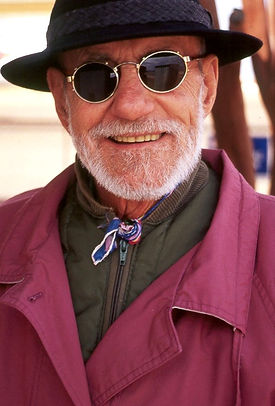

Crocodile Harry (Arvid Blumenthal) was a famous, Latvian opal miner, WWII veteran and former crocodile hunter in Coober Pedy. He is known for his strange, graffiti-covered u dugout, filled with art, artifacts, and mementos. A good proportion are from his many female admirers. Harry's dugout is now a quirky, must-see attraction. Most would say its eccentric and a bit off-color, an Australian version of the "Playboy mansion" - who would have guessed the decadence under Coober Pedy.


Right: In the movie, "Pitch Black", the Hunter-Gratzner, is a large commercial transport vessel that gets hit by micrometeoroids, killing the captain and forcing an emergency crash landing on a desert planet. This world has triple suns and to the survivor's horror, flesh eating creatures that live beneath the surface.
Left: Holes pock the landscape, likely where the flesh eaters live, and miners.
