


Igneous rocks in the Bancroft area
Long lived though they are, igneous rocks are just a part of the endless geological cycle. These rocks are born of fire and they are broadly classified as to their silica content and their grain size. In time these igneous rocks are altered by metamorphosism or worn down by erosion and redeposited as sedimentary rocks. At the bottom of mountains all 3 of these rock varieties return to magma and resurface at mid-oceanic ridges to begin the process anew.


Left: grain size and crystal size increase as cooling slows and space becomes more abundant. These feldspar crystals clearly formed in ideal conditions
Igneous Rock Formation in the Bancroft Area – Rockhounding in Ontario’s Mineral Capital
The Bancroft region is the heart of rockhounding in Ontario, offering some of the most diverse Ontario rocks and minerals thanks to its deep igneous roots, rare pegmatites, and world-class crystal localities near Dark Star Crystal Mines.
Why Bancroft Is the Center of Rockhounding in Ontario
The Bancroft area of eastern Ontario is widely known as Canada’s Mineral Capital, and for good reason. Its extraordinary diversity of Ontario rocks and minerals is rooted in a long and complex history of igneous activity tied to deep Earth processes. For anyone interested in rockhounding in the Bancroft area, this region offers granite, syenite, pegmatite, nepheline-bearing rocks, and an incredible variety of collectible crystals.
To understand why Bancroft is so rich in minerals, we need, in part, to look at how igneous rocks form—and how those processes shaped the Grenville Province beneath your feet. The other side of the equation is metamorphic rocks - another article
The Tectonic Engine That Creates Magma Beneath Ontario
Igneous rocks originate from molten rock—magma—generated by heat deep within the Earth. That heat comes largely from the radioactive decay of uranium, thorium, and potassium in the mantle and crust. As temperature increases with depth (about 2.4 °C per 100 m), rocks begin to melt. At roughly 1,200 °C around 100 km below the surface most rocks have fully melted.
Plate tectonics is driven by mantle convection: hot material rises and cool material sinks. In some areas, mantle plumes (hot spots) generate basaltic magma. In others, magma forms where oceanic plates subduct beneath continents. Water carried down by the oceanic crust lowers the melting point of rocks, creating silica-rich, sticky magmas that feed explosive volcanoes and deep crustal intrusions like those found beneath Bancroft. Pegmatites as intrusions in the Bancroft area are especially common, usually those in the same area are of the same age and have originated from the same magma source. Minerals within a pegmatite Province seem to bond these closely situated features together. So if one pegmatite is rich in uranium, most in close proximity will be rich in uranium. In contrast, carbonatites grouped in the same area seem to differ quite widely as we see on our Dark star crystal mines claim.
Three Main Types of Igneous Rocks in Ontario
All igneous rocks fall into three main compositional families:
1. Mafic (Basalt / Gabbro) – Low silica, rich in iron and magnesium, dark colored and fluid when molten. Basalt forms at mid-ocean ridges and hot spots; gabbro is its coarse-grained intrusive equivalent.
2. Intermediate (Andesite / Diorite) – Moderate silica, common at subduction zones. These magmas are thicker and gas-rich.
3. Felsic (Rhyolite / Granite) – High silica, light colored, very viscous. These form from melting continental crust and produce granite and pegmatite—key rocks for rockhounding in the Bancroft area.
As magma cools, minerals crystallize in a predictable order known as Bowen’s Reaction Series, developed by Canadian geologist Norman L. Bowen of Kingston, Ontario. Early minerals drop out of the melt, changing the content and chemistry of the melt in a process called "magmatic differentiation". Over time, as crystals drop to the bottom of the magma chamber, the remaining melt becomes richer in silica, forming granite and rhyolite. Quartz and mica are typically the last minerals to crystallize in the Bowen's reaction series.
Igneous Foundations of the Bancroft Area
The Bancroft region lies within the Grenville Province, a deeply metamorphosed belt of ancient crust more than a billion years old. Most igneous rock here occurs in about sixty plutons—large bodies of magma that cooled slowly underground around 1.3 billion years ago. Fortunately, for those of you who want to see the resulting intrusions in Bancroft's country rock, there are plenty of examples in the Bancroft road cuts.
These plutons are concentrated into three major circular complexes about 10 km across:
• Cheddar Complex
• Cardiff Complex
• Faraday Complex
These are the ancient “roots” of long-eroded mountains. Glaciers did their work both eroding the rock and burying the surfaces for. Where mountain roots were exposed it made for easy prospecting. Because the magma cooled slowly, minerals grew large, forming coarse-grained granite, syenite, and pegmatite—prime targets for collectors interested in Ontario rocks and minerals.
Key Igneous Rocks and Minerals for Rockhounding in the Bancroft Area
Bancroft is famous for unusual and alkaline igneous rocks, including:
-
Nepheline syenite and related rocks – Foyaite, urtite, ijolite, jacupirangite, and shonkinite. These silica-poor, alkali-rich rocks often intrude marble.
-
Granite and Syenite – Granite contains quartz; syenite is similar but quartz-poor. There’s no sharp dividing line between them. The Burgess Mine is within a northeasterly trending body of syenitic gneisses & pink & white leuco-syenite pegmatite. I have found corundum, zircon and titanite here.
-
Pegmatites – Extremely coarse-grained granite with crystals larger than 2.5 cm. These host spectacular crystals and are the crown jewels of rockhounding in Ontario.
-
Associated minerals include zircon, sodalite, biotite, green apatite, orthoclase, and many more—making Bancroft a world-class destination for mineral collectors
-
Basaltic Roots and Metamorphosed Volcanic Rocks in Ontario
Although Bancroft is dominated by intrusive rocks, volcanic ancestors are also present. Many original basalts and andesites in the Grenville Province were later metamorphosed into amphibolite during mountain-building events. Typically basalts are dark and heavy and low in silica. as they flow out onto the ocean floor the rock that hits the water billows out into what they call pillow larva. Down beneath there are the dykes where the basalt cools more slowly. Once exposed these dykes show themselves as pillared columns.
Evidence of ancient volcanic centers exists south of Bancroft near Apsley, including a basaltic lava remnant at The Gut. These rocks record an early volcanic environment later buried, intruded, and transformed—part of the deep story behind Ontario’s rocks and minerals.
From Plutons to Pegmatites – How Bancroft’s Crystals Formed
As granitic magma rose into the crust beneath Bancroft, it stalled and cooled slowly in any of the area's many plutons. Large crystals formed formed underground in what we would call the roots of the Grenville range. In the final stages, leftover melt became rich in water, rare elements, and silica—perfect conditions for pegmatite formation. Now worn down by several glaciations, the deeply buried mountain roots are now exposed.
This is where Bancroft’s giant feldspar, apatite, and crystal clusters originated. At the edges of these intrusions, sedimentary rocks were “baked” into marble, slate, and gneiss, further increasing the geological diversity for rockhounding. Industry took advantage of these mineralogical riches and there have been successive waves of mining in Bancroft's igneous intrusions.
Mineral booms in the Bancroft area igneous intrusions
-
Iron (1880s): Iron and magnetic ores were mined starting around 1882 in areas like Coe Hill and Faraday Township.
-
Gold (1890s): Following the 1886–1887 gold discoveries in Madoc, a rush occurred in the Bancroft area. Surface gold was found near Bancroft in 1897.
-
Corundum and Mica (1890s–1900s): Corundum was mined in Carlow and Raglan townships around 1898. Mica was mined from the late 1890s through the early 20th century.
-
Sodalite and Marble (1900s–1911): The famous blue sodalite was first discovered in the late 1800s, with mining beginning around 1905 at the Princess Sodalite Mine. Marble quarrying started in 1911, with stone from the area used in the Royal Ontario Museum and Parliament Buildings. Sodalite can often be seen when rockhounding in the Bancroft area.
-
Feldspar mining in the Bancroft area, particularly in townships like Monteagle, has a history dating back to at least 1919 with operations such as the Watson Mine. The area's pegmatites produced feldspar alongside mica and granite, often utilizing side-hill cuts and, in the case of the Watson Mine, an adit as well.
-
Uranium boom in 1949, prospector Arthur H. Shore discovered uranium in Faraday Township. By 1953, the area experienced what was described as the "greatest uranium prospecting rush in the world".
-
Key Mines (1954–1964): Four major mines operated during this era:
-
-
Bicroft Mine (1957–1963): Operated in Cardiff Township.
-
Greyhawk Mine (1957–1959): Later resumed operation in the 1970s.
-
Dyno Mine (1958–1960): Operated at the eastern edge of the Cheddar granite.
-
-
Faraday Mine (1954–1964): The most lucrative, which later became the Madawaska Mine.
-
The Collapse (1964): When federal government contracts for purchasing uranium expired, the market collapsed, causing all four mines to shut down by 1964, impacting the local economy.
3. The Second Uranium Wave (1970s–1982)
-
Reopening (1975–1982): Due to rising uranium prices during the 1970s energy crisis, the Faraday Mine reopened as the Madawaska Mine in 1975–1976.
-
Final Closure (1982): The uranium market fell again in the early 1980s, and the remaining mines (Madawaska and Greyhawk) closed for good in March 1982
FAQ about Bancroft area Igneous Rocks:
Based on the geology of the Bancroft region in Ontario, Canada, which is known for being the "Mineral Capital of Canada" with a complex history of deeply buried, metamorphosed igneous rocks (specifically within the Grenville Province), here are the 5 most commonly asked questions:
-
What types of igneous rocks are found in the Bancroft area?
The area is dominated by plutonic (intrusive) igneous rocks, including granite, syenite, and famously, nepheline syenite and pegmatites. -
Why are the crystals in Bancroft igneous rocks so large?
The area underwent intense geological pressure and heat 16 km underground, allowing for slow cooling and the growth of exceptionally large mineral grains, particularly in pegmatites, which can sometimes feature crystals over 10 feet in length. -
What is the "foid-syenitoid" rock found in Bancroft?
It is nepheline syenite, a rare, silica-deficient igneous rock that is highly prized by rockhounds and for industrial use. Bancroft is one of the few places in the world where it is found in large quantities. -
Are the igneous rocks in Bancroft part of the Canadian Shield?
Yes, they are part of the Central Metasedimentary Belt of the Grenville Province in the Canadian Shield, which experienced intense mountain-building processes. -
What valuable minerals are associated with Bancroft igneous rocks?
The pegmatites and metamorphic rocks in this area are famous for hosting sodalite, apatite, mica, rose quartz, and fluorite.
Why Bancroft Is the Ultimate Destination for Rockhounding in Ontario
Bancroft’s mineral wealth comes from the interaction of:
• Deep mantle heat and tectonics
• Long-lived magmatic differentiation
• Repeated intrusion into varied host rocks
• Later metamorphism and fluid movement
The result is an extraordinary concentration of igneous and metamorphic rocks, rare minerals, and crystal-rich pegmatites. For anyone interested in rockhounding in the Bancroft area, few places in the world offer such geological variety.
From basaltic beginnings to granitic roots and crystal-filled pegmatites, the Bancroft region is a textbook example of how igneous processes shape both landscapes and mineral treasures over geological time—making it a true crown jewel of Ontario rocks and minerals and the perfect home for Dark Star Crystal Mines.
Author Bio
Michael Gordon has been rockhounding and studying Ontario pegmatites for over 30 years, he has a degree in geography and a Diploma in gemology and is author of the Rockhound Series which can be purchased on the Lulu website.
Last updated 2026


Left: Shield volcano Iceland. Its made of basaltic magma which has little silica and is very runny. The consistency of the molten rock makes it difficult for a steep sided cone to develop.
Right: Strato volcano, its more likely blowing andesite or rhyolite. The magma is sticky and gaseous so it builds a high cone and is likely to blow out a lot of ash and surprise those who are too near with pyroclastic flows.


Right: Robillard Mountain, located near Bancroft (specifically the Craigmont area), is a prominent, rugged upheaval of alkaline syenite and nepheline-bearing rock. It is renowned for hosting significant deposits of corundum (aluminum oxide) crystals, which are found within these metamorphic rocks
Left: Where heated igneous rock intrudes alongside sedimentary rock the sediment is metamorphosed to marble or slate. Here a cave has formed in marble.


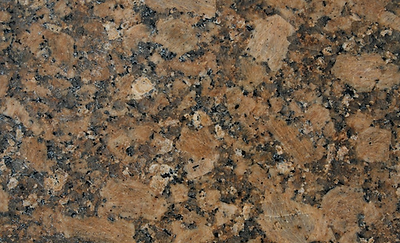
Right: the coarse grain of granite up close.
At a distance a granite wall in Yosemite (El, Capitan). Its tough and hardly weathers and is a favorite big wall challenge for elite climbers.


Above: On our Dark Star Crystal Mines claim vein dykes have intruded up through the metamorphic rock to then cool and produce some amazing silicate minerals.
Right: The process of plate techtonics where rock is born in in a mid oceanic rift and then pulled back down to melt and re-circulate at a subduction zone.

Left: Quartz with tiny spheres of magnetite.found on the Dark Star Crystal Mines Claim.
Above: Amphibole that is so common in the Bancroft area vein dykes.
Right: Liz finds a pyroxene cluster on the Dark star Claim


Left: Large grain of pegmatite consisting of feldspar and quartz from somewhere north of Huntsville, Ontario
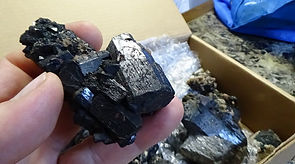
Above: Impressive pyroxenite cluster from the Titanite Hole on the Dark Star Crystal Mines claim near Bancroft, Ontario.

Left: Chart indicates the relationship between the type of igneous rock and its grain size and silica composition.
Above: Quartz coated with hematite from a skarn on the claim of Dark star Crystal mines near Bancroft, Ontario
Right: Here you can see the basalt as it formed in dykes beneath the ocean floor and contributed to ridge push. Up top is the rock that escaped out into the ocean and cooled quickly, and below is the material that cooled more slowly.
Below Right: Gabbro, a coarse grained basalt that cooled more slowly than the material that was ejected out in a mid oceanic rift.

Right: a nephylene syenite as it appears on Cancrinite Hill. Amongst the syenite there are plenty of sodalite veins.
Left: sodalite and magnetite on the Property of the Princess sodalite Mine just east of Bancroft. Ontario.