


Rockhounding in Bancroft
Rockhounding in Bancroft, Ontario can leave you broken and despondent, or if you collect rocks and minerals the right way you will exceed your most ambitious expectations. Follow our guidance for rockhounding and you are bound to meet your expectations. we'll tell you about lost mines, fabulous mineral occurrences and old mine dumps seeping gold for the panning. Bancroft crystal mining is a growing interest and by reading and focusing on what you learn you should be ahead of the crowd.


Rockhounding in Bancroft, Ontario: Expert Advice for Finding Crystals the Smart Way
Rockhounding in Bancroft, Ontario is one of the most rewarding mineral collecting experiences in Canada. Known for its rich geology, abandoned mines, crystal-bearing pegmatites, and famous minerals like apatite, titanite, fluorite, sodalite, and zircon, the Bancroft area attracts collectors from around the world. Whether you're a beginner searching for your first crystal or an experienced rockhound seeking high-grade specimens, success here depends on geological knowledge, field skills, and realistic expectations.
At Dark Star Crystal Mines, we specialize in ethical crystal mining and guided rockhounding experiences in Bancroft. Our approach combines science-based collecting techniques with respect for the land, helping visitors find real Ontario crystals while learning how to “read the rock” instead of just searching it.
Table of Contents
-
What Should You Expect When Rockhounding in Bancroft?
-
Rockhound Skill Levels: From Beginner to Expert
-
Where Should Beginners Collect in the Bancroft Area?
-
Best Rockhounding Sites for Beginners in Bancroft, Ontario
-
How to Read the Rock: Finding Crystals the Smart Way
-
Why is Geological Knowledge so important in the Bancroft Area?
-
What practical skills matter most in the field?
-
Why Bancroft Is One of Ontario’s Best Rockhounding Regions?
-
How should you prepare for a rockhounding trip in Bancroft?
-
Safety Tips for Rockhounding in Bancroft
-
What Equipment Do You Need for Rockhounding in Bancroft?
-
Is Rockhounding Legal in Bancroft, Ontario?
-
Why does local knowledge of Bancroft rockhounding sites Matter?
-
Frequently Asked Questions About Rockhounding in Bancroft
-
Conclusion: Mastery Comes From Thinking, Not Just Digging
What Should You Expect When Rockhounding in Bancroft?
Your expectations must match your effort, experience, and understanding of geology. If you meet your expectations we can agree that you've spent your day well. Some might consider starting with Bancroft area road cuts.
If your experience has been limited to crystal shops or rock farms, it’s important to reset expectations away from finding world class crystals. You only have luck to rely upon and nature's treasures are few and far between. World-class crystals rarely sit on the surface waiting to be picked up by a deserving rockhound. Rockhounding in Bancroft rewards patience, effort, and the ability to interpret the land, both geologically and geographically. Ambling around in others tailings will get you OK stuff, crystals that the real diggers have discarded.
Everyone operates at a different level, depending upon your raw ability and ambition. A rock farm might be all you want, so scale your expectations down accordingly. Likewise you might be up a level from beginner and find happiness at one of the sites run by the township - Titanite Hill or the Schickler Property. The point is, no matter where you are on the hierarchy of rockhound skill levels, if you are happy that’s all that counts. Amateur rockhounding in Bancroft is a hobby and satisfaction and contentment are the aim.
Satisfaction comes of being honest about where you are in your rockhound journey. Knowledge without application rarely leads beyond mediocrity. A creative, observant mind paired with basic geological understanding will consistently outperform someone who memorizes textbooks but can’t “read the rock.” You need to be able to understand concepts, not regurgitate information. The more time you spend in the field, the easier it becomes to apply geological concepts. We spend most of the summer on our claims so seeing the rock becomes easier and easier.
Many a learned mind has scoured the Bancroft area and you’d think that everything should have been found. It’s not the case. We are living proof of that at Dark Star. Some recognized the potential of our area, few understood its reality, if they had they would have acted as we had.
Amateurs who "think outside the box" are still unearthing incredible stuff and its not likely to stop any time soon. Every weekend amateurs on the Dark Star Claim prove that theory and find exciting and museum quality pieces.
Rockhound Skill Levels: From Beginner to Expert
Rockhounds progress through overlapping stages, not rigid categories. Rockhounding in Bancroft requires that you match your skills to your ambition; don't set out to spend your day in a vein dyke if you aren't prepared to use a shovel.
Beginner Rockhound
A beginner is still learning basic geology and mineral identification. Most attractive or shiny rocks are exciting, and familiar environments like rock farms or crystal shops feel most comfortable. This is a necessary and valuable step, it sorts "the wheat from the chaff", those who dabble on the surface and those who are willing to give it their all, but you gotta start somewhere.
Intermediate Rockhound
An intermediate rockhound has begun venturing into the field regularly, often with a club or mentor. You can identify common minerals such as mica, apatite, amphibole, or feldspar, but geological processes are still unclear. Well-known sites like Titanite Hill in the Bancroft area, or the Schickler Fluorite Occurrence are familiar territory, and most mediocre crystals still feel like good finds when you are at this level.
Experienced Rockhound
At this stage, geological theory starts to click. You understand how and why crystals form, where within a site they are most likely to occur, and you begin visiting lesser-known locations. Your standards rise—specimens must have quality, form, or rarity to earn a place in your collection.
Proficient Rockhound
Others now look to you for advice. You distinguish pegmatites from vein dykes and skarns, study geological maps, and reference historical surveys by well known Ontario geologists such as Satterly or Hewitt. Your preparation for a trip is deliberate, and you prefer sites that are obscure, overlooked, or rarely visited.
Expert Rockhound
An expert is widely recognized within the regional mineral community. Your knowledge borders on professional, often supported by formal education or prospecting credentials. You are able to identify unfamiliar minerals, discover new collecting locations, assist in educating others, and you may hold active mineral claims with economic potential.
Note: These are not fixed categories. Rockhounds exist across boundaries, shaped by age, fitness, time, and personal interest. Some clubs that I have spoken at are almost exclusively 60+ Enjoying a rock farm does not make you a beginner—it probably reflects where you are on your journey, not a linear journey, but punctuated by curves in either direction.
Where Should Beginners Collect in the Bancroft Area?
Beginners should try and focus their initial searches where thy can encounter other Ontario rockhounds and learn from them. Sites should be relatively easy to access and pay to dig sites are usually a known commodity.
Again it is important to know where you fit in the rockhounding experience. It's no use going to a rock farm if what you are looking for is adventure and treasure - pick a place where with knowledge and hard work you can achieve satisfaction.
What follows are some of the best places for beginners to go rockhounding in the Bancroft area, from beginner-friendly spots to classic Ontario mineral collecting locales. Many of these are well-known within the regional rockhound community and can provide excellent opportunities to find interesting minerals and crystals without straying too far out of the average person's comfort zone. (always check land access rules before collecting).
Best Rockhounding Sites for Beginners in Bancroft, Ontario
-
CN Rock Pile – Ideal for All Skill Levels
The CN Rock Pile is one of the most accessible and popular rockhounding sites in Bancroft. Originally it consisted of material brought in during railway construction from the Golden-Keene Quarry, you can sift through a variety of minerals right off the Hastings Heritage Trail.
-
Princess Sodalite Mine – Classic Bancroft Rockhounding
The Princess Sodalite Mine offers a rock farm experience where collectors of all ages can hunt for sodalite, calcite, and other minerals. The shop itself has a large selection of local and international specimens, and the rock farm is constantly seeded with new material for digging. A small fee applies for collecting here.
-
Titanite Hill / Tory Hill – Local Favorite for Apatite
Near the village of Tory Hill, Titanite Hill is a classic Bancroft area collecting site known for abundant apatite and other pegmatitic minerals. Many rockhounds return here year after year for its variety and the chance to find deeper-lying crystals. You have the option here of scouring tailings, or finding your own fissure and casting your luck with your sweat and shovel.
-
Dark Star Crystal Mines - Finest Bancroft Vein Dyke Mineralogy (South Claim)
Rockhounding in Bancroft is at its finest here. All rockhound guests get an introductory lecture on how to find crystals in virgin vein dykes. Those who are prepared to dig unearth some amazing crystals - amphibole, apatite, titanite, feldspar and pyroxene. Dark star has several other claims, featured from time to time for it's regular customers. Both beginner rockhounds and expert rockhounds can find amazing crystals here.
-
Schickler Fluorite Occurrence – Fluorite and More
The Schickler Fluorite Occurrence offers a chance to find cranberry colored fluorite embedded in green apatite. Collectors often search weathered calcite veins and soil to uncover pieces, and it’s well-regarded for its colorful material.
How to Read the Rock: Finding Crystals the Smart Way
Successful rockhounding in Bancroft depends on thinking in three dimensions.
At a road cut, many rockhounds stop at the exposed face and conclude, “It’s just quartz and feldspar—another pegmatite.” But pegmatites have dimensions, orientations, and hollow cores. That crystal pocket might be 100 yards back into the forest - virtually untouched by those who don't understand the local rock's geology.
Crystals rarely occur in isolation. There is rhyme and reason to their placement. If you find sodalite at the Princess Sodalite Mine, the nepheline syenite doesn’t stop there—it can often be traced kilometers beyond the visible workings. I found some incredible royal-blue veins of sodalite atop Cancrinite Hill. It was just a hunch that led me there.
Most missed finds come down to one-dimensional thinking - it's usually how we think in our every day lives (unless you are an inventor).
Why Is Geological Knowledge So Important in the Bancroft Area
Understanding metamorphism and mineral associations multiplies your success.
Book knowledge provides a foundation, especially when combined with field observation. Knowing the difference between contact metamorphism and regional metamorphism helps you predict mineral assemblages:
-
Weak metamorphism: tremolite, spessartine garnet
-
Stronger metamorphism: almandine garnet, forsterite
Recognizing a skarn allows you to follow its “onion shell” zoning outward—sometimes leading to unexpected and valuable minerals, including gold.
What Practical Skills Matter Most for Crystal Hunting?
There is no substitute for hands-on mineral identification.
Being able to:
-
Scratch-test and recognize calcite from feldspar
-
Distinguish apatite from diopside by crystal form
-
Recognize mica schist versus sheet mica
-
Tell gabbro from diabase
-
Clearly recognize crystals that occur in metamorphic environments and those that grew in an igneous crucible.
This basic knowledge is critical when rockhounding in Bancroft. Transitional zones are common here, and missing subtle features—like furrows from a buried vein dyke—can mean walking past significant mineralization, failing to set down and dig where your probability of finding treasure is greatest.
Why Is Bancroft One of Ontario’s Best Rockhounding Regions?
Bancroft’s diversity and history make it uniquely productive.
Deposits are often small but incredibly complex. The region is riddled with abandoned mines, quarries, and historical workings. Extensive blasting—often in search of uranium—has exposed mineralized rock that was never fully assessed. Without the initial exploratory and prospecting work on our quartz claim its probable that we'd never have recognized its value. Fortunately, somebody had too much dynamite and they cut loose on a cap lying over a yielding skarn. Now we find amethyst, smoky quartz and clear quartz.
Old geological documents are invaluable, especially since many past surveys were mono-focused and they overlooked secondary mineralization. Read between the lines and maybe you'll find something others have missed. It's like a treasure hunt.
How Should You Prepare for a Rockhounding Trip in Bancroft?
Preparation should scale with experience and environmental risk.
Venturing deep into the woods without GPS, maps, or compass skills is risky. Old logging roads frequently lead to forgotten mines, and tailings that had spilled from old carts 100 years back usually mark the correct path to the now forgotten workings. Sharp, angular debris on tracks is a strong indicator of past extraction—rounded cobbles are not.
Always know your physical limits. Rockhounding with a partner is safer and more productive. An injury in remote terrain can quickly become serious, a partner is back-up if there's trouble.
Safety tips for Rockhounding in Bancroft?
The terrain is rugged, remote, and unforgiving.
Expect:
-
Scree slopes and rolling boulders
-
Collapsed structures and hidden shafts
-
Fallen trees and unstable ground
Wear boots with ankle support and steel shanks near old infrastructure. At the Harcourt Graphite Mine a 3 story mill lies collapsed in a heap of greying planks. I attempted to wade through the wreckage and got a rusty nail through my foot for my efforts.
Dress defensively during tick season, and carry bear spray in known bear corridors such as "the Bear Highway" near the Saranac Zircon Mine. Its a horror show of garbage strewn tunnels leading off from the access track into thick bush. Don't be there after sun down.
Always check weather conditions. Down-bursts, tornado damage, and forest fire risks are real and ongoing concerns in the region.
What Equipment do you need for Rockhounding in Bancroft?
Match your gear to your goal and the site you are visiting. Factor weather into the plan.
If your intention is to scout out a digging location for future work you will likely be covering a considerable distance on foot. Covering ground efficiently requires light equipment and sturdy footwear - ankle support is vital. Your choice of tools in Bancroft is important. Focused digging requires heavier tools. A shovel can come in many sizes and weights. Pick what is right for travel if that's what you are doing. Pick what's right for digging if that is your intention.
Pegmatites require a hammer and chisel. a long thin metal bar is appropriate for feeling under the soil for vein dykes. Never underestimate the value of a good stiff brush for cleaning off dirt. Not having a brush is why tailings piles are so yielding to people like me.
Always carry ample water—working a productive crystal fissure is far more physically demanding than most expect. Bugs and humidity go hand in hand. Though a bug jacket is apparently made of porous mesh it sure doesn't feel that way in a 6 foot deep trench. Soon you are desperate for a drink.
Is Rockhounding Legal in Bancroft, Ontario?
Know land status before collecting.
Rockhounding is permitted on Crown land but not on active mining claims or private property without permission. Provincial parks, such as Egan Chutes, are off-limits. Always research before you go.
Why Does Local Knowledge of Bancroft Rockhounding Sites Matter?
Each Bancroft site is unique and rockhounds are advised to follow certain procedures to be successful. A little bit of research quickly points you in the right direction.
-
At Dark Star Crystal Mines, we advise collectors to work high-temperature trenches for titanite, work low-temperature trenches for massive apatite.
-
At Titanite Hill, its fabled titanite crystals are often trapped in tree roots, so that's where rockhounds need to look.
-
At the Schickler Fluorite Occurrence, success comes from identifying weathered calcite veins and searching soil for floated specimens—especially deep pink or purple fluorite and apatite.
-
At the Saranac Zircon Mine small gray zircons are most easily found in the sand in front of the decaying sandstone sill. Don't waste your time digging in unyielding rock.
-
When rockhounding in Bancroft you are sometimes required to bring a sieve, other times a pick or shovel - do your research.
Different sites demand different strategies.
Frequently Asked Questions About Rockhounding in Bancroft, Ontario
Is Bancroft, Ontario good for beginner rockhounds?
Yes. Bancroft is one of the best places in Canada for beginner rockhounds. It offers accessible collecting sites, rock farms, and guided experiences that help new collectors safely find real Ontario crystals while learning basic mineral identification and field skills.
What minerals is Bancroft famous for?
Bancroft is famous for apatite, titanite (sphene), fluorite, sodalite, zircon, mica, feldspar, amphibole, pyroxene, and many skarn-related minerals. The area’s complex geology produces both common and rare mineral species.
Is rockhounding legal in Bancroft, Ontario?
Rockhounding is legal on Crown land in Ontario for recreational purposes, but not on active mining claims, private property without permission, or in provincial parks. Always check land status before collecting.
Can you collect crystals on Crown land in Ontario?
Yes, recreational collecting of small quantities of minerals for personal use is generally allowed on Crown land, provided the land is not under claim, lease, or protected status.
Do I need geological knowledge to succeed in Bancroft?
You can collect without it, but understanding Bancroft area geology greatly improves both the quality and consistency of your finds. Knowing how pegmatites, skarns, and vein dykes form helps you predict where crystals occur.
Is rockhounding in Bancroft safe?
It can be, if you prepare properly. Wear proper boots, carry navigation tools, watch weather conditions, avoid old mine structures, and never collect alone in remote areas.
What is the best time of year to go rockhounding in Bancroft?
Late spring through early fall is best. Snow-free ground, longer daylight hours, and safer access make May to October the ideal season for rockhounding in Bancroft, Ontario.
Do I need special equipment for rockhounding in Bancroft?
Basic gear includes a rock hammer, safety glasses, gloves, sturdy boots, water, and a backpack. For digging sites, a shovel, sieve, and pry bar may also be needed depending on the terrain.
Conclusion: Mastery Comes From Thinking, Not Just Digging
Rockhounding in Bancroft is not about luck — it’s about observation, preparation, and understanding geology in three dimensions. The collectors who consistently find quality crystals in Ontario are the ones who study mineral associations, read the land, and respect both the terrain and their own limits. If you keep returning to the same overworked sites, you’ll only find what everyone else finds - leftovers from bygone days of greater glory. Consider river deposited gravels in appropriate locations. A river having run over a pegmatite might have valuable gems within its gravel beds. Think of the illam in Sri Lanka and the gems that you find there (admittedly we have suffered the privations of glaciation , they did not.
Whether you’re uncovering your first apatite crystal or exploring forgotten Bancroft mineral deposits, this region offers a lifetime of discovery. Progress comes quickly to those who stay curious, physically prepared, and willing to think beyond the exposed rock face.
👉 Ready to experience real crystal collecting in Bancroft?
Join us at Dark Star Crystal Mines for guided rockhounding tours, ethical crystal mining, and hands-on geology education in Ontario’s most famous mineral region. There is no pre-sorted material on our site; you will be digging into virgin vein dykes. You could unearth almost anything.
Book your Bancroft rockhounding experience here →
Author Bio
Michael Gordon has been rockhounding and studying gems and crystals for over 30 years, he has a degree in geography and a Diploma in gemology and is author of the Rockhound Series which can be purchased on the Lulu website.
Work cited
Fouts, Chris (1998) Bancroft & District Mineral collecting Guide Book, Bancroft and District Chamber of Commerce, Bancroft, Ontario.
Last updated 2026

Right: Garnet found in a skarn
Below: Quartz with hematite inclusion (Dark star Crystal Mines quartz claim


Left: A feldspar fissure found while rockhounding in the Bancroft area.
Below: Tremolite found at the now off limits Grace Lake road cut.

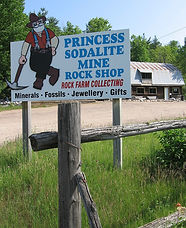

Left: Andy Christie of the Princess Sodalite Mine. It's been an iconic Bancroft location for beginner rockhounds for the last 50 years.
Below: Rough amphibole at Titanite Hill.


Right: Corundum from the Bancroft area with a core of blue so it's sapphire, but in need of some destructive cabbing if you want to expose the center in jewellery.
Left: metamorphosed rock near Wilberforce, and in the potholes of these tunnels there were all kinds of loose and tumbled crystals.
Left: Mark, our Dark Star Crystal Mines Chief Extraction Officer is an expert at thinking outside the box. From a dusty fissure he opened a cavity that had severaL such pyroxene crystals and more that we are yet to extract.


Left: Deep purple amethyst from the Dark Star quartz claim.
Below: Quartz with hematite spheres from the Dark Star Crystal mines quartz claim.


Right: At the Bessemer Mine. It's old mining infrastructure, the shafts and buildings that seem to hide the greatest danger, but never underestimate the environment. Check out the foundations of the old hotel, its beside the track at the edge of Little Mullet Lake.


Left: An iconic Bancroft rockhounding location - the old Bear Lake Diggings
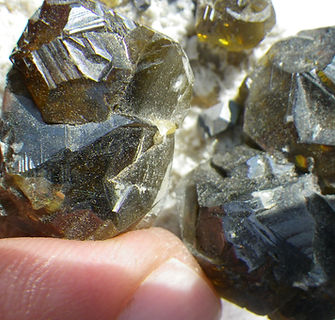
Right: Apatite crystal from titanite Hill
Far Right: Tremolite - it indicates a metamorphic environment.


Above and Right: a trip to the old Croft mine looking for garnets in the tailings reveals something of the terrain that you encounter while rockhounding in the Bancroft area.