Skarn Deposits of Monmouth Township, Ontario: Contact Metamorphism and Mineralization
Skarns in Monmouth Township, Ontario formed where igneous intrusions met carbonate-rich country rock, creating mineralized contact zones that host crystal-bearing assemblages valuable to prospectors, rockhounds, and mineral collectors.
Question: Are the fluorite mines in Madoc Skarn deposits?
No, skarn deposits are a different type of geological formation involving contact metamorphism and this is not the case in Madoc. While other mines in the broader region, such as the nearby Marmoraton Iron Mine, were skarn-type deposits, the specific fluorite mines in Madoc were vein-type deposits.
Left: Garnets from the Marmoraton Iron Mine - an enormous skarn that now exists as a water filled crater with endless heaps of tailings.


Skarn formation in Monmouth Township, Ontario
Skarns in Monmouth Township formed where intrusive igneous bodies interacted with carbonate-rich host rocks, creating contact metamorphic environments that concentrated economically and collector-grade mineral assemblages.
Today we’re diving into the fascinating world of skarns, with a general focus on those located in the Bancroft area of Ontario and a specific focus on Monmouth county. This region—rich in mineral history and geologic complexity—hosts some of the most intriguing skarn systems in the province, and possibly even the country. Monmouth Township is a place well known for pegmatites and skarns for which it has become the self dubbed mineral capital of Canada. Skarns in Ontario are known for hosting a variety of minerals, including industrial minerals like wollastonite and potentially valuable metals. The area west of Bancroft is particularly noted for its complex and intriguing skarn systems. This region is famous for a wide variety of minerals, with almost 90% of all mineral types found on Earth located in and around the community.
A skarn is a course grained metamorphic rock that has formed by the replacement of carbonate bearing rocks during regional or contact metamorphism or metasomatism. Skarns are rich in calc-silicate minerals that have formed when super-heated fluids interact with the country rock. Skarns are typically associated with granitic plutons in the vicinity of a fault that intrudes into limestone or dolostone – hence the exchange of super-heated fluids and the formation of the skarn within the intrusion or without.
A skarn forming within the intrusive body needs a permeable area within the intrusion and then there is circulation of super-heated fluids into the country rock and back into the intrusion where the calc-silicate minerals develop. This is called an endoskarn.
The York River Skarn as shown above is an exoskarn. Exoskarns form outside the intrusion. After high temperature crystals form inside the intrusion, the left over water leaves the fissure in a process called “boiling” and skarn materials form outside the intrusion , usually in limestone or dolostone. Exoskarns are the most common skarns in the Bancroft area, the York River skarn being the classic example. This skarn formed in dolomitic marble adjacent to an intrusion of nepheline syenite. By its signature minerals this is clearly a magnesium skarn, the magnesium content of the dolostone being what chemically defines it from standard limestone.
But in the Bancroft area, skarns are much more than textbook features, they’re historical mines and exploration targets waiting to be decoded by those who are interested in the minerals that they give rise to. What rockhound wouldn't want to tap into a skarn and haul out lovely skarn-based crystals, zircon, garnet, quartz and diopside.
Notable Skarn Occurrences in Monmouth Township, Ontario
There are several notable skarn deposits in the Bancroft area and as is seen by our success at Dark Star, many that are yet to be discovered. Those that jump to mind are ...
-
York River Skarn: A world-famous locality, find it along the east bank of the York River north of Highway 28. Famous for grossular garnet (hessonite), vesuvianite, diopside, wollastonite, and fluorescent zircon. You will note that all of these crystals entail some component of magnesium in their structure.
-
Dyno Mine: Another significant skarn location for mineral collecting. The site was mined 1958 – 1960 to a depth of 525 meters.
-
Bessemer Mine: Historically mined for iron, this site also exhibits classic skarn features and darkened garnet clusters in with calcite on the otherwise hard grey country rock.
-
Rankin mine: close to the Bessemer mine and yielding disseminated magnetite in a 1900 foot long ore body.
-
Saranac Skarn: This is just south of the 118 on the track leading to the well known zircon showing. It is known for its graphite.
-
Silver Crater Mine: A notable site for diverse mineral finds.
Each of these represents a unique variant of the skarn-forming process, but all share a few important traits.
Defining Geological Features of Monmouth Township Skarns
Monmouth Township skarns share common traits such as calc-silicate mineral assemblages, sharp lithological contacts, and structural controls that reflect intense contact metamorphism and fluid-driven mineralization.
Now to be a little more specific to the Dark star claims, Monmouth’s skarns are mostly calcic skarns, meaning they’re rich in calcium-bearing minerals. These formed when granitic and syenitic intrusions forced their way into surrounding limestone and marble, releasing super-heated fluids. The resulting chemical exchange transformed the original rocks, generating mineral-rich skarn zones.
Importantly, these skarns have historically been mined for a variety of resources, including:
-
Fluorite
-
Apatite
-
Rare Earth Elements (REEs) (Silver crater mine)
Metals in particular are concentrated in skarns, because by their very nature, skarns are an ideal natural mechanism for the concentration of ores. The super heated liquids that develop from the boiling off of the intrusive magma are rich in metals and the faults within which these fluids flow act as depositional highways.
Metals deposit in varying proximity to the fault highway, typically iron and tungsten right beside the fault and Uranium and REEs out in the retrograde zones. A skarn develops in proximity to carbonate rocks (limestone and dolostone) because those rocks are highly reactive to the super-heated fluids unlike silicate rocks which are relatively inert.
When acidic metal bearing fluids meet carbonates along the fault that allows fluid transfer, calcium is released and saturated fluids become super-saturated thus raising the PH which now super-saturates the fluid and metals precipitate as oxides, sulfides and silicates. It is for this reason that carbonates in tandem with the initial metal bearing fluid and the fault highway are amongst the most efficient ore traps in nature.
The mineralogical diversity of the skarn process is a defining feature, and in Monmouth, the zoning of its skarn bodies offers a clear record of the thermal and chemical gradients that shaped them.
Skarn Zoning and Mineral Layering in Monmouth Township
Distinct mineral zoning within Monmouth skarns records changing temperature and fluid chemistry away from intrusive contacts, allowing geologists and prospectors to interpret skarn evolution and target mineral-rich horizons.
One of the most fascinating aspects of skarns is their concentric zoning. Imagine an onion-like structure forming around the intrusive body. Each “shell” reflects different physical and chemical conditions during formation.
Proximal Skarn Zone Near Igneous Intrusions
The proximal skarn zone forms immediately adjacent to the intrusive body and is characterized by high-temperature calc-silicate minerals that reflect intense contact metamorphism and early-stage metasomatic mineralization. This is the highest-temperature, lowest water-activity zone. It features coarse-grained textures and is dominated by pyroxenes such as hedenbergite and diopside, alongside grossular and andradite garnets. These minerals form where metasomatism was most intense.
Retrograde Alteration Zone in Skarn Systems
Retrograde skarn zones develop as cooling fluids overprint earlier high-temperature minerals, producing hydrous mineral assemblages that can re-mobilize metals and enhance crystal development in Ontario skarn deposits. As the system cools and fluid chemistry evolves, retrograde minerals take over. This zone hosts amphiboles like actinolite and tremolite, along with quartz, magnetite, and sulfides like pyrite. Interestingly, this is also where ore minerals—such as gold, copper, and tungsten—tend to accumulate, often in association with magnetite or sulfide veins.
Skarn Front and Distal Contact Zone
The skarn front marks the outermost extent of metasomatic alteration, where skarn minerals grade into unaltered country rock and provide important clues for tracing mineralized contact zones in the field. The original marble or limestone is only partially altered in the skarn front.
The formation of these zones is largely controlled by fractures, which act as highways for fluid flow. These fractures determine not only the extent of metasomatism, but also the symmetry and directionality of the skarn body. You’ll often find that the geometry of the skarn mirrors the structural fabric of the host rocks and as we speculate by the crystals that we are finding on our quartz claim, we appear to have cut into a skarn as our trench pierces a Cliff side and runs directly into the retrograde zone. For us there are the quartz and base metal markers that confirm this.
The Monmouth Skarn Project: Geological Mapping and Exploration
The Monmouth Skarn Project documents skarn development, host rock relationships, and mineralization patterns to better understand contact metamorphic systems and guide responsible mineral exploration in eastern Ontario.
Among the most promising modern developments is the Monmouth Project, located just south of Highway 503. Here, exploration has revealed a sizable skarn system that dips steeply and extends beyond 750 feet in depth, stretching over 1,200 feet in length. This is no minor occurrence—it represents one of the more substantial uranium-bearing skarns in southern Ontario.
Drilling data has shown significant uranium concentrations in skarns, especially within the retrograde zone, consistent with what we see in other uranium-rich skarns. The depth and extent of the Monmouth skarn make it a prime candidate for continued exploration, particularly given rising global interest in nuclear energy and the demand for stable uranium supplies.
The Skarn Beneath the Hump - A Case Study (it gets technical)
One fortuitous afternoon Mark and I went for a drive in the area in which our south claim is located – Monmouth County. There was something about the mineralogy that made us stake a 200 acre area some few kilometers from our usual rockhounding area. The land was dominated by a hump of rock that seemed to be yielding interesting crystals. To answer your question right now, this location is not currently open to public collecting.
This newly staked area was within the Grenville Province, specifically the structurally complex Bancroft region, where pressures from the Grenville Orogeny created an intensely deformed crustal domain. It is a region that is characterized by a dense network of shear zones, faults, and fractures, which occur not as single continuous breaks but as broad, anastomosing zones of deformation. Our use of LIDAR – seeing beneath the soil, revealed a likely fault in the vicinity of our south claim and another in this new area that we’d decided to call the “quartz claim”. Of topographical note is that the fissures that are exposed in the south claim are largely missing a cap rock and are profuse and wide while at the quartz claim, a caprock seems to cover the rock hump that we first observed and the fissures within it are narrow and less eroded; I’d chalk that up to the fact that they are protected by a caprock.
The most significant regional influence on the quartz claim is the Bancroft shear zone system, a Proterozoic high-strain belt made up of narrow mylonitic zones, ductile shear fabrics, and locally recrystallized marble units. These structures extend over kilometers in discontinuous splays and high-strain corridors, controlling the overall architecture of marble, silicate rocks, and mineralized zones. It seems that the most exciting mineral concentrations are all concentrated within or in close proximity to this Bancroft shear zone. We are at this time exploring another spot just east of Bancroft that is also within this Bancroft shear zone, but less riven by fissures and the influence of calcite.
At a more local scale within Monmouth County, the local bedrock is overprinted by abundant fracture networks and brittle faulting systems associated with later tectonic reactivation of the Grenville Orogeny. Brittle faulting occurs in the upper crust where rocks are cool and rigid, causing them to fracture rather than flow. Stress had built until the rock broke, forming faults, joints, and fractures that may show movement features such as slickensides. These fractures create critical permeability pathways, allowing fluids to circulate and concentrate mineral deposition. In contrast to deeper ductile shear zones, these brittle structures form open spaces and interconnected fracture swarms such as in the south claim, that are especially important in controlling hydrothermal mineralization.
Together, the regional shear zones and local fracture systems form a connected structural network that governs fluid movement through the rock. In shear zones, rocks are mechanically weakened, recrystallized, and repeatedly reactivated, producing long-lived conduits that allow multiple pulses of fluid flow. This repeated deformation is essential in skarn formation, where mineral systems become zoned and chemically complex through successive overprinting events. These structures are responsible for directing fluids along marble–silicate contacts, where reactive rocks and circulating fluids interact to form skarn assemblages.
Initially we had been badly confused by the complexity of the geological environment, and in truth we are still developing our “unifying theory”. There is much in the way of metallic inclusion that suggests that it was not a singular event that made our complex geology.
Skarns develop where three conditions overlap: a heat source (typically an intrusion that we are yet to locate, but we have seen graphic granite scattered across the top of the rock hump on the quartz claim.), reactive carbonate rock such as marble, and structural pathways provided by faults, fractures, and shear zones. Clearly superheated fluids had once flowed beneath this hump of rock, you can see both the corrosion and deposition.
When a magma body intrudes into carbonate rock, it releases high-temperature hydrothermal fluids that are rich in dissolved metals such as iron, copper, zinc, tungsten, or molybdenum. These fluids move outward into surrounding rock, but when they hit carbonate material (like the caprock on top of the hump), a strong chemical reaction occurs: the fluids are no longer stable in that environment, so they dump their dissolved metals and replace the original rock minerals with new ones. This process is called metasomatism (chemical replacement by fluids), and it is the core mechanism of skarn formation.
On our quartz claim, marble acts as the reactive host, while silica- and metal-bearing fluids migrate through the structural network. Quartz and hematite intermingle indicating multiple pulses of metal rich fluid.
A carbonate host rock is especially important to the concentration of metals because it is chemically reactive—it readily breaks down and neutralizes acidic, metal-bearing fluids. It is a reaction that causes rapid precipitation of minerals like garnet, pyroxene, and a variety of metal-bearing sulfides such as chalcopyrite, galena, or sphalerite. In other words, the limestone/marble doesn’t just host the system—it actively forces metals out of solution by changing the circulating fluid’s chemistry.
On our quartz claim these fluids deposited quartz while simultaneously dissolving and reprecipitating carbonate material such as calcite, forming veins and crystal-lined cavities. In one area of the big hump we tunneled in about 6 feet and found 6 inch calcite crystals literally side by side with vugs of smoky quartz that were covered in a hematite skin. Near major fluid conduits, replacement textures dominate, while farther from the core pathways, vugs and open pockets allow free crystal growth, producing well-formed quartz and calcite crystals.
Without rhyme or reason it would appear that in the vicinity of vugs the rock decomposes into a brittle sponge-like material, this occurs when hot hydrothermal fluids from the intrusion move into a carbonate rock like limestone or marble. Instead of simply filling cracks or cavities with calcite, as in the south claim, these fluids react directly with the host rock. The original minerals (mainly calcite or dolomite) are progressively dissolved, while new silicate and ore minerals precipitate in the same space; its called metasomatic replacement—a chemical process where one mineral assemblage is replaced by another without the rock fully melting. I’m reminded of the corrosion that I’ve see in the walls of certain cave tunnels in the area. In skarns, replacement textures are important because they show that the system was chemically reactive and fluid-dominated, not just a simple vein-filling process. Instead of minerals growing into open space, the rock itself is being consumed and rebuilt molecule by molecule. This is why skarns can preserve the shape of the original limestone while being completely transformed into a dense, metal-bearing silicate rock.
Over time, crystals grow under fluctuating chemical conditions. It ranges from clear quartz to amethyst and smoky varieties, often accompanied by calcite linings and nearby feldspar, which suggests a contribution from deeper silicate or possibly granitic/pegmatitic sources. The coexistence of amethyst and smoky quartz reflects changing oxidation states and radiation conditions during growth: amethyst forms with trace iron in oxidized conditions exposed to natural radiation, while smoky quartz develops when radiation interacts with aluminum impurities in the crystal lattice. This indicates a dynamic system influenced by evolving fluid chemistry and external geological energy sources.
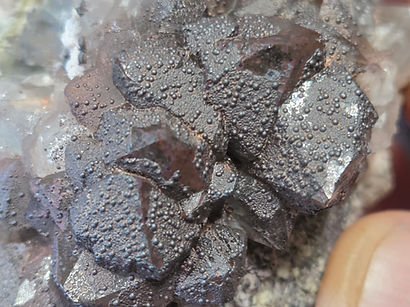
Possibly the most common quartz assemblage is composed of half inch crystal points that include spheres of black hematite and are often covered with those same spheres and a skin of red hematite. It would suggest that in some cases the spheres had formed before the quartz did (protogenic) and in other cases the metallic filigree formed after the crystals formed. Then there is the star attraction, that which we have faceters calling to request samples and some less principled rockhounds scheming to make covert trips to harvest their own specimens. The slower amongst them discussing their plans on a public forum. Puffy orange billows of goethite or hematite are seen like clouds in some of the amethyst crystals. It looks like the “Fire and Ice” amethyst from Thunder Bay.
The mineral inclusions within the quartz of our Monmouth County claim record multiple stages of fluid evolution. The metallic coatings on quartz, along with orange and black inclusions, represent late-stage hydrothermal and oxidation processes. Iron-rich fluids precipitated coatings of iron oxides such as hematite or goethite under increasingly oxidizing conditions. The puffy orange inclusions likely represent iron oxide or hydroxide phases, sometimes replacing earlier sulfides, while spherical black metallic inclusions may represent minerals such as pyrite or magnetite, formed in fluid and later altered.
A key feature of these hematite inclusions is their spherical shape, particularly hematite occurring as rounded bodies within the quartz. These included spheres typically form when iron is transported in hydrothermal fluids as colloidal particles or droplet-like phases rather than as fully crystallized solids. Surface tension naturally shapes these into spheres, and when quartz grows around them, it preserves their form. It is also possible that these spheres may have originated as sulfide droplets such as pyrite that were later oxidized into hematite, preserving their original geometry. Once enclosed in quartz, they are physically confined and cannot grow into crystal faces, so they remain spherical, recording their origin as fluid or gel-like precursors rather than free-growing crystals.
When hematite forms as spheres inside quartz, one of the key ideas geologists consider is supersaturation of the hydrothermal fluid—meaning the fluid contained more dissolved iron (or iron-bearing species) than it could normally keep stable under equilibrium conditions.
In a hydrothermal system, iron is transported in solution as complexes (often chloride, hydroxide, or sulfide-bearing forms depending on chemistry). When conditions change suddenly, such as a drop in temperature, a shift in pH, oxidation state, or pressure, the fluid can cross a threshold where it becomes supersaturated with respect to iron oxides like hematite. At that point, iron can no longer remain dissolved and must precipitate rapidly.
When precipitation happens under high supersaturation, crystals don’t have time to grow in an orderly, faceted way. Instead of forming well-defined crystal faces, the mineral nucleates extremely quickly in many tiny sites at once. This leads to non-crystalline or poorly crystalline aggregates, which naturally minimize surface energy by forming rounded or spherical shapes. In fluids, surface tension and rapid growth conditions favor the development of droplets or globules rather than euhedral crystals.
This is why spheres often form: the hematite is essentially “freezing out” of solution so fast that it behaves more like a colloidal or gel-like precipitate than a slowly growing crystal. The system is so iron-rich and unstable that nucleation overwhelms crystal growth, producing many tiny particles that cluster into rounded masses. If these form inside growing quartz, they get trapped immediately and preserved as inclusions.
Supersaturation also explains why these spheres can appear alongside multiple iron textures in the same system—coatings, stains, and discrete inclusions. It indicates a highly dynamic hydrothermal environment, where fluid pulses rapidly change chemistry (especially oxidation and temperature), repeatedly pushing the system in and out of equilibrium.
In short, spherical hematite inclusions are a signature of a system that was chemically overloaded with iron and undergoing rapid change, forcing iron to precipitate so quickly that it formed rounded, droplet-like masses rather than crystalline shapes.
The geology beneath Monmouth County’s quartz claim represents a single, interconnected hydrothermal system controlled by the structural framework of the Grenville Province and the broader influence of the Bancroft shear zone network, where shear zones, fractures, and brittle faults repeatedly focused fluid flow through marble and silicate rocks. This “rock hump” acts as a structural and chemical focal point where hot, metal-bearing fluids circulated, reacted, and evolved over time, producing a multi-stage skarn system rather than a single mineralizing event.
Quartz, calcite, feldspar, and iron-rich phases record alternating pulses of silica-rich and carbonate-reactive fluids, likely linked to deeper intrusive activity and repeated structural reactivation, while the progression from replacement textures to open vugs and crystal-lined cavities reflects shifting fluid pathways during cooling and deformation.
The mineral inclusions within quartz preserve a detailed record of these changing conditions, with spherical hematite, orange iron-rich aggregates, and spherical black metallic inclusions indicating episodes of supersaturated hydrothermal fluids that precipitated iron and sulfides rapidly under fluctuating temperature, oxidation, and pressure conditions. These features capture the transition from fluid to solid through colloidal or droplet-like iron phases and later oxidation products, all preserved within growing quartz, ultimately showing that the skarn is a long-lived, structurally controlled hydrothermal system where deformation created pathways, chemistry drove replacement, and repeated fluid pulses built the complex mineral assemblage observed today.


Amongst the Bancroft crystal collecting sites this one stands out above the others as a skarn for the quality and diversity of its mineral specimens. Here Mick's father (James) examines the location.
-
Geography: Situated on the east bank of the York River in Dungannon Township, approximately 400 meters north of Highway 28.
-
Status: Most of the locality now falls within the boundaries of Egan Chutes Provincial Park. As of 2025, mineral collecting is strictly forbidden within the park.
-
2. Geological Context
-
Rock Type: It is a tactite (a type of skarn), which is a multimineralic carbonate rock formed through contact metamorphism and metasomatism.
-
Formation: It occurs where igneous intrusions (specifically nepheline syenites and granitic rocks) met and altered the surrounding country rocks, such as dolomitic marble.
-
Appearance: The skarn rock itself is typically white and green, composed of roughly 50–60% wollastonite and diopside.
-

Right: an example of a copper skarn in Iran. You can see that as proximity to the intrusion decreases, so too does the heat. The path of fluid travel is marked by the fissure and so you can see the extent of the skarn increases where the path of fluid travel is greater. Copper leaves the intrusion and deposits in the skarn zone, in part because of the higher ph an marble (the country rock).


Above: An old train once served the spur line to Bessemer - sparks burned a bridge along the line and led to some delays. The sulphur content of the mine's ore eventually closed it.
Right: Enormous tailings piles around the Bessemer open pit in which I have found epidote and garnets.
Far right: A relic from the Dynomine.


Left: Grossular garnets and diopside from the york river skarn
Right: hematite coated quartz from the Dark Star Quartz claim.


Above Left: Chalcopyrite, (Cu,Fe)S2, a common economic ore that is found in skarns.
Above right: lab grown bismuthinite Bi2S3, a great indicator mineral for gold and often found in its natural form (non-descript silver metal) in skarns. The Childs Mine is well known for this metal in a skarn.
Identifying Skarn Deposits Within Their Geological Setting
Recognizing skarn in its geological setting requires understanding host rock composition, intrusive contacts, structural controls, and surface expressions that guide prospectors toward mineralized skarn environments in Ontario.
1) look for marble and the accompanying minerals of green epidote, pyroxene, dark red to brown garnets.
2) Look for a bleached layer of rock that possibly extends well past the skarn mineralization. fractures and bedding planes could well extend the bleach-halo well past what you might expect.
3) Look for fluid escape structures, namely faults, chimneys and pipes, structures that would have relieved the pressures of a cooling intrusion and along which super-heated waters would have flown.
4) The presence of economic minerals, especially those that have formed with sulphides e.g. chalcopyrite CuFeS2, molybdenite MoS2 , bismuthinite B2S3, galena PbS
Above: Grossular and andradite garnets are common in skarns. Garnets in skarns often exhibit oscillatory zoning, where the composition changes rhythmically between andradite-rich and grossular-rich layers, reflecting fluctuating physical and chemical conditions (such as oxygen fugacity, pH, and fluid composition) during their formation by hydrothermal fluids. This makes garnet a valuable indicator mineral for geologists exploring for specific metal deposits


Bessemer Mine drops down in a huge hole to a depth of 236 feet. Today that hole is full of water. They were mining magnetite from one of the Bancroft area's largest skarns. Miners report the terror of hungry wolves howling incessantly around the camp during the winter. Nobody could come or go except by train and nobody ventured too far into the woods. At its greatest depth the mine then bent like a "J" and continued under nearby Little Mullet Lake, it closed after one of the all to common accidents when a young miner fell from the ore skip and died.