

Rockhounding for Zircon Crystals in Bancroft, Ontario Pegmatites
Introduction to Rockhounding Zircon Crystals in Bancroft, Ontario
Discover expert tips and essential techniques for rockhounding zircon crystals in Bancroft, Ontario, one of Canada’s top destinations for mineral enthusiasts.
The Saranac Zircon Mine remains one of my most memorable rockhounding experiences in Monmouth Township. Its smack in the middle of an area rich in pegmatites and very suitable for zircon rockhounding. There are rare earth ores and radioactive mineral deposits all in close proximity along the 503.
The approach to the Saranac Mine was through the bear-ravaged Monmouth Township Dump—a chaotic mix of torn blue garbage bags and scattered debris. Walking along what could only be described as a “bear’s highway,” we navigated claw-marked paths beside walls of dense bush, punctuated by dark tunnels clearly used by local wildlife. For Ontario rockhounding enthusiasts in search of rare minerals, the journey alone highlights the adventurous spirit of mineral collecting in this region.
History of the Saranac Zircon Mine and Uranium Exploration in Bancroft
Explore the rich history of the Saranac Zircon Mine in Bancroft, Ontario, and learn about its past uranium exploration and significance in the region’s mineral discoveries.
The zircon occurrence at Saranac was originally exposed by the Saranac Uranium Mines between 1954 and 1956, when a main trench approximately 150 feet long was excavated along with three additional northerly trenches. Today, this site is characterized by a gravel-bottomed gully surrounded by heavy bush and large boulders, dug into a classic Ontario collecting locality. This whole claim that was staked by the Saranac mines is a veritable treasure chest of rare minerals and mineral specimens that are difficult to find elsewhere.
Though the crystals are generally quite small at the Saranac Zircon Mine, it is central to Zircon rockhounding in Bancroft. If you are an Ontario rockhound this is an Ontario rockhounding environment to which you must pay attention. Within the main cut, the zircon-bearing horizon consists of a four-foot-thick layer of thorite–zircon–leucogranite. The sill is visible for roughly 100 feet along the excavation wall, offering an excellent window into the local pegmatite geology of the Bancroft area.
How to Explore Zircon-Bearing Pegmatites at the Saranac Mine in Bancroft
Discover how to explore zircon-bearing pegmatites at the Saranac Mine in Bancroft, and uncover the region’s unique crystal formations and mineral treasures.
The Saranac mine's crystals occur in a narrow valley overhung by thick vegetation. I squeezed my way up to the digging face beneath an overhanging ledge, where sand cascaded down like a dusty waterfall. The thrill of hands-on rockhounding quickly replaced any discomfort as I tunneled into the granitic pegmatite. Every swing of my wooden-handled mason’s hammer into the soft, decaying rock sounded like breaking brittle teeth—crump, crump, crump—while tree roots brushed my neck, creating the illusion of crawling spiders. This is the glamor of zircon rockhounding in Bancroft, Ontario; dust, sweat and the menace of rogue bears taking an interest in your activities. Here you must bring bear spray for your safety.
Minerals Found at the Saranac Zircon Showing in Bancroft, Ontario
Learn about the diverse minerals found at the Saranac Zircon Showing in Bancroft, Ontario, including zircon, feldspar, and other notable crystals prized by collectors.
The zircon crystals at the Saranac showing occur primarily in the lower portion of the exposed layer, which rests directly on a marble unit dipping at about 35 degrees. Drilling conducted at some time in the past has shown that the zircon-bearing layer pinches out at relatively shallow depth, making the exposed interval the main productive zone. Some suggest that rockhounds have picked the area clean, but I don't believe so. Rockhounding in Bancroft Ontario takes effort and digging. A zircon bearing seam seldom just stops producing when its outer layer has been scraped. There is lots more here.
Additional shallow trenches also occur just north and south of the main opening, representing further small exploration cuts from the original workings and as you head from the dump to the exposed trench there are certain spots along the crumbling wall to your left that act as a secondary showing for the zircons.
I must admit it was intimidating as I found myself digging next to bear claw marks in the soft material - yes a bear possibly as big as the one that we saw in the dump.
Zircons found in the exposed cut are typically dark brown to grey-brown, generally small, but in some cases reach sizes up to about three-quarters of an inch. They commonly exhibit the classic well-formed zircon crystal habit prized by collectors, although many are small and embedded in matrix. Associated with the zircon is earthy brown thorite, which can occur as doubly terminated pyramidal crystals up to half an inch across. Purple fluorite has also been found in the cuttings north of the main showing. This combination of zircon, thorite, marble, and leucogranite makes the Saranac site an excellent example of Ontario pegmatite mineralization.
Maggie and I had arrived on a grey, drizzly morning, eager to hunt for zircon. Asking at the Chamber of commerce we had been pointed here as the best zircon rockhounding in the Bancroft area. Saranac Uranium Mines Limited had originally excavated the site in the mid-1950s, and the discovery of zircon was incidental to their search for uranite and other radioactive minerals. Most of what we found was in the dirt between the low rock walls of the digging, and Maggie’s sharp eyes helped me spot a glassy prism of smoky brown zircon—a translucent gem far exceeding my expectations.
Zircon Crystal Properties and Tips for Rockhounding Zircon in Bancroft, Ontario
Explore the key properties of zircon crystals and expert tips for collecting them in Ontario, helping rockhounds identify, handle, and appreciate these unique minerals.
Historically, colorless zircon from Sri-Lanka was often mistaken for low-quality diamonds due to its brilliance and rainbow-like play of light. Zircon’s distinctive double refraction allows gemologists to distinguish it from diamond, as lines viewed through the crown appear doubled—a feature absent in diamonds, which crystallize in the cubic system.
Across Ontario, zircon crystals are sought after by collectors for their unique shapes, luster, and crystal properties. In the Bancroft area, small but well-formed zircon prisms are often found within granitic pegmatite dykes or occasionally in alluvial sediments, making them a prized target for local rockhounding enthusiasts.
Rockhounding the Monmouth Township and Quadeville Pegmatites Near Bancroft
Discover the fascinating Monmouth Township and Quadeville pegmatites in the Bancroft area, Ontario, and learn where to find rare minerals and zircon crystals prized by collectors.
Bancroft is renowned as one of Ontario’s premier rockhounding destinations, with pegmatites scattered throughout the region offering a diverse range of collectible minerals. The Monmouth Township pegmatites are particularly known for their well-formed crystals, while the Quadeville pegmatites host rare-element minerals that attract both amateur and serious collectors. These pegmatites provide countless opportunities to discover zircon, mica, feldspar, and other mineral treasures during Ontario rockhounding excursions.
Gem-quality zircon is for rockhounds one of the rare minerals to be found in the Bancroft region, though as Raymond McDougal confirms in his article, "Collecting the vein Dykes of Tory Hill Ontario", there have been some great specimens found. Exceptional occurrences, like those at the now-restricted York River Skarn, highlight the area’s unique mineral diversity. Michael Walter, in his article “York River Skarn Zone Near Bancroft, Ontario, Canada”, notes that zircon specimens fluoresce bright mustard yellow under ultraviolet light, a hallmark of the mineral. York River Skarn zircons are often small and white, sometimes associated with larger brown vesuvianite crystals. On one visit, Walter recovered a slab of calcite embedded with doubly-terminated purple zircons, some exceeding an inch in length—a rare find for casual collectors.
Cyrtolite: A Radioactive Variety of Zircon Found in Ontario
earn about cyrtolite, a unique variety of zircon, and its distinctive properties that make it a sought-after mineral for collectors in Ontario and beyond.
The Old McDonald Mine, just off the Musclow-Greenview Road has produced many specimens of cyrtolite zircon which by way of their high radioactive content have lost or partially lost their internal crystal structure - they have become amorphous. The McDonald Mine is one of the famous Ontario pegmatite collecting spots. The same can also be said of the "Saranac Zircon showing". The zircons from the "showing" in certain cases display high radioactivity and diminished structure. The name for these radiation changed crystals is cyrtolite. The name "cyrtolite" comes from the Greek word for "bent" or "curved", referring to its typically curved, rounded, or irregular crystal faces, which result from the expansion and structural changes during metamictization. It is usually reddish-brown in color.
The Blue Rock Cerium Mine: Abandoned Workings and Uranium Exploration Near Bancroft
Explore the history of the abandoned Blue Rock Cerium Mine and nearby uranium workings in Bancroft, Ontario, uncovering the region’s rare minerals and fascinating mining heritage.
For collectors who are Bancroft zircon rockhounding in the Saranac area, a short trip south brings you to the historic Number 2 shaft of the former Blue Rock Cerium Mine. It is but one of two such local shafts, the other labeled #1 is a short way off and over 600 feet deep. Here at #2, a massive tailings pile extends toward Lowery Lake beside a capped shaft that leaks a steady breeze of freezing air. I push a rock into the hole and it eventually made a heck of a splash and echoed ominously deep below.
Blue Rock Cerium Mine as it would look from within
This shaft beneath the cap of the Blue Rock cerium Mine extends approximately 440 feet below the surface. The old workings once included multiple levels, elevator infrastructure, and a three-compartment shaft supported by wooden cribbing beneath the concrete cap—long since sealed and abandoned. You can imagine that from beneath the cap water now sprays down the shaft in twinkling droplets and all below the adit level is flooded. Deep within the mine there is an elevator room that's sealed by a heavy lead door. Old railway tracks lead beneath the door and you know that’s where the majority of ore was emptied into rail cars and trucked out the adit to the main dumps.
Safety Tips for Abandoned Mines and Bat Habitats in Ontario
While rockhounding for zircon in Bancroft you are in a mineral rich zone and over 9000 abandoned mines pit the Ontario landscape. Remember, even if you can access the mine it is extremely hazardous to do so. Dark Star Crystal Mines recommends that you leave mine entry to the bats. Many Ontario mines are known as bat habitats. Abandoned mines across Ontario often provide ideal habitat for several species. These underground workings mimic natural caves by offering stable temperatures, darkness, humidity, and protection from predators, making them important roosting and hibernation sites.
Zircon and Rare Earth Element Minerals at the Blue Rock Cerium Mine
The tailings around the site clearly reflect the mine’s rich mineralogy. Zircon is abundant throughout the waste rock, making this location a noteworthy destination for Ontario zircon collectors and rockhounds interested in rare earth mineralization. Alongside zircon, collectors may also encounter allanite, greasy-black fergusonite, and uranite—creating a true smorgasbord of rare earth minerals associated with the Blue Rock Cerium Mine.
This area represents one of Ontario’s intriguing historic rare earth occurrences and highlights the diversity of zircon-bearing deposits, rare earth elements, and radioactive accessory minerals found within the Saranac region. As with all abandoned mines, access to underground workings is unsafe and prohibited, but surface tailings continue to offer opportunities for study and responsible collecting.
Radioactive Mineral Deposits in Ontario: Bancroft and Blind River Regions
Bancroft and Blind River are two of the most important regions for Ontario’s radioactive mineral deposits. In the Bancroft area, radioactive minerals are primarily concentrated in the belt of land stretching from the western edge of Bancroft toward Tory Hill. Along Highway 503, three major batholiths dominate the landscape, and it is within the contact zones and outer margins of these intrusive bodies that uranium-bearing and rare earth–associated radioactive minerals are most commonly found.
This region between Bancroft and Tory Hill is historically significant for uranium exploration, radioactive minerals, and rare earth element occurrences in Ontario, making it an important destination for geology enthusiasts and collectors interested in Canada’s nuclear and rare earth resources.
Kuehl Lake
Kuehl Lake is one of Ontario’s most notable zircon localities, famous for producing well-formed, sometimes large reddish-brown “hyacinth” zircon crystals hosted in pink hornblende syenite gneiss of the Grenville Province. The more typical Ontario zircon is found in granite or pegmatite settings; here, zircon occurs as an accessory mineral within syenitic rock rich in hornblende, feldspar, and minerals like apatite and titanite. Zircons are often concentrated in pods, veins, or coarse-grained zones, and can appear as sharp tetragonal prisms with glassy lustre when freshly broken. Weathered surfaces may obscure the zircons as dull brown grains, making it essential for collectors to break open promising rock from the old pit and surrounding dumps. Target pink to yellow-brown syenite fragments and checking downslope toward the lake where material has accumulated, as zircon is rarely loose and must usually be extracted from host rock. This site is one of the few in Canada where amateurs can still recover attractive, display-quality zircon specimens rather than just microscopic indicator grains.
Zircon forms in syenites largely because of how zirconium behaves in silica-poor, alkaline magmas. Zirconium is an incompatible element, meaning it does not readily enter early-forming minerals like feldspar or hornblende, so it becomes progressively concentrated in the remaining melt as crystallization proceeds. In syenite, which is relatively low in silica, zircon cannot crystallize early because there is not enough available SiO₂ to form zircon. This delay allows zirconium to build up to high concentrations in late-stage, often fluid-rich portions of the magma. When silica finally becomes available in these residual pockets, zircon crystallizes under conditions similar to pegmatites, producing larger, well-formed crystals that are often localized in specific zones rather than evenly distributed throughout the rock.
In contrast, granite is silica-rich from the outset, so zircon can begin crystallizing much earlier in the cooling history. Because zirconium reaches saturation sooner, zircon forms as small, dispersed accessory grains throughout the rock rather than concentrating in late-stage pockets. The earlier crystallization also means growth occurs under less fluid-rich conditions, limiting crystal size and development. As a result, granitic zircons are typically small and widespread, while syenitic zircons tend to be fewer in number but larger, sharper, and associated with late-stage mineral assemblages, reflecting the fundamental difference in silica availability and magma evolution between the two rock types.
Why Zircon Crystals Are Naturally Radioactive and How They Form
Learn why zircon is naturally radioactive, its geological origins, and what rockhounds in Ontario should know when collecting these unique and scientifically significant crystals.
Zircon is radioactive because it naturally incorporates trace amounts of uranium (U) and thorium (Th) into its crystal structure when it forms, and these elements decay over geological time, releasing radiation and altering the zircon's structure. While these radiation levels are generally low and pose minimal risk in finished jewelry, the internal breakdown of these elements is what gives zircon its unique properties and makes it invaluable for radiometric dating, acting as a natural geologic clock.
Top 5 most Common Questions asked about finding Zircon in Ontario
Discover the 5 most common questions about finding zircon in Ontario and get expert answers to help rockhounds locate, identify, and collect these rare crystals.
1. Where can I find zircon crystals in Bancroft Ontario?
Zircon is most commonly found in granitic pegmatites, skarns, and mine tailings across central Ontario. Well-known areas include Bancroft, Monmouth Township, Quadeville, Saranac, and Blind River. It typically occurs in pegmatite dykes, contact metamorphic zones, and historic uranium or rare-earth mines.
2. What does zircon look like in the field?
Ontario zircon crystals are usually small, brown to grey-brown prisms with sharp edges and a glassy to resinous luster. They often show the classic tetragonal “zircon-shaped” crystal habit and may be embedded in granite, leucogranite, or pegmatite matrix. Some may appear weathered or rounded in soil or tailings.
3. Is zircon radioactive and is it Safe to Collect?
Yes, many zircons in Ontario are weakly to moderately radioactive because they contain trace uranium and thorium in their crystal lattice. This radioactivity increases over geologic time and is normal for zircon. Handling crystals briefly is generally safe, but collecting should always be done responsibly, and mine openings should be avoided.
4. What tools do I need to collect zircon Crystals?
Most zircon rockhounding in Bancroft, Ontario requires only basic rockhounding tools, such as a rock hammer, chisel, gloves, and safety glasses. For mine dumps or soft decomposed pegmatite, a small shovel, sifting screen, and bucket are useful. Always follow land access rules and safety guidelines, especially near abandoned mines.
5. How big are zircon crystals in Ontario?
Ontario zircon crystals are typically small, often only a few millimeters to a centimeter in length. At certain localities, such as Saranac, crystals are usually grey-brown and well-formed but modest in size. Larger gem-quality zircons do occur but are rare and highly localized.
Tips for Ontario Rockhounding in Bancroft Pegmatites
Get essential tips for rockhounding in Bancroft’s Ontario pegmatites, including how to find zircon, handle minerals safely, and make the most of your mineral-collecting adventures.
Bancroft’s pegmatites—from Monmouth Township pegmatites to Quadeville occurrences—offers endless opportunities to discover Ontario’s rich geological treasures. Collectors can dig through granitic dykes, sift through old mine dumps, or examine alluvial sediments in streams. Each site presents its own challenge and reward, making Bancroft one of the most exciting destinations for Ontario rockhounding.
For collectors interested in Bancroft rockhounding, Ontario mineral collecting, and rare pegmatite minerals, the "Saranac Zircon Showing represents a historically significant and geologically interesting locality. Although the zircons here tend to be small, they display the expected crystal form and occur with attractive thorite crystals, making the site particularly appealing to serious mineral enthusiasts and students of Ontario pegmatite geology.
Other Zircon Collecting Locations Near Bancroft, Ontario
Discover other zircon localities near Bancroft, Ontario, where rockhounds can find rare crystals and explore some of the region’s most mineral-rich sites.
Other spots in the Bancroft area to find zircons are at the MacDonald Mine, the Khuel Mine, the Smart Mine and the Davis Mine amongst the nepheline. Those particular specimens are especially radioactive. Zircon occurs in nepheline syenites because these rocks crystallize from magma's that are rich in zirconium (Zr) and poor in silica (Si). Zircon is also found amongst the nepheline of the CN rock dumps. This specific chemical environment attached to nepheline formation is conducive to the formation and concentration of zircon as an accessory, or sometimes even a primary ore, mineral. Zircon has also been reported to have been found as inclusions in Bear Lake Diggings amphibole (McDougall).
Whether seeking the small, grey zircons of Saranac or more colorful and rare minerals elsewhere in the region, the Bancroft area continues to captivate collectors with its pegmatite treasures, geological variety, and unforgettable rockhounding adventures.
Written by Michael Gordon of Dark star Crystal Mines
Access, Directions, for the Saranac Zircon Mine
From Bancroft, drive south on Highway 28 for about 13 km to the junction with Highway 118. Turn right onto Highway 118 and continue for approximately 23 km to the T-intersection. Turn left toward Tory Hill and follow Highway 118 for about 1.3 km. The Monmouth dump will be on your left. Ask for permission to park at the dump and go to the back end of the dump and follow the trail about 320 meters to a point where the path splits 3 ways. Take the middle path and you will soon find yourself at the main cut.
Author Bio
Michael Gordon has been rockhounding and studying Ontario pegmatites for over 30 years, he has a degree in geography and a Diploma in gemology and is author of the Rockhound Series which can be purchased on the Lulu website.
Work cited
McDougall, R., & Joyce, D. K. (2025, September 4). Collecting the vein‑dikes of Tory Hill, Ontario. McDougall Minerals. https://www.mcdougallminerals.com/blog/collecting-the-vein-dikes-of-tory-hill-ontario/
Last updated 2026


Left: Monmouth TWP. garbage dump
Right: Your walk to the zircon showing is kinda scary. The bears are ravaging the garbage bags and as you get deeper in to the woods there is only scrub and tunnels into the scrub that are strewn with garbage.
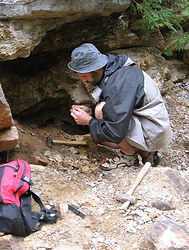

Right and left: digging in the seams at the Saranac zircon showings


Left and above: typical small zircons from the Saranac Zircon showing. Zircon crystals are generally box shaped with 4 sided pyramids at either end. “A doubly terminated tetragonal prism,” as the lingo describes it.

Right: typical small zircons from the saranac zircon showing. Some can get up to 3/4 of an inch, but in my experience that is a rarity. there are also pyramidal thorite crystals up to half an inch across.


Left: Under the concrete cap the shaft drops away 440 feet into the earth.
Right: James Gordon (Mick's father) combs the tailings beside Lowrey Lake for Greasy black fergusonite, allenite, zircon and uranite.

Right: A cluster of beautiful zircon crystals that I saw on a rockhound eco-tour at Greenmantle Farms, just North of Wilberforce, Ontario.

Below: Bear spray is a reasonable precaution at the Saranac Zircon showing


Above: Bats like sleeping at the end of drill holes in abandoned mines.