


Discover Where Radioactive Crystals Occur, Why Bancroft Is Unique, and How Rockhounds Still Find Uranium in Ontario Today
Bancroft is known as the Mineral Capital of Canada — and it’s one of the only places in the world where uranium was mined from pegmatites and intrusive granite systems rather than sedimentary basins.
In this guide by Dark Star Crystal Mines, you’ll learn the geology behind Bancroft’s radioactive minerals, the history of its uranium mines, and exactly how modern rockhounds safely and legally find uranium crystals in Ontario.
Want to find crystals yourself?
Join a guided crystal dig at Dark Star Crystal Mines and explore Bancroft’s pegmatites with expert instruction.
Written by Michael Gordon, co-founder of Dark Star Crystal Mines, mineral educator, and lifelong rockhound with decades of field experience in Bancroft’s pegmatites and historic uranium mines.
Left: Richardson Fission Mine. Situated 2 km east of Wilberforce in a pegmatite that yielded purple fluorite and uranite.


How to Find Uranium in Bancroft, Ontario (Rockhounding Guide)
Uranium in Bancroft, Ontario is most commonly found in pegmatites, skarn zones, and fractured gneiss within the Grenville Province. Rockhounds typically identify it using indicator minerals like betafite, uraninite, zircon, and apatite, often with the help of a Geiger counter or UV light.
To truly appreciate why uranium occurs in this region, it helps to understand the broader geological context of its formation and deposition worldwide and why Bancroft is one of the very few places where uranium was mined from pegmatite and intrusive granite systems rather than the more common sedimentary basins. This unique combination of Bancroft uranium mines, ancient granites, and high-grade metamorphism creates a rare setting that produces these collectible radioactive minerals and sets Bancroft apart from other uranium-producing regions.
By Dark Star Crystal Mines — The Mineral Capital of Canada
Last Updated: 2026
Table of Contents
-
Global Uranium Geology and How to Find Uranium in Bancroft, Ontario
-
Find Uranium in Bancroft by indicator Minerals
-
Why Bancroft Uranium is Globally Unique
-
Grenville Province Geology: Why Bancroft Uranium Minerals are Unique
-
Exploring the Historic Bicroft Uranium Mine: First-Hand Account of Uranium Minerals
-
Bancroft Uranium Mines and Radioactive Minerals Ontario: How Bancroft became a Uranium Hot spot
-
Life around Bancroft Uranium Mines and Collecting Radioactive Minerals
-
Major Bancroft Uranium Mines and Radioactive Minerals, Bancroft Collecting sites
-
How to Find Uranium in Ontario
-
How to Find Uranium and Radioactive Minerals in Bancroft, Ontario - Safely and Legally
-
What do Radioactive Minerals Look Like?
-
Living With Radiation in Old Bancroft Mining Towns
-
Unexpected Health Stories From Living Near Bancroft Uranium Mines
-
Unexplained Phenomenon in Bancroft Uranium Mines
-
What Uranium and Bancroft Uranium Mines Teach Rockhounds about Pegmatites
-
FAQ: Collecting and Identifying Uranium and Radioactive Minerals in Bancroft
-
About Michael Gordon – Dark Star Crystal Mines
Global Uranium Geology & How to Find Uranium in Bancroft, Ontario
Uranium occurs in many geological environments, but globally its grouped into 15 major deposit types (IAEA classification). Most of the world’s uranium comes from three dominant geologies:
The World’s Main Uranium Deposits
-
Sandstone deposits – Kazakhstan, USA, Niger
-
Unconformity-related deposits – Athabasca Basin (Saskatchewan), Australia
-
Iron-oxide breccia complexes – Olympic Dam (Australia)
Intrusive & Granite-Related Uranium Deposits (Why Bancroft is Rare)
Bancroft belongs to this much rarer category, where uranium forms in:
-
Granites
-
Pegmatites
-
Gneiss & skarn systems
-
Structural vein zones
Global examples include:
-
Rössing & Husab (Namibia)
-
Kvanefjeld (Greenland)
-
Palabora (South Africa)
-
Bancroft, Ontario (Canada)
-
Iron-oxide breccia complexes – Olympic Dam (Australia)
Find Uranium in Bancroft by Indicator Minerals
In the pegmatite districts around Bancroft, uranium minerals rarely occur alone and are usually associated with a distinctive suite of indicator minerals that signal the highly evolved pegmatites within the Grenville Province. One of the most important indicator minerals is Betafite, a uranium and thorium-bearing mineral that typically appears brown, black, or honey-colored with a resinous luster. It often occurs as metamict, rounded crystals. By metamict I mean with internal structure destroyed.
Pegmatites containing betafite frequently also host primary uranium minerals such as Uraninite, the main uranium ore historically mined in the Bancroft district. It appears as jet-black, dense, sub-metallic masses capable of producing strong radiation readings.
Another common associated mineral is Pyrochlore, a niobium-rich oxide that can contain uranium or thorium and usually forms brown to yellow octahedral crystals with a resinous luster. Collectors also watch for Zircon, which commonly occurs as small dense tetragonal crystals ranging from reddish to honey-brown and can contain trace uranium within its crystal structure. In addition, Monazite, a rare-earth phosphate mineral that often contains thorium and uranium, appears as reddish-brown crystals and may be noticeably radioactive.
Even the common phosphate mineral Apatite, which forms green, and rarely blue (in Ontario) hexagonal crystals and was historically mined in the Bancroft area, is significant because many uranium occurrences are spatially associated with apatite-rich pegmatites. When several of these minerals occur together in coarse-grained pegmatite containing large feldspar and quartz crystals, they often signal the presence of radioactive minerals and can guide collectors searching for uranium-bearing specimens in the region.
Why Bancroft Uranium is Globally Unique
Bancroft is one of the only places in the world where uranium was mined from pegmatite and intrusive granite systems, rather than the sedimentary basins that host most large uranium deposits. This makes Ontario radioactive crystals particularly unique, and it is a key reason why collectors and geologists seek to find uranium in Bancroft; that and their abundance. The combination of high-grade metamorphic rocks, ancient granites, and pegmatites creates a setting that is unlike the typical sandstone-hosted uranium deposits found elsewhere.
Uranium in Bancroft pegmatites formed during the Grenville orogeny, a period of intense high-grade metamorphism. This event mobilized uranium into late-stage magma fluids, allowing it to crystallize directly within granite pegmatites and granitic leucogranites. Unlike sedimentary basins, which rely on low-temperature dissolution, transport, and deposition, Bancroft’s radioactive deposits are magmatic or hydro-metamorphic, having been concentrated by heat and pressure rather than by erosion: it explains why Bancroft uranium minerals are particularly prized by collectors and researchers.
While much of the world’s large uranium deposits are sandstone- or sedimentary-hosted, eroded from granites, metamorphic rocks, and volcanic sources, Bancroft’s uranium occurs in its original host rocks. Globally, sandstone-hosted uranium—such as in parts of Kazakhstan forms when uranium is weathered from high-grade metamorphic rocks, transported in soluble form as uranyl ions, and precipitated in permeable sands where reducing conditions allow minerals like uraninite or coffinite to deposit. By contrast, Bancroft uranium mines preserve uranium in place, creating rare, collectible radioactive minerals.
Uraninite is not the only radioactive mineral in the Bancroft Region, its estimated that there are at least 40 variants of minor to common species. Bancroft's coarse-grained pegmatites and granites are the primary sources of these minerals, with pegmatites forming from the last stages of magma crystallization and concentrating uranium and thorium, while granites host accessory radioactive minerals. These rocks provide natural reservoirs for both mining and collecting radioactives in the Bancroft area.
Hydrothermal fluids later enhanced Bancroft’s mineral wealth by circulating through cracks in the bedrock, dissolving uranium and thorium, and redepositing them in veins and pockets. Uranium dissolves in oxidizing conditions, often with carbonates and sulfates and redeposits in reducing conditions. In Bancroft uranium minerals typically stay stable in reducing zones and become mobile when exposed to oxygenated groundwater. Bonding with carbonate ions the uranium remains dissolved at a much higher level than would normally be possible and in this phase it is easily transported. There is a sizeable yellow stump of radioactive calcite in a local mine that expresses just this process of oxidization and reduction.
In addition, rare carbonatites and alkaline intrusions added small but significant concentrations of uranium and thorium, along with valuable rare earth elements to Bancroft's geology. Later, glacial activity reshaped the landscape, concentrating heavy radioactive minerals in surface deposits such as till and gravel. Till in the Faraday, Bicroft, Dyno coridor often sets a geiger counter to counting. Today, Bancroft uranium minerals and specimens such as uraninite, monazite, and radioactive calcite or apatite are highly valued, making Bancroft a hot spot for collectors and geologists eager to find uranium in Ontario.
Grenville Province Geology: Why Bancroft Uranium Minerals Are Unique
Below are several cases of where uranite and other radioactives can be found. The mines have long ago been lost and forgotten, but the Grenville Province geology remains. There are still granitic radioactive pegmatite dykes, as an Ontario rockhound you just have to find them.
Madawaska Mine – Heart of the Uranium Rush
Geology:
Uranium in fractured gneiss and amphibolite near pegmatites.
History:
Center of the uranium rush. Closed abruptly when the federal government stockpiled uranium and shut down producers. Discovered in 1952. Became Ontario’s largest uranium producer.
Bicroft Mine – Skarn & Rare Element System
Geology:
Uranium with apatite, amphibole, pyroxene in altered marble (skarn).
History:
Famous for crystal associations and complex ground conditions. There were over 28 miles of side drift in the mine.
Dyno Mine – Pegmatites Uranium in Bancroft
Geology:
Uraninite in coarse pegmatitic zones with feldspar and apatite.
History:
Named for the heavy blasting needed, the Dyno Mine was small but high-grade. It had a mill on site, accommodation in the Dyno estates for managers, and a 525-meter shaft. In total, 8.5 million tons were extracted, but the tailings seemed less extensive than at the Bicroft Mine, from which only half the amount of ore had been removed. Apparently, a good deal of the material was dispersed at unrecorded locations within a 30-kilometer radius. This historic mining activity contributed to the abundance of Bancroft uranium minerals and radioactive minerals Ontario collectors now seek.
In the afternoon sun, it was devilishly hot. Again, there were the mysterious octagonal platforms that I'd seen at Bicroft—essentially just concrete pads held up by a forest of pillars. In the deadening silence, it felt a little eerie. There was an aura of unspoken secrets guarded by a great multitude of basking snakes. One old-timer whispered confidentially, "The only thing they was mining there was other people's pockets. They sold the shares, you know" (not substantiated). Even amid these stories, the remnants of these mines remain a critical part of the landscape for anyone searching for Bancroft uranium minerals or other radioactive minerals Ontario.
Silver Crater Mine
Geology:
The geology of the Silver Crater Mine is actually one of the most unusual in the entire Bancroft district—it’s not a typical pegmatite uranium occurrence, but a carbonatite “vein-dike” system enriched in uranium, niobium, and titanium.
History:
Originally the mine had been established during the search for feldspar, mica and apatite, but in the 1950s it was then known for betafite. It’s a short walk to get here and there is an adit that displays apatite and other large crystals.
Cardiff – The Rockhound’s Classroom
Geology:
Famous pegmatites with feldspar, apatite, titanite, and accessory uranium minerals.
History:
Not a big uranium producer, but one of Ontario’s most important collecting and teaching sites. I found impressive plates of purple fluorite around here.
Exploring Historic Bancroft Uranium Mines: First-Hand Account of Radioactive Minerals
I visited the unrehabilitated Bicroft mine site. I’d wandered into a field of lumber, graying with age and collapsed in piles . Looking for a head structure that may have indicated a shaft or adit entrance I couldn't see one. Today the site is cleared and both shafts are capped with concrete plates. A pipe protrudes to let the gasses vent.
🌍 First-Hand Exploration of the Old Bicroft site
Surveyed from afar, concrete pilings from the Bicroft mine had suggested a Greek amphitheater. The shattered stumps of pillars were lined up like soldiers boots; roof and walls were gone and the floor was open to the sky. A massive structure at the far end of the amphitheater was topped by a raised octagonal platform.
🌍 Yellow Cake, Fluorite and Uranophane at Bicroft
Most intriguing was an 80 foot metal silo, lying on its side with a hatchway leading into shadow. Rivets lined the hole like on the shell of a submarine. Inside murk hung like a polluted cloud and through the haze I could see a shaft with a propeller at its end. Henry D. Later explained that the silo was one of the vessels in which yellow cake was mixed. I wish I’d known it then. The slurry had to be continually stirred or it would gel. If this brew solidified would someone have to scoop it out? Shortly after my camera stopped working and the film developed into darkened and smokey images (above, right).
Huge crystals of fluorite and selenite had been extracted from the local rock and delicate yellow spines of uranophane were picked from this very location. (extract from Rockhound: an Experience of the North)
Bancroft Uranium Mines & Radioactive Minerals Ontario: How Bancroft Became a Uranium Hot spot
Bancroft lies within the Grenville Province geology, a billion-year-old mountain belt formed during the Grenville Orogeny (1.0–1.3 billion years ago). These rocks were once deep inside an ancient mountain chain and later exposed by erosion and glaciation.
What did the metamorphosism of this deep burial do for the area's uranium Deposition?
-
Liberated uranium from source rocks
-
Created fractures and fluid pathways
-
Allowed uranium-rich fluids to move and crystallize in Bancroft area pegmatites
How Uranium crystallized in Grenville Rocks
Uranium travels in hot, oxygen-rich fluids and drops out when it hits reducing conditions, often near:
-
Carbon-rich rocks like those found on the Dark Star Crystal Mines claims
-
Iron minerals
-
Sulfides
-
Marble and skarn zones
In what type of rock formations do Bancroft area's radioactive minerals typically occur?
-
Pegmatites
-
Skarn systems
-
Fractured gneiss & amphibolites
Life Around Bancroft Uranium Mines & Collecting Radioactive Minerals
Aimsley’s story from the Bicroft Mine
“Yeah, there was this time when the tank overflowed , guy come screaming past me for the showers. His clothes was already melted off his back”.
I was sitting in Aimsley D’s kitchen with Aimsley himself, former electrical supervisor at the Bicroft Mine. He was well past 80, skeletal thin and softly spoken. A faded shirt hung limply from his sagging shoulders, his features fringed by a halo of wispy hair; the smell of toast from a late breakfast still hanging in the air.
As we talked Aimsley seemed lucid, but at times his words trailed off into silence. I often found myself speculating as to what he’d intended to say. Henry, Aimsley’s son, a big strapping fellow, sometimes finished the sentence for him.
South of highway 121, built in 1957 to connect highway 28 to the Bancroft area uranium mines - namely Bicroft Mine, Aimsley’s house sits atop a hill. With each passing year it looks increasingly neglected. Outside a stream of water pattered from the eaves trough and siding hung like sagging skin. An altered landscape was decaying all around. The placement of roads, buildings and the very shape of contours had all been in relation to the needs of uranium extraction. Deep underground there are tunnels; some drop down in excess of 1500 feet. The abandoned mines sprawl out on many levels.
Though industry is gone it is only rockhounds who now scour the countryside. Somewhere down below there are dark and yawning spaces that will sit untouched forever.
In Aimsley’s kitchen the kettle had boiled for 20 minutes and nobody seemed to notice, we were absorbed by the telling of Aimsley’s bizarre and amazing life. He was entertaining and sometimes shocking and his narrative followed all sorts of unexpected twists and turns. The conversation turned to “yellow fudge”, It’s uranium concentrate with 70 – 90% uranium oxide. (U3O8) The cake comes from crushed and concentrated ore after it has been mixed with acid and leached.
Living with Uranium in Ontario
Technically speaking yellow cake is no longer yellow. Higher calcining temperatures in new mills produce a substance that is blackish/green; the base material from which fuel rods for reactors are made. I expressed interest at the change and Aimsley grinned. Like a hanged man he fatefully jerked his head back towards the door. “Oh I got some seeping from the barn beams”, he said casually (this stuff was yellow) .Another Aimsley joke I wondered? Apparently not, the wood had come from the mines and according to him, in one of the many spills it had absorbed radioactive sludge.
It was exactly as he’d said. The barn’s supporting structure was constructed from yellowing planks and upon them a granular encrustation had collected. It was yellow fudge (the yellow variety) and Henry discussed the toxic horror in an abstract sort of way, tracing the powdery smear along the grain with his fingers. Teetering at the door Aimsley smiled serenely. I wondered what monstrosities their chickens laid in that barn of silent menace. (Extract from Rockhound – An Experience of the North)
Major Bancroft Uranium Mines & Radioactive Minerals Bancroft Collecting Sites
By the early 1950s, prospectors recognized:
-
Bancroft already hosted rare-element pegmatites
-
Uraninite occurred in visible crystals
-
The geology was structurally perfect for uranium traps
This recognition of Bancroft as a potential uranium hot spot triggered what became known as the greatest uranium prospecting rush in the world, drawing attention to the region’s Bancroft uranium mines and the abundance of radioactive minerals Ontario enthusiasts now seek.
Initially, the Ontario government had offered a reward of $25,000 for any discovery of uranium in the Bancroft area. With a Geiger counter, G.W. Burns found uranium in highly radioactive purple fluorite near Center Lake. The intense demand of the Cold War pushed exploration to a higher level in the area, but by the 1960s it was mostly over, with the US moving on to supplies in Saskatchewan.
As H. Spence said at the World Nuclear Association’s 14th Annual Symposium:
“The roar from the great Canadian uranium rush was so great in 1953 that you could hardly hear the Geiger counters ticking.”
Between 1953–1956:
-
Over 100 uranium claims were staked
-
Multiple underground hard-rock mines opened
Ready to find uranium in Bancroft Ontario? Join our guided rockhounding tours at Dark Star Crystal Mines.
How to Find Uranium in Ontario – Step-by-Step Guide for Rockhounds
Learning to recognize uraninite pitchblende crystals and fluorescent secondary minerals is an essential part of how to identify radioactive minerals in the field while rockhounding in Bancroft.
Key Field Identification Methods
-
Radiation Detection (Scintillometer/Geiger Counter): The primary, most reliable method. A device that "screams" or clicks rapidly when near radioactive rock is essential to distinguish uranium from similarly colored but non-radioactive minerals.
-
Ultraviolet Light (UV Flashlight): Used at night or in shade, a UV light will cause many secondary uranium minerals to fluoresce with a "brilliant" or "neon" yellow-green glow.
-
Visual Inspection (Color & Habit):
-
Primary (Uraninite/Pitchblende): Black, dark grey, brownish, or metallic-looking, often in dense, massive (SG - 9.0), or "grape-cluster" (botryoidal) forms.
-
Secondary (Weathering Products): Bright yellow, canary-yellow, or bright green coatings on fractures and in cavities.
-
Primary Uranium Minerals
-
Uraninite (pitchblende)
-
Uranothorite
-
Brannerite
Secondary & Fluorescent Uranium Minerals
-
Autunite: Yellow to lemon-yellow, platy crystals. Highly fluorescent (bright green).
-
Carnotite: Bright canary-yellow powdery coating or crusts. Common in sandstone.
-
Uranophane: Lemon-yellow to orange-yellow, often fibrous or needle-like (acicular) crystals.
-
Torbernite/Metatorbernite: Emerald green to grass-green tabular crystals. Often non-fluorescent or weakly fluorescent.
-
Zippeite: Bright orange-yellow to yellow-brown, typically as crusts on oxidized rock.
Many glow bright green under UV light, making radioactive crystals in Ontario especially exciting for collectors.
How to Find Uranium & Radioactive Minerals in Bancroft Ontario Safely & Legally
At Dark Star Crystal Mines Bancroft Ontario, we teach crystal collecting along with safety tips as part of every guided crystal dig in Bancroft and educational program.
What are the best Geological settings to look for uranium minerals in Bancroft, Ontario?
-
Bancroft Pegmatite zones where they cut gneiss and marble. These pegmatites formed from late-stage fluids of granitic intrusions and often contain rare minerals.
-
Skarn contacts in marble
-
Fracture systems
-
Carbonate veining such as at our Dark Star Crystal Mines
What do Radioactive Minerals Look like?
-
Coarse-grained granite - In many Bancroft pegmatites, uraninite forms small black grains surrounded by orange or brown alteration zones.
-
Apatite, zircon, titanite - Apatite, titanite, and zircon are considered strong indicators of radioactive elements because they commonly incorporate uranium (U) and thorium (Th) into their crystal structures during crystallization from molten rock. These accessory minerals act as natural radioactive "clocks" (U-Pb geochronometers), and their durability allows them to retain these radioactive elements over billions of years, often resulting in "metamictization" (damage to the crystal structure caused by radiation).
-
Color Changes: Natural radiation can cause "color centers" to form within crystals like apatite, producing vibrant colors like neon blue and green in radiation-rich environments. The formation of brightly colored secondary minerals is also indicative of the presence of radioactives. Quartz gone smokey indicates its presence in close proximity to radiation.
-
Dark oxide minerals - Dark oxide minerals, particularly uraninite (also known as pitchblende), are strong indicators of uranium because they are the primary, high-grade form of uranium ore. These black-to-brownish oxides represent the stable, reduced form of uranium (UO₂ or U₃O₈) and are often found in hydrothermal veins, granites, and as primary deposits in sandstone.Uranium is highly soluble in oxygen-rich water but precipitates out of solution in reducing conditions. Dark, reduced oxide minerals (like magnetite, associated with iron) often form in the same environments (redox boundaries) that allow uranium to concentrate.
-
Rusty staining - If you see hematite staining or magnetite-rich zones, uranium concentrations are more likely.
-
Silica alteration - When discussing radioactive mineral deposits, especially in places like the pegmatites and veins around Bancroft, silica alteration refers to a geological process where silica (SiO₂) is introduced into surrounding rocks by hot mineral-rich fluids, changing the rock’s composition and texture. These fluids are often the same hydrothermal solutions that transport uranium and other radioactive elements. Silica alteration may appear as: Hard white or grey quartz veins cutting through darker host rock, bleached or hardened rock zones around fractures, quartz veins associated with uranium minerals such as Uraninite
-
Radioactive mineral halos in pegmatites. A radioactive halo (often called a radiation halo or pleochroic halo) is a small circular zone of discoloration in a mineral caused by radiation damage from a tiny radioactive crystal trapped inside it.
-
Large feldspar and quartz crystals - Large feldspar and quartz crystals in the rocks around Bancroft often indicate conditions that are favorable for uranium mineralization, because these large crystals are typical products of highly evolved pegmatitic magmas—the same geological environment where uranium tends to concentrate. Pegmatites form from the last, water-rich portion of a cooling granite magma. By the time the melt reaches this stage, most common minerals have already crystallized. The remaining melt becomes enriched in rare and incompatible elements. Uranium is one of those incompatible elements, meaning it stays in the melt until the very late stages of crystallization.
In summary, Pegmatite with giant feldspar and quartz crystals = evolved system, An evolved pegmatite = greater chance of uranium, rare earths, and radioactive minerals.
Radiation safety tips for rockhounds
-
Never lick rocks 😅
-
Don’t breathe dust
-
Wash hands after handling or wear disposable gloves
-
Store radioactive specimens in designated shielded locations
-
Use a Geiger counter
-
Minimize time spent near source, maximize distance from source
Legal & Ethical Crystal Collecting in Ontario
-
Never collect from protected or active mine sites
-
Respect private land
-
Follow Ontario Prospecting and Rockhounding regulations
-
Practice ethical crystal mining in Canada as per basic rockhound considerations
Unexpected Health Stories From Living Near Bancroft Uranium Mines
Chatting with Aimsley you never knew what to think – was he messing with us or was he serious? He had this ethereal quality like an angel. Angels only tell the truth! That morning he bought out a scrap book of clippings; its innards spilling like a gutted deer. Aimsley's theory was that some level of radiation was beneficial, “Bruce Evans who’d just died recently. In his 80s and not of radiation poisoning”. His index finger rose to emphasize the point. He’d packed yellow fudge into barrels for a job, lived a good long time that fellow did and he’d had plenty of exposure.
Aimsley’s Reflections on Radiation Exposure and Child Birth
Further to his point and with a scrapbook spilling old newspaper cuttings he tossed the idea out there that men who worked around radiation had a tendency to father boys. “I had six boys before my seventh was a girl. I thoughtfully gave this consideration as he tapped a newspaper article that seemed to back the point.
You ever watch the Simpsons? Homer’s first born was a boy! That settled my doubts and Aimsley concluded sweetly in a whisper “That’s what you get when you work for Mr. Burns” (he discovered the uranium at Center Lake - Cardiff - somebody called "Burns"). Henry nodded in agreement. (excerpt from Rockhound: An Experience of the North)
Unexplained Phenomenon in Bancroft Uranium Mines
Historically miners have been, and in some cases still are, quite superstitious. Mining is a dangerous and unpredictable occupation, and superstition can develop in high-risk jobs as a way to cope with uncertainty. Aimsley was the first to assure you of the presence of the supernatural underground.
In some places mines are treated almost like living entities. Miners might speak respectfully to “the mountain” or “the rock” to avoid angering it. Specific shafts, tunnels, or veins, were often named, speaking of them as if they have personalities: “she’s a tricky one,” or “she’s generous today.” Mines are sometimes described as “hungry,” “sleeping,” or “restless,” depending on activity levels, collapses, or the richness of ore extraction.
Cobalt had it's Kobalts, Bicroft its eerie glow. Many miners swore that certain tunnels held spirits, or at least illusions created by shadows and the faint glow of uranium and mica in the rock.
New workers were warned never to whistle down Bicroft's tunnels, in fact its a superstition common to many miners, not just those in Bancroft. Whistling was said to “angrily awaken the rock.” and when a million tons of rock awakes on the wrong side of the bed, Watch Out! During blasting near the 600-foot level, a huge feldspar block rolled just enough to trap a miner’s boot; while everyone panicked, he laughed it off, claiming the rock “just wanted to dance,” and the site was thereafter called Dancing Rock.
At night, faint green or yellow glows along the walls were often mistaken for ghosts. Alone in narrow drifts, miners sometimes heard phantom footsteps behind them. These eerie phenomena, along with the singing of quartz at 3 a.m., became part of the Bicroft Mine folklore, with some miners knocking on walls for luck or carrying tiny crystals in their pockets as “good omen stones,” blending superstition with the real hazards of working underground. It was common for miners through the ages to harbor superstitions and the Bancroft mines were no different.
What Uranium & Bancroft Uranium Minerals Teach Rockhounds About Pegmatites
Uranium serves as a critical indicator for rockhounds, teaching them about the formation, composition, and economic potential of pegmatites. Because uranium-bearing minerals like uraninite and betafite often occur as primary minerals in pegmatites, they act as "trackers" for identifying highly evolved, volatile-rich igneous bodies and help collectors find uranium in Bancroft Ontario.
Understanding uranium geology helps you:
-
Read pegmatite systems
-
Recognize mineral associations and geological transitions
-
Understand fluid pathways
-
See why apatite, titanite, monazite & uranium occur together
Here is what uranium teaches rockhounds about pegmatites:
Indicators of "Evolved" and Rare-Metal Pegmatites
-
Late-Stage Crystallization: Uranium acts as an incompatible element, meaning it does not fit easily into early-forming silicate crystals. Therefore, it tends to concentrate in the final, most evolved, and volatile-rich melt phase. Rockhounds hoping to find uranium in Bancroft Ontario often focus on these zones to locate radioactive minerals.
-
Connection to Rare Metals: Uraniferous pegmatites often signal the presence of other valuable, rare-earth, and critical elements, including tantalum (Ta), niobium (Nb), beryllium (Be), and lithium (Li). Collectors targeting radioactive minerals will notice that these rare-metal associations often coincide with uranium occurrences.
-
Mineral Association: When prospecting, finding uranium (often detected via Geiger counter) frequently correlates with finding potash-feldspar-rich and smoky quartz-bearing zones.
Identifying Specific Geological Environments
-
Peraluminous Signatures: Uranium is commonly associated with peraluminous and peralkaline pegmatites, where Bancroft uranium minerals are concentrated. In geochemistry, a rock is peraluminous when it has more aluminum (Al₂O₃) than can be accommodated by feldspars alone. That excess aluminum gets tied up in minerals like: muscovite, garnet, cordierite and sillimanite. Uranium (U⁴⁺ / U⁶⁺) doesn’t fit well into early-forming minerals (like feldspar, pyroxene, amphibole). So during magma evolution it stays in the melt, becomes increasingly concentrated, ends up in late-stage fluids and melts.
Core Zones: Highly evolved pegmatites often have cores of smoky quartz and pink feldspar, which are the most likely spots for locating radioactive minerals and other associated rare, colorful, or well-crystallized minerals.
Dating and Geologic History
-
Geochronology: Uraninite, the primary radioactive mineral in these rocks, is excellent for dating. The decay of uranium into lead allows precise dating of pegmatite crystallization (e.g., in the 2.5 Ga range for some Canadian examples). These cores often hold the best opportunities to find uranium in Bancroft Ontario.
-
Fluid Movement: Secondary uranium minerals (like green torbernite or yellow carnotite) indicate where fluids have moved through the rock, providing insights into the distribution of uranium minerals and other radioactive minerals sought by collectors.
Entire communities formed around uranium production. Serving the Bicroft Mine, Cardiff was established in 1862 and by 1867 had 37 people. In the 1950s as many as 500 people were employed so when the mine closed in 1963 it was left scrambling to re-invent itself.
Dyno Estates and the Uranium Mines Lifestyle
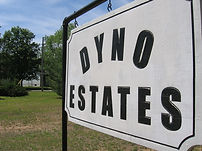
Dyno estates still sits in amiable decay alongside Dyno road. Workers from the Dyno Mines lived there and its driveways are said to set your Geiger counter to panic mode. “it’s a great place to retire” or so they pitch the Dyno lifestyle" in local papers. At the first closing of Bicroft mine, houses at Dyno estates went for no more than $4500 and to encourage retirees , each sale included a free rocking chair or a flight over Paudash Lake.
Abandoned Mines and Modern Rockhounding
I stopped on one of the hot driveways to interrupt a barbecue and ask the locals how to find the old Dyno Mine (before it was rehabilitated). It was a rambling convoluted explanation. I was told to watch for deep pits that dropped off into blackness. “Threw a breeze block down one and I hardly heard it hit. There some real doozies back there. Fall down one and they aint never gonna find you.”
FAQ: Collecting and Identifying Uranium & Radioactive Minerals in Bancroft
Is it legal to collect uranium minerals in Bancroft?
Yes, you can find uranium in Bancroft Ontario legally only on public land where collecting is permitted, or on private property with the landowner’s permission. Never collect from protected or rehabilitated mine sites, especially the historic Bancroft uranium mines. Following these guidelines ensures safe and ethical rockhounding for radioactive minerals Ontario.
Are uranium crystals dangerous to handle?
Uranium crystals are mildly radioactive. Safe handling practices; avoiding dust inhalation, washing hands, and storing specimens properly make collecting low risk for enthusiasts.
What tools do you need to find radioactive minerals?
Essential tools for radioactive minerals Ontario include a Geiger counter, UV flashlight, gloves, eye protection, and sample bags. A shovel is useful for digging in vein dykes, and a hammer and chisel are needed for accessing uranium minerals in pegmatites.
What do uranium minerals look like in the field?
You can identify uranium minerals by their distinctive appearance: bright yellow, green, or orange coatings (like autunite and carnotite), or heavy black masses such as uraninite that could appear as cubic crystals or botroidal habit. Uraninite (often called pitchblende) can look surprisingly varied in the field, which is why it’s sometimes overlooked—or occasionally mistaken for more common dark minerals. It is heavy, dull and greasy looking. Recognizing these features is key when you find uranium in Bancroft Ontario.
Where are the best rockhounding areas for radioactives near Bancroft?
-
Generally: Pegmatites, skarn zones, and permitted dumps around Bancroft, Cardiff, and Wilberforce are prime locations for anyone seeking radioactive minerals in Bancroft.
Specifically:
-
Beryl Pit (Quadeville): Famous for Euxenite-(Y) crystals and abundant Allanite; a hotspot for radioactive minerals.
-
Silver Crater Mine (Faraday): Known for Betafite; a challenging hike but yields some decent uranium minerals.
-
Faraday Hill Road cut: Accessible site for Uraninite; small dark cubes of uranium occur alongside blue apatite; ideal for those trying to find uranium in Bancroft.
-
Kemp Prospect: High radioactivity with Thorite and Uranothorite in a pyroxene skarn.
-
J.G. Gole Quarry (Madawaska): Produces Fergusonite and Euxenite crystals.
-
Greyhawk Mine: Tailings are visible along an ATV trail. They contain a fair variety of radioactive minerals.
-
Kenmac-Chibougamau Mine: A radioactive pegmatite where all minerals come from a fissure 20 feet wide and 500 feet long. Uranothorite, allenite and zircon are known to have been found here.
-
Schickler Occurence: here you are less likely to see the primary radioactive minerals, but more likely the indirect effect of radiation. The Schickler occurrence is best known as a fluorite-rich carbonatite / vein-dike system, not a classic uranium showing. At Schickler what people notice more often is: very dark fluorite (radiation-induced color centers), radioactive inclusions inside other minerals and elevated background readings on a Geiger counter
By focusing on these areas and following safety protocols, collectors can responsibly find uranium in Bancroft Ontario and enjoy the rich diversity of radioactive Bancroft minerals.
Note: inclusion in this article does not imply permission to trespass. Always check on surface and mineral rights and seek permission to rockhound when needed.
About Michael Gordon – Dark Star Crystal Mines
Michael Gordon is a co-founder of Dark Star Crystal Mines, Bancroft, Ontario and a lifelong rockhound, mineral educator, and ethical crystal advocate. Through ethical crystal mining in Canada, Michael focuses on education, safety, and preserving the integrity of Earth crystals from Bancroft. He has a degree in geography, a diploma in gemology and a certification in diamond grading. Michael is author of the 3-part rockhound series books and also curator of the popular you-tube channel - Caver461.
References:
-
Robinson, S.C. & Hewitt, D.F. (1959) – Uranium Deposits of the Bancroft Region, Ontario (Technical Report).
Classic geological overview of the uranium deposits including pegmatite hosted ores and primary radioactive minerals like uraninite and uranothorite.
-
Satterly, J. & Hewitt, D.F. (1955) – Some Radioactive Mineral Occurrences in the Bancroft Area, Ontario Department of Mines, Geological Circular No. 2.
Early Ontario government summary of radioactive mineral sites in the Bancroft area, useful for historical and locality context.
-
Lang, A.H., Griffith, J.W. & Steacy, H.R. (1962) – Canadian Deposits of Uranium and Thorium (Geological Survey of Canada, Economic Geology Series 16).
Comprehensive geological reference covering radioactive mineral occurrences in Bancroft and elsewhere.
-
Ontario Geological Survey — Uranium and Thorium Deposits of Southern Ontario (OFR5311, 1981).
Regional report that includes Bancroft pegmatitic uranium occurrences and summaries of various radioactive mineral occurrences.
-
Desbarats, A.J. & Percival, J.B. (2016) – Groundwater Chemistry of Uranium‑Thorium‑REE Deposits, Bancroft Area, Ontario (GSC Open File Report).
Modern Geological Survey of Canada investigation of historical uranium mine sites and groundwater chemistry related to radioactive deposits.
-
Parsons, M.B. et al. (2014) – Controls on Uranium, Rare Earth Element, and Radionuclide Mobility at the Decommissioned Bicroft Uranium Mine, Ontario (GSC Report).
Technical study of radionuclide behavior and environmental aspects at the former Bicroft Mine — valuable if discussing mobility of radioactives post‑mining.
-
McDougall, Raymond (2019). Mineral Highlights from the Bancroft Area, Ontario, Canada. Rocks & Minerals, Vol. 94(5): 408–419.
-
-
Aimsley, D. (2011, June 3rd). Interview by M. Gordon [Personal interview about his time as electrical foreman in the Bicroft Mine]. McGilvery Road Area, Bancroft, Ontario.
-
Michael Gordon. Rockhound: An Experience of the North. Guelph, ON: Edghill Press, 2015.


The 2 adit entrances of the Halo Mine. It was worked in the 1950s and burrows into a granitic pegmatite which is typical of the Bancroft area.


Right: Adit of the silver Crater Mines
Above and left: It was initially radium in the water that drew attention to the Richardson Fission Mine and in the 1930s they built a mill - since destroyed.


Left: Horneblende - Bancroft Chamber of Commerce Museum.
Hornblende is a complex silicate mineral that belongs to the amphibole group. It’s one of the most common dark-colored minerals in igneous and metamorphic rocks.
Here’s a detailed breakdown:
Hornblende is not a single mineral but a group of minerals with a general formula roughly:
(Ca,Na)2−3(Mg,Fe,Al)5(Si,Al)8O22(OH)2(Ca,Na)_2-3(Mg,Fe,Al)_5(Si,Al)_8O_22(OH)_2(Ca,Na)2−3(Mg,Fe,Al)5(Si,Al)8O22(OH)2
It contains calcium, sodium, magnesium, iron, aluminum, and silicon, with hydroxide groups. Its exact composition can vary depending on where it formed.
Right: Octagonal structure at the Dyno Mine- one also appeared at the Bicroft Mine. I never figured out what they were for.


Left: The author (Michael Gordon) digging in a Bear Lake Vein Dyke.
Right: Uranite cubes in Calcite.
Right: Something tells me we are not done with playing with radiation. You'd hope it was used for good, but there is always the threat of bad. (NBC - Gibraltar)
Below and left: secondary uranium minerals.


Left: Feldspar and quartz gone smokey at the McDonald Mine.
Below: Tory Hill Junction - Geographically central to Bancroft area radioactive deposits.
Left: Testing for radiation using a geiger counter. A Geiger counter, is a portable instrument used to detect and measure ionizing radiation, including alpha particles, beta particles, and gamma rays. It operates by using a gas-filled tube that produces a "click" sound or electrical pulse whenever radiation particles enter and ionize the gas
Right: Digging area at the Richardson Fission Mine from whence rockhounds extract purple fluorite, apatite, titanite and uranite.


Above: adit entrance to the old Croft Mine. Its a bit of a struggle to get there through a road that sinks into a marsh.
Above Right: shaft reaching towards the surface in an old uranium mine. historical accounts indicate that in the peak uranium boom years around Bancroft, multiple fatal accidents occurred across the district, with reports suggesting roughly 10 miners were killed in the uranium mines overall — most by falls or rock collapses, and at least two from carbon monoxide poisoning


Right: Aimsley's theory about uranium miners has proponents at either side of the argument. The way I believe it currently stands is that radiation could damage sperm or egg cells differently, potentially favoring Y-chromosome (male) sperm survival. But in reality, the effect is minor, unpredictable, and not reliable.
Left: James stands at the entrace to the now rehabilitated Dyno Mine. Clearly rockhounds are not allowed past this point.

As was pointed out by the residents of the old Dyno estates, radiation aside, being anywhere near old uranium mines is a dangerous thing. All of the bigger Bancroft area mines had deep shafts and as one of the redidents said, you can barely hear rocks hitting the bottom its so deep. The Bicroft Mine where Aimsley worked went down to 1844 feet, the Dyno mine to 1710 feet deep.
The reason that the Bancroft mines went to these depths is that uranium is mostly found in small, irregular veins within granitic pegmatites and metamorphic host rocks. These veins often “pinch and swell”, meaning the uranium-rich zones are not broad or continuous. To follow the ore underground, miners had to sink shafts and drive tunnels deep, sometimes hundreds of meters, to trace the veins as they dipped below the surface.

Left: Bicroft Mine - it had 28 miles of dift beneath the ground.
Above: Thorite crystal from the Bancroft area.


Above: Cardiff Mine - only the head frame remains


Left: Yellow stalagmite in a mine in the Bancroft area.
Right: Same stalagmite looking at its top, deposition is from a super saturate solution that loses CO2 to the air in the tunnel and then drops its solids


Mines have long been seen as places where the boundary between the living and the dead is thin—dark, dangerous, and full of unseen forces. Across cultures, miners developed rich folklore about spirits or “ghosts” that lived underground. These weren’t always evil—many were protectors, tricksters, or omens of danger. Germany had its Kobalts, the Cornish, their knockers and the North american version "tommy knockers" You'll not find much in authoratative texts, but the oral folklore is rich in stories and lessons.

Left: Uranophane, a calcium, uranium, silicate hydrate.
Above: apatite as so often seen in the Bancroft area pegmatites.