

Collecting Crystals from Ontario Pegmatites: A Rockhound’s Field Guide
This field-based guide explains how rockhounds and crystal collectors find, identify, and collect crystals from Ontario pegmatites and vein dykes, with a focus on Canadian Shield geology, mineral zoning, and responsible collecting practices.

Above and right: MacDonald Mine, once famous amongst rockhounds for its uranophane, smoky quartz and zircons


What Are Ontario Pegmatites and Vein Dykes?
Learn how Ontario pegmatites and vein dykes form, their unique mineral composition, and why they are essential destinations for Bancroft rockhounding and crystal collecting.
A pegmatite is defined as a coarse-grained igneous intrusive rock, and it plays a major role when rockhounding in Bancroft and mineral collecting in Ontario. The Pay to dig Dark Star Crystal Mines claims, located within the greater Bancroft area, are widely regarded as a rockhound’s paradise. Many visitors come to the Bancroft region specifically for the impressive calcite vein dykes, which cut across the forest floor in broad white ribbons, but the surrounding hills also contain major Bancroft pegmatites and skarn deposits. All three formation types in the Bancroft mineral district can conceal exceptional crystal pockets and collectible gemstones.
In the Bancroft rockhounding area, success relies on more than simple luck. Some digs may take days before showing any sign of reward, so experienced Bancroft mineral collectors quickly learn how to “read the rock.” Understanding how Bancroft pegmatites, vein dykes, and skarns form, recognizing mineral zoning, and interpreting changes in crystal size and composition helps collectors focus on the places where Bancroft area crystal pockets are most likely to occur. This geological knowledge is essential for anyone interested in Bancroft mineral collecting, Bancroft gemstone hunting, and exploring Ontario’s pegmatite country.
How to Find Crystal Pockets in Ontario Pegmatites
Discover proven techniques for locating crystal pockets in Ontario pegmatites, including tips from experienced Bancroft area collectors.
Many Ontario rockhounds are familiar with crystal collecting in Ontario, but fewer realize just how strongly the activity is connected to Ontario pegmatites. Much of Ontario rockhounding involves exploring pegmatites, vein dykes, and skarn deposits across the province’s diverse geological terrain. For example, many collectors don’t realize that the Quadeville Beryl Pit is a pegmatite, or that numerous deposits around Wilberforce belong to what geologists classify as the Hybla Pegmatite Province.
Successful Ontario mineral collecting requires more than a shovel and enthusiasm. It demands an understanding of the province’s geology—especially the difference between pegmatites, vein dykes, and skarns. Knowing how Ontario pegmatites form, where they occur, and which minerals they host dramatically increases your chances of finding quality crystals and gemstones.
Pegmatites in a given district often share similar mineralogy. Around the Dark Star Crystal Mines claims, local pegmatites are readily recognized by their molybdenum-bearing formations. Just east of the Dark Star property, the syenitic pegmatites of the Wilberforce area are considered among the oldest pegmatites in Ontario, while the Hybla pegmatites are younger and are especially noted for their rare earth element minerals. In eastern Ontario, many historic apatite mines were developed in pyroxenite pegmatites, reflecting another important pegmatite style in the region.
Historically, Ontario apatite was quarried and crushed for phosphate fertilizer. Across the Ottawa River in Quebec, the Leduc Mine at Wakefield is another classic pegmatite locality. During our last visit, beautiful green tourmalines with milky cores were still being found there, illustrating the continuing potential of historic pegmatite workings.
Across much of the province, Ontario pegmatites intrude rusty gneiss bedrock, which often weathers heavily at the surface. True crystal pockets at the surface are uncommon and, when exposed, are usually badly weathered and crumbly. The best crystal pockets are typically preserved below the frost line, where they remain protected from surface breakdown. That’s why, at Dark Star Crystal Mines, we often say: “You’ve got to get below the frost line to find the real treasures.”
Pegmatite Zoning in Ontario: Where Crystals Form
Understanding the border, wall, and core zones of Ontario pegmatites helps rockhounds predict where gem-quality minerals and rare crystals are most likely to occur.
For more than 20 years, we have been collecting and prospecting in Ontario pegmatites and vein dykes, and we actively work mineral claims through Dark Star Crystal Mines. Through decades of fieldwork, gemology, and hands-on Bancroft rockhounding, we’ve learned that a solid understanding of Ontario pegmatites and pegmatite vein dykes is essential for anyone hoping to successfully find crystals in the Bancroft area and across the province.
Pegmatites are among the easiest geological features for rockhounds and mineral collectors to interpret—once you know what to look for. These coarse-grained granitic bodies typically display a predictable internal structure: crystal size increases toward the center. For Ontario crystal collectors, this pattern serves as a natural guide. The central pegmatite core zone, usually located near the thickest portion of the body and roughly midway between the walls, is often the most promising location for discovering crystal pockets and well-formed specimens.
As you move from the outer margin toward the core, changes in crystal size and mineral composition provide important clues. Feldspar crystals commonly become progressively larger toward the interior, signaling a slower rate of cooling where gem-quality minerals such as elbaite tourmaline, zircon, and red or blue beryl are more likely to occur. This pattern is not always uniform, however. You may encounter bands of fine-grained aplite, which indicate sudden changes in temperature or pressure during the formation of the pegmatite.
The concentric zoning of Ontario pegmatites preserves a record of these physical disturbances, in much the same way that apatite crystals of the Ottawa Valley record chemical changes during crystallization. Understanding these structural and mineralogical patterns dramatically increases your success when rockhounding in the Bancroft area or exploring other major Ontario pegmatite localities. Provenance is important so remember to document your finds.
Locating Ontario Pegmatites on the Surface
Learn how to identify pegmatite outcrops in the Bancroft area, including key visual clues and surface mineral indicators.
Pegmatite pockets can be surprisingly deep, and at the surface they are often concealed beneath saplings and brush rooted in loose, decomposed material along the mid-line of the body.
A pegmatite exposed for 100 feet may average only five feet wide, yet swell locally to nearly ten feet. Many of these swellings contain only massive feldspar, solid and unproductive. Occasionally, however, a swelling reveals quartz and mica in a loosely packed matrix that crumbles easily under a pick. Clear quartz and pink mica that break free effortlessly often signal proximity to a pocket-rich zone, especially when the surrounding quartz appears glassy rather than cloudy.
Pegmatite Mineral Zoning: Where Ontario Crystals Occur
Explore how mineral zoning in Ontario pegmatites determines the distribution of feldspar, mica, quartz, and rare-element crystals for successful rockhounding.
Pegmatites form through multiple stages of crystallization, and as a result, their interiors are typically zoned, with minerals arranged in distinct concentric bands. This feature—known as pegmatite zoning—is one of the most important characteristics used in pegmatite identification in Ontario. The zones often resemble onion-like layers, although they are rarely perfectly uniform because they reflect the natural shape and emplacement of the pegmatite body.
Some simple Ontario pegmatites show only one or two zones, while more complex pegmatites may display three or four distinct mineral zones. Zoning is especially important for mineral collectors and rockhounds because certain minerals occur only in specific zones within the pegmatite. For example, molybdenum typically forms as a late-stage mineral, deposited in fractures or introduced during hydrothermal alteration. This means that searching outside the appropriate zone is unlikely to produce results.
When Ontario pegmatites were intruded into cooler surrounding country rock, rapid chilling produced a narrow, fine-grained border zone along the contact walls. This border completely surrounds the pegmatite interior and marks the first stage of crystallization.
Inside the border lies the wall zone, where cooling slowed and feldspar and mica developed into larger crystals. In several well-known Ontario pegmatite localities, including the Quadeville Beryl Pit near Bancroft, this zone may also contain beryl, garnet, and black tourmaline. The full extent and mineral potential of some of these pegmatites are still not fully understood, adding to their geological and collecting interest.
At the center is the core zone, usually the smallest but often the most visually striking. This zone is commonly dominated by milky quartz, which may grade into smoky or pink quartz depending on trace elements present. Quartz typically fills the remaining central space after feldspar crystals have grown outward from the walls toward the middle, completing the pegmatite structure.
Temperature and Pressure Effects on Ontario and Bancroft Pegmatites
Examine how cooling rates, pressure changes, and hydrothermal activity influence crystal size and mineral formation in Bancroft pegmatites.
Pegmatites are easily recognized by the very large size of their crystals, which are far coarser than the grain size of most plutonic rocks. This distinctive coarse texture makes them one of the easiest rock types to identify in the field and is especially useful for pegmatite identification in Ontario. For anyone rockhounding in the Bancroft area or exploring other major Ontario pegmatite localities, examining crystal grain size is one of the best ways to locate rocks that may host collectible minerals and gem-quality crystals.
In typical granites, syenites, and nepheline-bearing rocks, crystals are usually only about one inch to one foot across. In contrast, Ontario pegmatites—including those historically mined for feldspar, mica, nepheline, lithium, and rare-element minerals—often contain extremely coarse-grained crystals that may reach several feet in size. These giant crystals are a hallmark of pegmatite geology and are commonly found in major collecting areas such as Bancroft, Quadeville, and the wider Grenville Province. Because of their exceptionally large grain size and mineral diversity, pegmatites are among the most exciting and productive rock types for collecting crystals and mineral specimens in Ontario.
Grain Size in Pegmatites: A Rockhounding Guide for Ontario Collectors
Learn how the unusually large grain size of Ontario pegmatites serves as a key field tool for identifying rocks likely to host collectible crystals.
Pegmatites are distinguished by the exceptionally large size of their crystals, which are much coarser than the grain size found in most plutonic rocks. This feature is one of the most useful ways to identify pegmatites in Ontario, especially for anyone rockhounding in the Bancroft area or visiting other major Ontario pegmatite localities. Examining crystal grain size is a key field method for pegmatite identification and for recognizing rocks that may host collectible minerals and gem crystals.
In most granites, syenites, and nepheline-bearing rocks, individual crystals typically range from about one inch to one foot in size. By contrast, Ontario pegmatites—especially those mined commercially for feldspar, mica, nepheline, or rare-element minerals—often contain extremely coarse-grained crystals that can reach several feet across. These giant crystals are a hallmark of pegmatite geology and are frequently encountered in the larger pegmatite bodies around Bancroft, Quadeville, and other classic Ontario rockhounding areas. Because of this very large grain size, pegmatites are among the most productive and exciting rock types for collecting crystals in Ontario.
Grain size classification in pegmatites (after Cameron et. al. 1949, pg.16)
Texture
Fine grained less than 1"
Medium grained 1"- 4"
Coarse grained 4" - 12"
Very coarse greater than 12"
Vein Dykes in Ontario Pegmatites: Crystal-Bearing Zones
Discover how calcite-filled vein dykes and fracture zones in Ontario pegmatites concentrate gem-quality crystals and rare minerals.
Vein dykes in Ontario pegmatites behave differently from typical pegmatite bodies, and understanding this difference helps rockhounds locate crystal pockets more effectively. The best crystal pockets in vein dykes usually occur along the margins, especially where two contrasting rock or mineral types meet. Calcite-filled vein dykes often contain natural cavities and open spaces created by circulating fluids. These cavities may extend for surprising distances as water-worn tunnels, where crystals become concentrated and trapped in flow channels. However, crystal pockets in vein dykes are often scattered, irregular, and unpredictable, so persistence is essential when collecting crystals in Ontario.
Although calcite is not traditionally considered a primary pegmatite mineral, some Ontario pegmatite locations contain large quantities of calcite associated with rare minerals. A classic example is the MacDonald Feldspar Mine near Hybla, Ontario, one of the most famous Ontario pegmatite localities. Here, calcite-rich zones have produced minerals such as ellsworthite, titanite, and smoky quartz, along with feldspar and other pegmatite minerals. During the 1920s, this zoned granitic pegmatite was an active feldspar producer, shipping thousands of tons of material from nearby Hybla Station.
Although underground access is now closed, the MacDonald Mine remains one of the most unique and historically important Canadian pegmatites, and it continues to be an important reference site in the study of Ontario pegmatites and vein dykes.
Historic Pegmatite Mines in Ontario Rockhounding Areas
Explore classic Ontario pegmatite mines and quarries that reveal the history of mineral collecting and show where crystal pockets have been found.
Old mines and quarries often expose pocket-bearing areas that would otherwise require hours of excavation when not already exposed. Along Noggie’s Creek, for example, a 1950s adit plunges about 100 meters into a hillside, intersecting the core of a pegmatite. In its dim tunnel walls, flashes of peacock-blue peristerite glint from the rock. Yet it’s worth remembering that historic miners frequently avoided pegmatite cores altogether—they were after pure feldspar or quartz, not the accessory minerals gem collectors so greatly prize.
MacDonald Mine, Hybla Ontario – Historic Feldspar Operation and Rare-Element Pegmatite
The historic MacDonald Mine near Hybla, Ontario is widely recognized as one of Canada’s most important Ontario pegmatite mines. Famous for its feldspar production and exceptional diversity of rare-element minerals in Ontario, this location continues to attract geologists, crystal collectors, and Ontario rockhounding enthusiasts. The mine is especially noted for its large pegmatite dike, complex mineralogy, and easily accessible surface exposures, making it a classic destination for mineral collecting in Ontario.
History of the MacDonald Mine: A Key Pegmatite in Hybla near Bancroft
Learn about the MacDonald Mine’s feldspar production, rare-element minerals, and its significance to Ontario geology and Bancroft rockhounding.
The MacDonald Mine was first developed in the early 1900s as an Ontario feldspar mine, with continued activity through the 1920s and 1930s. Over its history, the property was operated by several companies, including the Genesee Company and the Canada Flint and Spar Co. In the 1950s and 1960s, the mine was also worked for uranium, contributing to the region’s history of uranium minerals in Ontario and exploration of radioactive minerals in Ontario.
Geology and Mineralogy of the MacDonald Mine
The deposit consists of a large, well-exposed pegmatite dike in Ontario, notable for its complex geology and diverse mineral content. In addition to abundant feldspar and quartz, the MacDonald Mine hosts numerous rare-element and radioactive minerals such as pyrochlore and allanite, along with large plates of black mica (biotite) and tourmaline. Because of this remarkable mineral variety, the site is highly regarded within Ontario geology and remains one of the best-known locations for rare-element minerals in Ontario and serious rockhounding in Ontario.
Mine Workings and Layout of the MacDonald Mine
Historically, the main workings included a large open cut approximately 600 feet long, 50 feet wide, and 85 feet deep. These surface excavations eventually connected with underground drifts and stopes, forming an extensive network of workings typical of historic Ontario mines developed during peak feldspar and uranium production.
Current Status and Rockhounding Access at the MacDonald Mine
Today, the MacDonald Mine is closed to underground access because of safety concerns and government rehabilitation work completed around 2013–2014. Most underground entrances and adits have been sealed or back-filled. However, the site remains a popular Ontario rockhounding location for surface collecting. The accessible waste piles still contain interesting specimens, and visitors often use Geiger counters to locate radioactive minerals and ultraviolet lights to search for fluorescent material, making it a premier destination for mineral collecting in Ontario.
Tips for Safely Opening Crystal Pockets in Ontario Pegmatites
Master the techniques used by experienced collectors to safely extract crystals from Ontario pegmatites without damaging specimens.
The outer edges of a pocket reveal themselves gradually. Feldspar crystals grow larger and begin to point inward. Tree roots often betray the location of hidden cavities, slipping like a squid’s tentacle into the loose, rotten pocket material of a pegmatite pocket long before a human notices it.
At the pocket’s threshold, feldspar may be draped in yellow-green mica or pierced by thin tourmaline needles. Quartz usually shifts from milky to transparent, sometimes taking on colours ranging from clear to smoky, amethystine, or even rose. Black tourmaline (schorl) begins as thin triangular crystals at the pegmatite’s edge and they thicken toward the center, sometimes transitioning into multicolored elbaite where lithium is present.
Beryl often appears first as pale, fractured lumps but becomes graceful and gem-quality closer to the pocket’s heart. Mica books grow larger too—silver on the outside, shading into yellow or green within, sometimes rimmed in purple where lithium enriches the material into lepidolite.
Local pegmatites may also host a wide range of accessory minerals, including apatite, fluorite, spodumene, monazite, phenakite, and more. At the famous Beryl Pit near Quadeville, Ontario, phenakite is often found alongside beryl, though the true core of that pegmatite remains undiscovered and every few years they have another go with the dynamite.
Pegmatite Swarms and the Ontario Rockhound Mindset
Successful Ontario rockhounds think regionally, recognizing that pegmatites often occur in swarms and clusters rather than as isolated bodies.
Pegmatites rarely occur alone. More often they form in swarms, sharing similar mineralogy, structural orientation, and dip angle. In fields where dozens or even hundreds are exposed, collectors quickly learn a key lesson: 90% of pegmatites may be barren, but the remaining 10% can be extraordinary.
The same is true of vein dykes. A plain, simple calcite dyke may sit directly beside one that erupts with spectacular crystals. Persistence—and a willingness to dig, read, and
explore—is the rockhounds greatest ally.
Frequently asked Questions about Ontario Pegmatites
Answers to common questions about the formation, age, minerals, and collecting techniques for Ontario pegmatites and Bancroft crystal pockets.
-
How do Ontario pegmatites form?
-
They form from leftover, water-rich, volatile fluids from large magma intrusions (batholiths) that crystallize slowly, allowing enormous crystals to grow, often in veins or pockets.
-
-
What valuable minerals are found in Ontario Pegmatites?
-
They are rich in lithium, beryllium, tantalum, cesium (pollucite), tin, uranium, mica, tourmaline, and rare gemstones, making them critical for technology.
-
-
What minerals are key indicators of Pegmatites for Ontario rockhounds?
-
Look for large crystals of quartz (greasy look), feldspar (pink/white, flat surfaces), mica, and black tourmaline. Big crystals are the give-away.
-
-
How old are Ontario pegmatites?
-
They are generally Precambrian, but studies show ages from hundreds of millions to over a billion years old, with variations by district (e.g., Hybla younger than Parry Sound).
-
-
Why are Ontario Pegmatites important for critical minerals?
-
Their unique chemistry concentrates elements vital for modern technology (batteries, electronics), making them significant sources for lithium, cesium, and other rare elements in Ontario.
-
Pegmatite Provinces in Ontario: Regional Mineral Zones
Discover Ontario’s major pegmatite provinces, including the Grenville and Superior Provinces, and learn how they influence mineral diversity and crystal occurrence.
Formed during mountain-building (orogenic) events, pegmatite provinces are often associated with continental collisions and crustal melting, as seen in the Sveconorwegian and Brazilian provinces.
Aside from the commonality in their formative processes, the pegmatites all lined to a specific province tend to occur in one area and they are often all of the same age and have originated from the same source magma. For this reason, the pegmatites of a set province usually have certain distinctive characteristics, such as their content of uranium or rare earth minerals, the presence of minerals such as beryl or spodumene, or the prevalence of Muscovite mica, etc.,
The Diversity of Ontario Pegmatites.
Explore the wide range of Ontario pegmatite types, from feldspar-rich bodies to rare-element mineralized zones, and their importance to rockhounding and mining.
As Hewitt points out in his landmark treatise on Ontario pegmatites, the best feldspar pegmatites have tended to be wide and pod shaped, but Bicroft's Uranium Pegmatite bucks the norm and extends to the vertical depth of 1350 feet. A typical pegmatite is of irregular shape, pinching and swelling along its length, but in dark gneiss's the pegmatite tends to be more regular without the usual spidering veins. I remember visiting the abandoned Bicroft infrastructure and its toppled silos. Taking a picture inside through a bolted porthole my film was blackened by the radiation.
Examples of pegmatite provinces in Ontario are the pegmatites of the following areas: Bancroft, Hybla, Verona, Perth, Madawaska, Sudbury, Mattawa, Parry Sound, Georgia Lake, and Crescent Lake.
Notable Ontario Pegmatite locations for Collectors
Learn about top Ontario pegmatite sites, including Bancroft, Hybla, Quadeville, Wilberforce, and other areas known for exceptional crystal collecting.
Southeastern Ontario Pegmatite Localities (Grenville Province)
-
Bancroft/Hybla Area: Famous for classic feldspar, mica, and quartz pegmatites, with historical mining in Monteagle Township.
-
Harcourt Area: Known for road cuts with pegmatite exposures and minerals like tantalum, as noted in the Two Rivers Occurrence.
-
Northern Ontario Pegmatite Localities (Superior Province)
Ontario is rich in rare-element pegmatites, particularly in the Superior Province, known for significant lithium (spodumene, petalite), tantalum (columbite-tantalite), niobium, cesium (pollucite), and beryllium (beryl) deposits, often linked to fertile, peraluminous granite and found near major faults, with the Separation Lake area being a prime example for lithium-cesium-tantalum (LCT) deposits.
-
Fort Hope Area (Kenora District): A major concentration of rare-element mineralization, explored for lithium and other rare elements.
-
Georgia Lake (Barbara Lake): Significant spodumene-bearing (lithium) pegmatites, with active exploration.
-
Red Lake Region: Home to major LCT (Lithium-Cesium-Tantalum) systems, including the large Pakeagama Lake deposit, important for lithium.
-
Wabigoon Sub province: Includes the Raleigh Lake area, known for rare-element pegmatites related to the Revell Lake Batholith, and the Separation Rapids area, important for lithium, cesium, and tantalum.
Rare element Pegmatites in Ontario
The Separation Lake Area: is famous for significant rare-element pegmatites, particularly lithium-rich types like the Big Whopper and Big Mack, potentially the world's second-largest petalite deposits, formed near the Separation Rapids pluton.
Other Notable Southern Ontario Pegmatite Locations
-
Mattawa & Sudbury Districts: Also noted for rare element-bearing pegmatites.
-
Verona (just north of Kingston): The largest pegmatite yet worked in Ontario was the Richardson Mine, Located near Verona. The deposit consisted of a large, zoned granite pegmatite dike that cut through metagabbro and para gneiss.
-
Perth: The area around Perth, Ontario, in the Grenville Province is known for numerous smaller pegmatite occurrences, though they are generally less famous than the complex, rare-element pegmatites found in the Bancroft or Quadeville areas of southeastern Ontario
These regions contain diverse pegmatites, from historical feldspar mines to major lithium-focused deposits, making them important for both mineral collecting and resource exploration.
Written by Michael Gordon, Dark Star Crystal Mines
Author Bio
Michael Gordon has been rockhounding and studying Ontario pegmatites for over 30 years, he has a degree in geography and a Diploma in gemology and is author of the Rockhound Series which can be purchased on the Lulu website.
Last Updated 2026
Work Cited:
Hewitt, D. F. (1967) Pegmatite Mineral Resources of Ontario. Industrial Mineral Report 21. Ontario Department of Mines
Cameron, E.N., Jahns, R.H., McNair, A.H., and Page, L.R. (1949) Internal structure of granitic pegmatites. Economic Geology Monograph 2, 115 p.


Pegmatites have large sized crystals such as above where you see feldspar crystals intermingled with quartz, and when radioactives are present the quartz becomes smokey. Towards the center of the pegmatite quartz becomes a lot more clear.


The Richardson Fission Mine, known for its purple fluorite was a high producing uranium pegmatite. Within the actual adit they found a 1 foot perfect uranite cube. Other local pegmatites all produce a similar suite of minerals, Bicroft was mined for uranium, the Cairns mine for its "Graphic granite", the beryl pit for for its beryllium and related minerals including the much sought after euxinite and of course there's the Smart Mine where local collectors have found zircon, and the usual apatite and titanite. All these pegmatites were formed during the Grenville Orogeny, typically cutting through older metamorphic gneisses.


Above Left: Fluor-richterite, it tends to have a flattened prism and it often cleaves down the length of it's c axis.
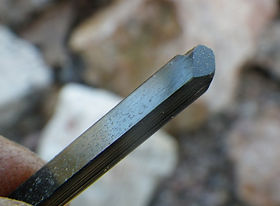
Above right" a thin spine of tourmaline found at the beryl pit.
Above: Peristerite from the Crystal Lake Mine - near Noggie's creek, it burrows into a pegmatite.
Right: The huge inner chamber of the once - accessible Macdonalds mine


Above: Old mines are dangerous places.
Right: The Halo Mine in winter. To me it looked like a "Death Trap" and I chose to not follow my curiosity. You know the saying about the cat.


The Wallingford - Back mine bores into a massive pegmatite intrusion and was mined for it's quartz and feldspar. After its closure in the 1970s, the mine flooded, and the remaining quartz in the area is responsible for the striking turquoise blue color of the water that now fills the lower parts of the mine. In the winter locals play hockey on the underground frozen lake - it's magical. The exposed rock pillars create a cathedral-like cavern that has become a notable, though often illicit, natural attraction.