

Canada's Gold Capital:
-
Unlike some regions where gold is concentrated in predictable river bends, Ontario’s gold was scattered by retreating glaciers, creating "placer" gold deposits in unusual places like swamps, farmland, and glacial till.
-
While large nuggets are rare, many rivers in Northern Ontario, such as those near Timmins, Red Lake, and Wawa, contain "flour" gold or small flakes that are accessible for recreational panning.
-
Ontario produces 43% of Canada's gold so it is a great place for panning if you go to the right areas, but where are the right areas?


Table of Contents
• Why Ontario Is one of the best Regions for Gold
• The Geological Origins of Gold in Ontario’s Canadian Shield
• A Brief History of Gold Mining in Ontario’s Historic Mining Districts
• Types of Gold Prospecting in Ontario: Lode, Placer and Glacial Gold
• Rockhounding & Gold Panning in Ontario’s Placer Environments
• How heavy minerals and crystals move in Ontario's Streams and Soils
• Historic Central Ontario Gold Mines: Golden Fleece, Ore Chimney and More
• Other Central Ontario Gold mines and Mineral showings
• Geological Linking of Madoc and Marmora in the Hastings Gold Belt
• Dangerous working Conditions
• Gold Geology in Southern Ontario
• Estimated recoverable gold at Selected Mines in Central Ontario
• Legal Requirements for Gold Prospecting in Ontario (Mining act and MLAS)
• Safety, ethics and Responsible Rockhounding at Ontario Mine sites
• Abandoned mine Hazards in Ontario: Environmental and Physical Risks
• Gold, Crystals and Ontario's Living Mine Legacy
• FAQ. Gold panning in Ontario: Dark Star Crystal Mines Guide
Gold Prospecting in Ontario: A Complete Guide for Rockhounds & Dark Star Crystal Mines
Ontario is one of Canada’s most important regions for gold prospecting and rockhounding. Understanding where and how gold forms is the key to finding meaningful specimens and finding historic mineral localities. From ancient greenstone belts to forgotten Central Ontario mines, this guide explores how gold, and geology intersect across the province. An important point, Mark has recently received a slew of calls from those who are interested in gold prospecting in Ontario. The start of this article before I corrected it gave the impression that Dark Star Crystal Mines was offering gold prospecting opportunities - very sorry; It is not the case, we offer crystal digs on possibly the best crystal digging grounds in Ontario. Book a crystal digging tour with us, not a gold prospecting tour. Our crystal dig opportunities are in vein dykes in the Bear Lake area - it's a famous spot and museums across the world have crystals from this area.
Why Ontario Is One of the Best Regions for Gold Prospecting & Rockhounding
Ontario is especially good for gold prospecting in Ontario because the province sits on some of the oldest and most mineral-rich bedrock on Earth, where gold-bearing quartz veins and iron-rich greenstone belts have been eroded for billions of years into today’s streams and gravels. This makes gold panning in Ontario highly rewarding, particularly in areas near historic Ontario gold mines, where glaciers and water have redistributed fine and coarse gold into creeks, rivers, and tailings.
Combined with a strong culture of Ontario rockhounding, prospectors benefit from both geological diversity and practical access—many promising zones can be reached along old mine roads, logging tracks, and crown land trails. Regions known for Central Ontario gold offer countless small waterways and exposed outcrops where placer and lode gold still occur, making exploration both exciting and achievable for hobbyists and serious prospectors alike. At Dark Star Crystal Mines, this unique mix of gold-rich rock, historic workings, and accessible terrain is exactly what draws modern explorers back into the field year after year. Rockhounding in the Bancroft area is alive and well with Dark star.
The Geological Origins of Gold in Ontario’s Canadian Shield
Most of Ontario lies on the Canadian Shield, an extremely old geological region made up of volcanic and sedimentary rocks that were fractured and mineralized billions of years ago. gold is especially abundant around Kirkland Lake, Red Lake and Pickle Lake, which sits on rich gold-bearing faults, with historic sites like the "Mile of Gold". These fractures became pathways for gold-bearing fluids, depositing gold in:
• Quartz veins
• Shear zones and faults
• Altered volcanic and sedimentary rocks
• Greenstone belts like the Abitibi (so named for the
greenish color of the metamorphosed basalts).
In Timmins there is the Kidd Creek gold and copper-zinc deposit that formed by super heated water with dissolved metals passing through basalts on the ocean floor. Billions of years later we find those same rocks entrapped within the Canadian Shield and harvest valuable materials from them. (Eyles)
Gold in Ontario is commonly associated with pyrite, arsenopyrite, chalcopyrite, and iron-stained quartz, all important visual indicators for prospectors and rockhounds in the field.
A Brief History of Gold Mining in Ontario’s Historic Mining Districts
Ontario’s gold legacy stretches back over 150 years and includes both famous world-class mines and forgotten Central Ontario showings that are now important to mineral collectors and hobby prospectors.
Gold Prospecting in Ontario came front and center with the Central Ontario gold strike just north of Madoc. It was Ontario’s first gold mine in the town of Eldorado (Richardson Mine 1867). That discovery triggered early exploration across Central Ontario, including Bancroft, Kingston, and surrounding townships. Later, major finds in Timmins, Kirkland Lake, Red Lake, and Larder Lake made Ontario one of the world’s great gold-producing regions.
The peak period of activity and production occurred between 1895 and 1908, with 12 properties operating. Interest revived in the mid-1930s when Cominco Limited conducted extensive underground work at the Cordova and Addington mines, along with surface exploration on nearby properties. Production ceased again in 1939, but the surge in gold prices in the late 1970s renewed interest in these historic sites.
Many early operations were small and inefficient. As a result, they left behind tailings piles, trenches, and shallow shafts that still contain mineralized material — valuable today for education, specimen collecting, and Ontario rockhounding where legal. Today old Ontario gold mines are hot spots for the more adventurous Ontario rockhounds. Creeks in this area are known for small gold deposits.
Types of Gold Prospecting in Ontario: Lode, Placer & Glacial Gold
Understanding whether you are looking for lode gold or secondary placer gold helps focus your tools, research, and expectations, keeping in mind that Gold panning in Ontario requires different tools from regular Ontario rockhounding. Searching for crystals in Ontario vein dykes requires prybars and hammers, panning is more around working with gravel and loose dirt.
Hard-Rock (Lode) Gold Prospecting
Most Ontario gold occurs in solid rock, not loose river gravels. Prospectors look for:
• Quartz veins in outcrop
• Iron-stained or rusty zones (gossans)
• Alteration minerals like chlorite and sericite
• Float quartz on hillsides and road cuts
Samples are crushed and panned or sent for assay to determine gold content.
Placer & Glacial Gold
Ontario does not have major placer fields like the Yukon, but glaciers redistributed fine gold into:
• Stream gravels
• Glacial till
• Heavy-mineral concentrates
Panning below known gold showings or near historic mines can sometimes reveal fine “flour gold.”
Rockhounding & Gold Panning in Ontario’s Placer Environments
Gold prospecting in Ontario streams, also known as "Placer prospecting" depends on understanding how heavy minerals move through water and sediment. Stream beds contain material eroded from upstream rock units, including veins, dikes, and pegmatites. Tougher and denser minerals survive transport and concentrate where water slows.
A prime location for gem panning and gold panning in Ontario would be below the Egan chutes on the York River. The river runs over rock that's known to have produced sapphire crystals and other heavy minerals and then it flows over the Egan Chutes cataract to a wide and shallow gravel plain. Sadly this spot is in a Provincial park. Gold prospecting in Ontario needs to be on Crown Land.
How Heavy Minerals & Crystals Move in Ontario’s Streams and Soils
-
Work upstream until you stop finding the crystal or mineral that you’re looking for. Once the mineral stops appearing, backtrack to locate where the material is being eroded from.
-
Gold and heavy crystals tends to concentrate on: Bedrock surfaces beneath the water, in cracks and crevices within the bedrock,behind obstacles (large boulders, sweeper logs, roots), deep pools after waterfalls, and where the water runs over natural riffles in the bottom of the river. Heavy minerals settle where the current slows
-
Fine gold travels farther from where it was eroded than nuggets.
-
Gravels accumulate where the current slows, such as inside the bends of a stream and downstream of rapids where the water flows
-
Glacial features such as: eskers, morains and drumlins re-concentrate indicator minerals. The minerals in those features represent the directions of past ice flows (The Laurentian ice sheet to be exact).
-
Certain glacial features such as eskers sort ancient sediments in such a way that the heavier minerals will be down along the bottom edge of the feature, this includes gold and heavy gemstones.
-
Hard, tough minerals resist stream transport damage, for example: Jade, nephrite, diamond and sapphire and so their presence as a pristine crystal or block of mineral with unworn edges is no indication of distance traveled.
-
Finding a quartz pebble with a gold vein would indicate close proximity to the source as quartz wears quickly in a river so it probably did not travel far. If the quartz had traveled far it would only be the gold that was left.
-
Terraces along valley edges may preserve ancient gravel bars from past river levels.
-
The strongest concentrations of heavy materials occur where gravels touch bedrock.
There is a strong connection between placer behavior and crystal movement in calcium vein dykes. For example, titanite and other heavy crystals slowly sink through soil and deeper into their formative fissures, where natural traps stop their descent — similar to how gold settles in a stream bed, dropping into cracks or being waylaid by rocky obstacles.
Ontario rockhounding requires this knowledge of relative weight in comparison to the suspension medium. Specific gravity is a measure of a substance's weight in comparison to an equal volume of water. So water has a specific gravity of 1 and sandy soil is in the 2.6 range (similar to that of quartz or silica). Gold has an SG of 19.3 so it will over time sink in both mediums. Sapphire has an SG of 4.02 so it will also sink, but not as readily. The lower the SG, the less prone the substance is to concentrating because of its weight.
For Dark Star Crystal Mines, this crossover between placer geology and crystal collecting is central to understanding Ontario’s crystal deposits. Loose crystals of weight collect in rock traps within their formative fissures.
Historic Central Ontario Gold Mines: Golden Fleece, Ore Chimney & More
Central Ontario’s forgotten gold mines are especially important for Dark Star Crystal Mines because they connect mineral collecting, geology, and gold prospecting in one region.
Golden Fleece Mine (Kingston area)
Discovered in the 1860s, the Golden Fleece Mine worked narrow quartz veins with pyrite and arsenopyrite.
Tailings may contain:
• Iron-stained quartz
• Pyrite cubes and gossan
• Altered wall rock
• Rare fine gold locked in quartz
• Calcite and chlorite
Early recovery methods were crude, meaning much mineralized rock was discarded.
Ore Chimney Mine (Frontenac County)
The Ore Chimney Mine followed steep quartz-sulfide structures.
Tailings may include:
• Vein quartz with iron oxides
• Weathered pyrite
• Arsenopyrite remnants
• Chalcopyrite and sphalerite
• Sericite-altered host rock
Gold is usually microscopic and associated with sulfides rather than visible nuggets.
Records indicate around 480 ounces of gold were produced between 1881-1921, with gold found in quartz veins alongside sulfides like pyrite and arsenopyrite.
Other Important Central Ontario Gold Mines & Mineral Showings
These historic locations are important to Ontario rockhounding and prospecting culture and often combine gold with collectible crystal minerals. In some cases it is allowable to visit old mining sites and prospect the tailings for gold and other minerals. More valuable than the gold itself is a visible gold fleck or nugget with quartz, its a collector rarity. Below are listed some of the better known abandoned Gold Mines in Southern Ontario. The north is another matter - pocked with mines all over.
The Hastings Gold Belt is a well-known linear zone of gold mineralization in Hastings County, Ontario, stretching roughly from the Marmora–Madoc area in the east to Bancroft in the north. It is part of the broader Canadian Shield and consists mainly of Huronian-age metasedimentary rocks, including quartzites, greywackes, schists, and minor iron formations, often folded and cut by faults and shear zones.
Gold in this belt is structurally controlled, typically occurring in narrow quartz veins, stringers, or shoots associated with sulfides like pyrite and arsenopyrite. Many of the historical mines—Cordova, MacMillan, Boerth, Bannockburn, Richardson, and El Dorado—follow these same patterns, showing high-grade but erratic mineralization, with strong focusing in fold hinges or shear intersections.
Geological Linking of Madoc and Marmora in the Hastings Gold Belt
The towns of Madoc and Marmora are geologically linked through their position along the southern edge of the Grenville Province. This ancient terrain is composed of highly metamorphosed rocks like gneiss, marble, and amphibolite that were deeply buried and later deformed. That deformation created extensive faulting and shear zones, which are critical because they act as pathways for mineralizing fluids. Across this region, these structures provided the plumbing system that allowed gold-bearing hydrothermal fluids to circulate and deposit gold and as a result there are many smaller gold prospects that tended to yield a modest harvest.
Just south of Marmora there are the caves in surface limestone. A good portion of the Crowe river sinks down through the tunnels - open fractures in some cases, though not linked to the larger geological processes, more a karst process that has moved forward rapidly due to the more acidic water washing off nearby igneous and metamorphic rock.
Shakespeare Twp (Sudbury):
Shakespear Gold Mine: The Shakespear Gold Mine is hosted in northeast-trending, folded Huronian metasediments, primarily schistose Matinenda Formation quartzites with bands of greywacke, which are intruded by Nipissing and Keweenawan diabase dikes. Mineralization occurs as dark quartz stringers parallel to the fold strike, forming a lens in the shaft area, with the zone striking northeast and dipping steeply south. Sulfide minerals—chalcopyrite, pyrrhotite, and arsenopyrite—are present in the veins, along with reported native gold. Historical work from 1903 through 2014 included shaft sinking, adits, dewatering, diamond drilling, bulk sampling, and geophysical surveys, revealing high-grade shoots in the western zone (1.12–1.85 oz Au/ton over ~3.5 ft) and more erratic gold in the eastern zone (0.45–1.43 oz Au/ton over ~0.9–1.2 ft), reflecting a structurally controlled, vein-hosted gold system within folded Huronian strata.
Elzivir Twp.
Barry Occurrence: Lot 5 Con 2, In 1869, native gold was reported and a shallow shaft was sunk
Madoc Twp. It would appear that gold potential in Southern Ontario is greatest in Madoc Twp.
Empire Occurrence: Lot 1 Con. 6, A sample from 1868 was assaying at 19.32 oz/ton
El Dorado Gold Mine: Set off Ontario's first gold rush with the discovery of a cavity lined with sheets of gold and a nugget the size of a butternut.
Bannockburn Mine: A bush road leads west from the town of Bannockburn, the mine is 1/2 a kilometer along there, on the west side of the Moira River. The Bannockburn Gold Mine is a small, structurally controlled gold occurrence within the Hastings Basin of the Grenville Province, where gold is hosted in narrow quartz veins associated with shear zones and sulfide minerals like pyrite and arsenopyrite; while it produced some high-grade material—typically in the range of a few grams up to over 10 g/t—the mineralization was irregular and discontinuous, resulting in limited, intermittent production and leaving it better known as a modest but geologically classic example of vein-type gold rather than a major mining operation.
Tudor Twp.
Shepard Occurrence: Lot 12 Con. 2, The mine tapped into a quartz vein 11 feet wide and 200 feet long, assaying at 5oz/ton
Marmora Twp. Most gold showings here were consistently yielding .3 oz/ton
MacMillan Gold Mine: This was a high-grade, narrow-vein gold deposit, though assays vary by shoot and level. Reported grades generally fall in the range of 0.5 to 2.0 ounces of gold per ton (≈15–60 g/t) in the main quartz veins. Some localized pockets reportedly exceeded these values. Gold occurred primarily in quartz veins hosted in folded meta-sedimentary rocks, with sulfides such as pyrite and arsenopyrite commonly associated, reflecting a classic structurally controlled, vein-type system typical of the Marmora area.
Boerth Gold Mine: A small, structurally controlled gold occurrence in the Hastings gold belt, hosted in Huronian metasedimentary rocks—mainly quartzites, greywackes, and schists—with mineralization concentrated along shear zones and quartz veins. Gold occurs in association with sulfides such as pyrite and arsenopyrite, and historical reports describe narrow, high-grade shoots rather than broad ore zones, similar to nearby Marmora deposits. Gold assayed at .5 - 2 oz/ton.
Gawley #1, Gillen Occurrence and Gladstone Occurrence that between this and the Sovereign Mine are said to have produced 1000 oz.
Belmont Twp.
Cordova Mine: Con 1, Lot 20, situated 2 miles NE of Belmont Lake. Between 1892 and 1940 Cordova produced 23,000 oz of gold. In 1979 further work was done to leach gold from 50,000 tons of tailings, it produced at .12 oz/ton. Toward the end of underground exploration the #3 shaft continued on an incline to 1050 feet in depth with 10543 feet of cross cutting. ore bodies were in shear zones averaging 6 feet in width, the site being at the western margin of a mafic intrusion.
Dangerous working conditions
Conrad Fredrikson, a 42-year-old Norwegian immigrant who came to Canada as a young man, was fatally injured at the Cordova Gold Mine when a falling timber from the 200 foot level broke through a protective bunk at the 500 foot level and struck his leg, almost tearing it off at the knee and severing an artery. Despite prompt medical attention from Dr. D. J. Holdcroft of Havelock, he survived only a short time. Fredrikson, who had lived for several years with E. J. Martin of Actinolite and was well liked by both his employers and fellow workers, was laid to rest following a funeral service at Martin’s home, with burial in the Marmora Protestant Cemetery.
Gold Geology in Southern Ontario
Gold geology in Belmont Township is characterized by structurally controlled, higher-grade mineralization within sheared meta-sedimentary rocks of the Hastings Basin, where quartz veins with pyrite and arsenopyrite are tightly focused along deformation zones, making it the core setting of the Cordova Gold Mine; in contrast, Marmora Township hosts more variable geology with a mix of meta-sediments, carbonates, and iron-rich units, where gold tends to be more dispersed, lower grade, and associated with broader alteration systems rather than well-defined high-grade veins, reflecting weaker structural focusing despite being part of the same regional system within the Grenville Province.
The strongest connection between Madoc and Marmora lies in their shared structural framework, where northeast–southwest trending shear zones host quartz veins and sulphide minerals such as pyrite and arsenopyrite. These are typical features of orogenic gold systems, similar in origin to deposits in the Abitibi Greenstone Belt, though more heavily altered by later metamorphism. Marmora adds another important factor: its abundance of marble and iron-rich rocks, which can chemically interact with mineralizing fluids and help precipitate gold, creating localized zones of enrichment.
These old Ontario Gold Mines reflect the close link between gold prospecting and crystal collecting in Ontario, one might be incidental to the other. Remember it's the tailings that have the left over gold and don't go in the mines themselves. Between 2001 and 2017 there were 278 abandoned mine fatalities in the US. Most were male, most were from drowning or falling and most were in Ohio and Pennsylvania. The number may well be higher as some people just disappear when they fall down a shaft in the forest.
You might have read the story of the missing Chinese family from Cobalt Ontario. They disappeared without a trace one night leaving the laundry running. Some think they ended up at the bottom of a mine shaft. Read the Cobalt article for the full story. Whether they fell or were pushed is something we'll never know.
Ontario statistics for mine accidents and disappearances are insignificant, but don't be one of the few.
Estimated recoverable gold at Selected Mines in Central Ontario
Admittedly most abandoned gold mines are on patent claims in Central Ontario, but an assessment by Kingston and Papertzian indicates that there is still a reasonable amount that exists in situ, in the tailings and dumps and in stockpiles, sometimes on the surface and sometimes underground. The mine with the top potential - the Addington Mine (aka. Golden Fleece) was estimated by them to have 4 million tons at an average of .13 oz/ton, this was said to be over a strike of 3500 feet and to a depth of 700 feet. The ore zones are apparently 20 feet wide. So there is the potential of being able to recover 52,000 ounces from here. Other mines with reasonable amounts of reserve are Cordova and ore chimney.
Kingston and Papertzian suggest that a mill built on the property of the Addington Mine could service Boerth, Ore Chimney, Star of the East, and other prospects in the area. Cordova with 12,000 oz and Deloro, still thought to have 1500 oz in reserve are a fair distance away and not as easily processed. nevertheless, my point is, at an industrial level some kind of outside the box thinking could make gold recovery in central Ontario still profitable - private property issues not withstanding.
Legal Requirements for Gold Prospecting in Ontario (Mining Act & MLAS)
Understanding Ontario’s Mining Act is essential before doing any serious gold exploration.
✔ Recreational panning in Ontario on Crown land is usually allowed
✔ A Prospector’s License is required to stake claims
✔ Claims must be registered in MLAS
✔ No prospecting in parks or reserves
✔ No work on private land without permission
Stay out of abandoned mines they are extremely dangerous.
Safety, Ethics & Responsible Rockhounding at Ontario Mine Sites
Old mine sites are dangerous and historic — they should be respected and preserved. stay well back from the shafts as their edges are often crumbling and unstable.
• Never enter old shafts or adits
• Collect only loose surface material
• Fill small holes
• Leave sites intact
• Pack out everything you bring in
Abandoned Mine Hazards in Ontario: Environmental & Physical Risks
Since 1991, Ontario’s mine-closure regulations have become far more stringent, requiring every new mine to submit detailed closure plans that prioritize environmental protection. However, the province is still dealing with the legacy of thousands of abandoned mines, including historic pegmatite mines and Central Ontario gold operations that were opened and left behind long before modern standards existed. Radioactives, mica, apatite and feldspar comprised a thriving industry in the pegmatites.
In the past, mines were often developed quickly and then discarded just as easily. This worked well for gold prospecting in Ontario and Ontario rockhounding. The tailings were left with easy access and the mines were usually un-fenced. Abandoned infrastructure was around Ontario gold mines. Once the ore ran out or funding dried up, infrastructure was simply left in place. As environmental science advanced, it became clear that these abandoned mine sites were quietly degrading the land and water around them—creating a cleanup challenge that is both technically complex and extremely costly.
Gold mines are especially problematic because cyanide was commonly used in ore processing. That cyanide remains trapped in tailings piles and continues to leach into the ground in unpredictable ways. In addition, arsenic contamination from historic mining has caused long-term damage in places like Sudbury, where it seeps into Long Lake and has forced residents to rely on bottled water. Beyond pollution, abandoned mines also pose serious physical dangers, as many are little more than unguarded shafts and collapsing openings hidden in the bush.
For collectors and prospectors working with Dark Star Crystal Mines, understanding the risks and history of abandoned eastern Ontario pegmatite and gold mines is essential for both responsible exploration and long-term land stewardship.
Conclusion: Gold, Crystals & Ontario’s Living Mining Legacy
Ontario remains one of the best regions in Canada for combining gold prospecting with crystal collecting. From famous northern camps to forgotten Central Ontario showings near Bancroft and Kingston, the land still holds geological stories waiting to be understood. As I mention in my book, Rockhound: an Experience of the North, rockhounding in Ontario is as much about the journey as it is the destination. There is so much in the way of fascinating history to explore at these old mining sites.
Can you imagine the scene with the angry miners at Eldorado and their attempts to pull the housing off the top of the only producing mine?
And of course, there’s the reason for their being there, the gold! You stand to find some if you persist, search the tailings, the nearby streams and rock.
For Dark Star Crystal Mines, gold is not just about metal — it’s about minerals, history, and the pursuit of discovery.
FAQ: Gold Panning in Ontario – Dark Star Crystal Mines Guide
1. Is gold panning legal in Ontario for hobbyists?
Yes! Recreational gold panning in Ontario is legal on Crown land using just a pan, shovel, and classifier. You cannot pan on private property, active mining claims, provincial parks, or Indigenous lands without permission. Using sluice boxes or other mechanical equipment may require a registered mining claim. Dark Star Crystal Mines encourages hobbyists to follow provincial rules for safe and legal prospecting.
2. Where are the best gold panning spots in Ontario?
Top locations for gold panning in Ontario include Northern Ontario areas like Timmins, Kirkland Lake, Porcupine, and the Lake of the Woods region. Rivers, streams, and gravel deposits from glacial activity are prime targets. On an old mine site, down hill of where the stamp mill was is often productive. When you visit Ontario gold mines you need to think outside the box, where there was spillage, where rock was stored or cobbed by crews who were trying to separate "lode" from country rock. Did the mines close and leave unprocessed material for the future benefit of Ontario rockhounding?
Always check the Ontario Mining Lands Administration System (MLAS) before visiting to confirm areas are open for recreational gold prospecting in Ontario. On our website Dark Star Crystal Mines often highlights these historic gold-bearing regions for collectors and hobbyists.
3. How do I know if land is open for gold panning?
Verify land ownership before prospecting. Most land in Ontario is private or under a mining claim. Use the MLAS Map Viewer to check for active claims. Crown land that is not claimed is usually open to public gold panning and mineral prospecting. Following these steps ensures hobbyists remain compliant while exploring Ontario’s rich mineral areas.
4. What tools and equipment do I need to start gold panning?
Beginners can start with basic gold panning gear:
-
Gold Pan: 14–16 inches, blue or green for contrast.
-
Classifier: Screen to remove large rocks (¼ or ½ inch).
-
Shovel or Trowel: For digging gravel or crevices.
-
Snuffer Bottle: To collect fine gold flakes.
-
Vials: For safely storing gold finds.
At Dark Star Crystal Mines, we recommend keeping your setup simple and portable to maximize your time prospecting.
5. Do I need to report gold found while panning?
Small finds from recreational panning are usually yours to keep. However, all minerals belong to the Crown, and hobbyists cannot sell their discoveries. Significant gold finds may need to be reported as income. Following Ontario’s rules keeps your hobby legal and stress-free. Gold prospecting in Ontario comes with its regulations. Follow them and stay out of trouble.
Author Bio
Michael Gordon is a Canadian rockhound, geographer, and author with over 30 years of experience studying Ontario pegmatites vein dykes and gold deposits, amongst other geological structures. He holds a Diploma in Gemology and is the author of the well known Rockhound Series.
Work Cited:
Eyles, Nick. Ontario Rocks: Three Billion Years of Environmental Change. Markham, ON: Fitzhenry & Whiteside, 2002.
Bell, D.R. (1988). 1988 Surface Exploration Program, Bannockburn Project, Madoc, Ontario. Micham Exploration Inc., Assessment Report C-31C12NEMI31 6 3.5365 M ADOC 010, October 1988. David R. Bell Geological Services Inc., St. Catharines, Ontario.
Hewitt, D.F. (1967). Geology of Gold Deposits in Ontario. Ontario Department of Mines, Geological Report.
Hewitt, D.F. (1968). Lode Gold Deposits of Ontario. Ontario Department of Mines, Geological Survey Report.
Ontario Geological Survey (1971). Geology and Mineral Deposits of Ontario. Ontario Department of Mines and Northern Affairs.
Gordon, J. B., H. L. Lovell, Jan de Grijs, and R. F. Davie. 1979. Gold Deposits of Ontario, Part 2: Part of District of Cochrane, Districts of Muskoka, Nipissing, Parry Sound, Sudbury, Timiskaming, and Counties of Southern Ontario. Mineral Deposits Circular 18. Ontario Geological Survey.
Kingston, P. W. 5 and Papertzian, V. C. 1982: Gold Development Potential in Eastern Ontario; Ontario Geological Survey, Open File Report 5379 , 3.4 p. , l fig. , 2 tables.
Last updated 2026


Far Right: This is the cavity in which they found the gold at the Richardson Mine in Eldorado. It was supposedly the only gold found in the entire gold rush
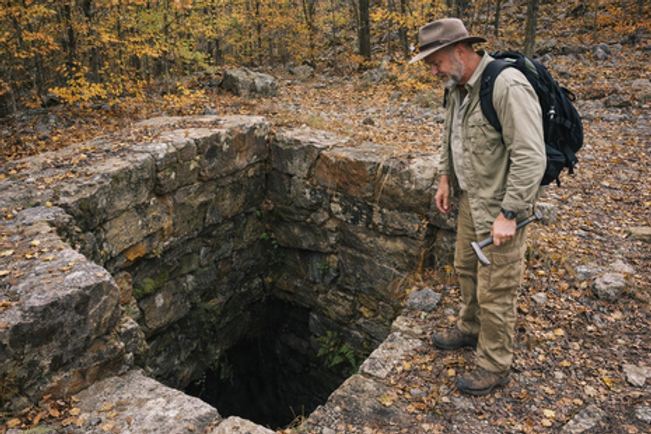
Right: Grant Rose sits atop one of the shafts on the Richardson property. The whole area is pocked by holes like this.

Right - quartz at the Ore Chimney Mine is a good indicator of the gold that was found there

Left: Success! A little tiny flake of gold. It's about as big as it ever seems to get in Ontario's placer deposits.


Right: Gravel banks accumulate on the inside curve of a swiftly flowing river.
Left: Heavier minerals and crystals can be separated by panning


Above and Right: These old relics at the Ore Chimney Mine.


Right: Holt Complex, Mathieson, Ontario.
Deep underground hard rock mining is conducted by companies such as Agnico Gold, Barrick Gold, Equinox Gold and Alamos gold.
In 2025 Canada ranked number 4 in gold production behind China, Russia and Australia.

Left: They call this "VG" - visible gold
Right: The Ontario government maintains the Abandoned Mines Information System (AMIS), a public database for known abandoned mines and hazards on Crown and private lands. These mines to the right are an example of such features and over 4600 are known to exist in Ontario

The old Shakespeare Mine about 50 kilometers west of Sudbury initially had a shaft sunk to 375 feet in 1903 along with 2600 feet of drifting. The mine flooded but was de-watered in 1945 and 9 tons of ore was cobbed yielding 22 - 30 oz/ton. As gold prices rose, so to did the degree to which low grade ore could be mined. Now days (2026) low grade ore is considered .015 oz/ton and high grade is .3 oz/ton. As an Ontario rockhound do the math and think creatively. It's said that the gold is found in quartzite near the grey-wack. A 1973 assessment of the area indicated that there were still unexplored faults near the mine, potentially yielding.

Above: How the Cordova Mine appeared in the early 1900s

Below: The old stamp Mill at Eldorado (north of Madoc) before it crumbled to about half the height and now its obscured by trees.


Left: Madoc as it appears today.
Right: Fluorite, what Madoc is known for to Ontario rockhounds today.

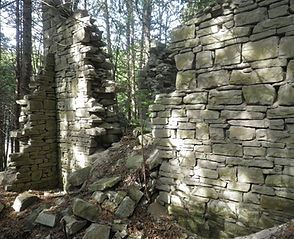
Above: The stamp mill as it is today in Eldorado 2024
Far Right: Just off John Street - not sure if this was connected to the copper mine or the gold mine.


Far Right: You can imagine how those old mining camps looked - something like this I'd guess, but way messier and without a public sewer system.
Fires and outbreaks of typhoid were common.
Right: Shafts up which the gold came, holes down which the miners went. Be careful around old mines, sometimes these features are just lightly covered over with rotting wood from 100 years back.