


I take a tour with Grant ...
Suddenly Grant hit the ground "Oh jeeze: a partridge,; it's got chicks with it."
Like a giant spider with long wiry arms and legs he skittered through the underbrush. "there, there" he shouted. I couldn't see a thing. "God I wish I had my pellet gun." He turned to me, eyes afire and breathing heavily in excitement. "Best thing about partridge is you clean em real easy. Stand on their wings and pull their legs. Splat! you got dinner." Whoooeee!
Grant is a local, living in the dying town of Eldorado - enjoying every minute of it - powered by weed and moonshine.


There's Still Gold in Eldorado: Ontario Gold Rush History and the Hidden Wealth Beneath the Canadian Shield
Ontario’s first gold rush left behind abandoned shafts, forgotten fissures, and lingering questions. But in Eldorado, Ontario — just south of Madoc — there’s compelling evidence that significant gold still remains beneath the surface. At Dark Star Crystal Mines, we explore the geological processes, historical discoveries, and mineralogical secrets that suggest Eldorado gold is far from exhausted.
Table of Contents
• A Forgotten Eldorado: Ontario’s First Gold Rush
• The Myth of Lost Gold: From King Solomon to Eldorado Ontario
• All the Gold Ever Mined Can Fit in a 20-Meter Cube
• How Is Gold Found? Geological Processes Behind Gold Deposits
• Mechanism #1: Placer Gold and the Role of Density
• The Ice Age’s Role in Redistributing Ontario Gold
• Mechanism #2: Hydrothermal Gold Deposits and Fissure Systems
• Gold in the Canadian Shield and Ontario’s Greenstone Belts
• Gold in Madoc: The 1866 Discovery That Sparked Ontario’s Gold Rush
• Refractory Gold and Arsenopyrite: Hidden Gold in Ontario
• The Role of Arsenic in Gold Concentration
• Modern Exploration in Eldorado: 145,000 Ounces Still Buried
• The Richardson Legacy and the Continuing Story of Eldorado Gold
• Frequently Asked Questions About Prospecting for Gold in Ontario
A Forgotten Eldorado: Ontario’s First Gold Rush
It's a sweaty, buggy day. Grant leads the way, stooping over as we fight our way beneath the bush. It's a horrible tangled mess that's wound with rusting barbed wire and pits lurking within the densest thickets.
Grant curses to himself, dentures popping out as he swigs from a Coke bottle that he carries. He's still recovering he informs me, from a moonshine binge the night before, that and his bush-grown weed which must have been the final straw. We speak about plans to extract his car — it's in a ditch nearby. I take a break on a dry-stacked wall, clearly infrastructure from the gold rush — Ontario's first, at a time when a great transient population was looking for adventure.
This abandoned Eldorado site feels lost to time, yet it represents a pivotal moment in Ontario gold rush history. Like many early gold discoveries across the Canadian Shield, excitement surged quickly — but understanding lagged behind.
The Myth of Lost Gold: From King Solomon to Eldorado Ontario
Imagine this: a lost mine on the Arabian peninsula, hidden somewhere between Medina and Mecca, nestled along ancient trade routes. There, amongst the shallow pits, lies what’s believed to be the legendary Orphir Mine of King Solomon. To me, this abandoned Eldorado site is reminiscent of that mythic place. It seems to have slipped from public memory and like Orphir, there's still much to be gathered from Eldorado.
Recent tests show that there are still vast amounts of gold scattered amongst the debris of the Orphir Mine. So, how did we lose track of where the gold came from? It’s still there—waiting for extraction. Records indicate that slaves at the Orphir Mine used cobbles to crush gold-bearing quartz, carefully picking out the tiny flakes by hand. What human effort was required to fill King Solomon’s coffers? What hopes were crushed and fortunes wasted in both these now abandoned places?
The thought of buried wealth plucks a sentiment in those of us who are treasure hunters, addicted to the adrenaline of possibility. Prospecting for gold in Ontario brings to mind all kinds of fantasy of wealth.
We can’t ignore the pull of gold and you begin looking with a pan that you’d ordered off Amazon, it has custom designed ridges and great reviews. Huge excitement heralds your first outing, your wife waves you off at the door, but you come home in a cloud of disappointment. You’re reminded that if gold was that easy to find, the river banks would be crowded with others like yourself and their mail-ordered equipment. If you’d been thinking straight you’d have waited till reality set in and at the end of the day scooped up equipment abandoned in disappointment.
All the Gold Ever Mined Can Fit in a 20-Meter Cube
Now, think about this for a moment: all the gold ever mined in human history could fit inside a 20 meter square cube. Every hurricane-blown Spanish galleon that floundered on a Caribbean reef, everything in Fort Knox, every golden bangle in India combined could be melted into that single gleaming box. It’s mind-blowing. So how do we find this precious metal and add to the sum total?
How Is Gold Found? Geological Processes Behind Gold Deposits
Gold doesn’t just appear — it is concentrated through the complex geological processes of erosion and transportation.
Initially, surface gold is spewed from the earth’s interior within mid-oceanic trenches. Molten magma wells up with trace gold. Gold atoms are thought to have formed through “rapid neutron capture” during neutron star collisions — cosmic events that predate Earth itself.
Deep in oceanic trenches from whence the crust of the earth is born, cooled rock moves conveyor belt-like with its trace gold in either direction. Gold is a rare element found at about 4 parts per billion in forming crustal rocks, and then at subduction zones it is returned to the mantle, blown onto the surface by volcanic action or deposited by hydrothermal action.
The key to discovering a profitable deposit lies in how gold is brought together. Without the nimble fingers of Solomon’s gold-picking slaves, only time and natural processes concentrate gold. But within those natural processes lies a secret: gold can be in plain sight yet remain unseen. Many rich deposits in Ontario have been overlooked for this reason.
Mechanism #1: Placer Gold and the Role of Density
Relative weight is the first mechanism of gold concentration. Gold is incredibly heavy — far denser than most other minerals. When it erodes from rock, it is transported by wind and water, accumulating where natural obstacles slow its movement.
Imagine a river with an inner bend or deep fissure — these are prime locations for placer gold deposits. Gold’s density is about 20 times that of water, so when water slows, gold sinks and concentrates with other heavy minerals, while lighter quartz and sand are carried away.
Considering how little success many gold panners have had in Ontario, you’d think there’s no gold to be found. But that isn’t the case. In 2022, 3.9 million troy ounces of gold were extracted from Ontario geology — valued at approximately $5.4 billion. There’s enormous gold potential if you are rockhounding in Ontario or near Bancroft — literally.
The Ice Age’s Role in Redistributing Ontario Gold
So again you ask, why is my pan empty?
Around 14,000 years ago, as the last Ice Age ended, glaciers scraped back across Ontario. Gold that had been concentrated by ancient rivers was carried southward by glacial ice and redeposited in drumlins, moraines, and eskers — even as far south as the Mississippi River basin.
This glacial redistribution disrupted millions of years of natural concentration. What resulted were gold-bearing glacial features that are often uneconomical for mining but still geologically significant.
Mechanism #2: Hydrothermal Gold Deposits and Fissure Systems
The second mechanism of gold concentration involves hydrothermal fluids — super-heated waters driven by nearby magma bodies known as batholiths or plutons.
These hydrothermal fluids, often rich in carbonates from limestone or dolostone, travel through fissures formed by tectonic activity. As pressure and temperature decrease, gold precipitates out of solution, forming vein and lode deposits.
One famous example is James Marshall's discovery in California’s Sierra Nevadas, a hydrothermal gold deposit that fueled the 1849 gold rush. Known as “free milling,” the gold was often visible to the naked eye so miners initially retrieved gold flakes and nuggets by hand or through simple panning in rivers and streams.
As the easily accessible gold became scarce, prospectors advanced to more efficient placer mining methods, employing cradles, rockers, and long-toms to process larger volumes of gravel. Some miners practiced “coyoteing,” digging deep shafts and tunnels to reach rich pay dirt. The most ambitious operations involved diverting entire rivers into sluices, a technique first pioneered by Chilean and Mexican miners, who brought expertise from long mining traditions and introduced tools like the batea gold pan and the trapiche, or Chilean mill. These collaborative methods contributed to the extraction of an estimated 12 million ounces of gold in just the first five years of the Gold Rush.
Gold in the Canadian Shield and Ontario’s Greenstone Belts
The western edge of the Canadian Shield — home to Ontario’s richest gold mining districts — is riven with fissures and fault lines known locally as “breaks.” Offshoots are called splay faults.
Geologically, these regions are part of greenstone belts, and enormous quantities of gold have been mined from faults on either side of these belts. Though gold is most sought after, hydrothermal systems also concentrate other minerals.
Just south of Eldorado lies Madoc, where a major fracture runs beneath Stocco Lake and through town. This tectonic feature is part of the Ottawa–Bonnechere Graben. In Madoc, hydrothermal fluids concentrated fluorite rather than gold. The mechanism is the same — the host rock determines the mineral.
Gold in Madoc: The 1866 Discovery That Sparked Ontario’s Gold Rush
In 1866, Marcus Powell was digging for copper on the Richardson farm just north of Madoc. Instead, the ground collapsed beneath him, revealing a hidden cavern lined with sheets of gold. A nugget the size of a butternut sat before him.
News spread rapidly, igniting Ontario’s first gold rush. Prostitutes, prospectors, and scammers descended on Eldorado. Yet despite the frenzy, not another ounce of gold was officially recovered.
Cariboo Cameron led a mob demanding proof. The Mounties negotiated a compromise — Cameron confirmed the gold’s existence. But where was the rest?
How could gold accumulate in one cavity and nowhere else? The answer likely lies in hydrothermal fissures and mineral chemistry — particularly refractory gold.
Refractory Gold and Arsenopyrite: Hidden Gold in Ontario
Sometimes gold isn’t visible. It can be locked inside minerals such as arsenopyrite. This is known as refractory gold.
When gold is chemically bound within arsenopyrite’s crystal lattice, it cannot be seen or easily extracted. However, when arsenopyrite weathers or undergoes brittle deformation, gold may be released.
Iron and copper pyrites are common in nearby Eldorado shafts, alongside arsenopyrite. Several failed gold mines within kilometers extracted only free-milling gold. Yet arsenopyrite crystals remain piled near shafts — hinting that significant refractory gold may still exist below.
Kim Woodward, former owner of the Eldorado Mine property, stands before a mustard-colored mineralized layer above the fissure Marcus Powell fell into:
"See here is his blast hole and down there is where he fell. There's 37 different types of mineral in this layer. It came from way down deep and is unusual as most other rock layers around here are horizontal. Amongst other minerals there are radioactives, silver, copper and rare earths."
The Role of Arsenic in Gold Concentration
Arsenic acts like a sponge for gold. When gold bonds with arsenic, it forms stable chemical structures that can concentrate gold atoms up to a million times beyond natural background levels.
This process renders gold invisible — yet highly concentrated. As arsenopyrite breaks down, gold may be liberated.
Understanding refractory gold and arsenic chemistry is key to unlocking overlooked gold deposits in Ontario.
Ontario Pegmatites and skarns in Gold Deposition
Ontario pegmatites and Ontario skarns are both genetically linked to the deep magmatic and hydrothermal systems that also form many of the province’s gold deposits. Pegmatites represent the late-stage, volatile-rich fluids of crystallizing granitic intrusions — the same intrusive events that can drive hydrothermal circulation along faults and shear zones, depositing gold in quartz veins within greenstone belts such as those of the Abitibi.
Skarns, on the other hand, form where these intrusive magmas react with carbonate-rich country rock, producing calc-silicate mineral assemblages and often concentrating metals, including gold, copper, and iron. In many Ontario districts, the presence of pegmatites or skarn alteration halos signals intrusive activity and fluid movement — two critical ingredients for gold mineralization. Together, they reflect the broader tectonic and igneous processes that mobilized, transported, and ultimately concentrated gold throughout the Canadian Shield.
Modern Exploration in Eldorado: 145,000 Ounces Still Buried
A recent geological survey north of the Eldorado property suggests over 145,000 ounces of gold remain beneath the surface. Much of it is refractory, associated with arsenic-bearing minerals.
Modern extraction methods are capable of processing refractory gold. What was once overlooked due to limited knowledge may now represent significant untapped potential.
The Richardson Legacy and the Continuing Story of Eldorado Gold
The Eldorado gold discovery is not just historical. John Richardson minted gold rings from Marcus Powell’s find and gifted them to his children. Today, six descendants still wear those rings — tangible reminders of Ontario’s first gold rush.
The story of Eldorado is unfinished. The answers may lie within arsenopyrite lattices and a fissure extending beneath the original mine — deeper than early miners ever reached.
At Dark Star Crystal Mines, we continue to explore the geological truths behind Ontario’s mineral wealth — because in Eldorado, there’s still gold waiting.
Frequently Asked Questions About Prospecting for Gold in Ontario
1. Where is the best place to prospect for gold in Ontario?
The best areas for prospecting for gold in Ontario are within the Canadian Shield, particularly in greenstone belts around Timmins, Red Lake, Kirkland Lake, and areas near Madoc and Eldorado. Rivers, creeks, and exposed bedrock near historic gold mines are prime locations. Researching old mine records, geological maps, and mineral occurrences can significantly increase your success.
2. Do I need a license to pan for gold in Ontario?
Yes. In Ontario, recreational gold prospecting on Crown land typically requires a prospector’s licence issued by the Ontario government. You must also ensure the land is not already claimed. Always check land status maps through Ontario’s mining lands administration system before beginning any gold prospecting activity.
3. Why is it so hard to find placer gold in Ontario rivers?
Ontario’s placer gold deposits were heavily impacted by glaciation during the last Ice Age. Glaciers redistributed previously concentrated gold, spreading it into drumlins, moraines, and eskers. This means gold is present, but often scattered and less concentrated than in non-glaciated regions like British Columbia or California.
4. What is refractory gold, and why does it matter in Ontario?
Refractory gold is gold that is chemically locked inside minerals such as arsenopyrite. In many Ontario gold deposits — especially within hydrothermal vein systems — gold is not visible to the naked eye. Instead, it is trapped within sulfide minerals and requires specialized processing methods for extraction. Understanding refractory gold is key to recognizing overlooked deposits.
5. What are the best gold panning rivers in Ontario?
-
Madawaska – Bancroft area
-
Abatibi – Northern Ontario
-
Black River – Cochrane
-
Mattagami – Timmins
-
Spanish River – Sudbury
Author Bio
Michael Gordon has been rockhounding and studying Ontario pegmatites for over 30 years, he has a degree in geography and a Diploma in gemology and is author of the Rockhound Series which can be purchased on the Lulu website.
Last updated 2026


Above: A gold panner does his thing in the swamp beside the now defunct Richardson Road. In the trees behind there is the stamp mill and the rumour that there's gold aplendy that has accumulated in the swamp.


Right: Grant Rose here sits where 21 year old Marcus Powell broke through into the cavern of gold in 1866. Though about 4000 people flooded the property, digging pits all over - there was only disappointment. The Richardson mine was the only place that had gold.
John “Cariboo” Cameron, a veteran of previous rushes in British Columbia and California, took it upon himself to investigate, heading a march of 150 concerned citizens to the mine’s entrance. Negotiations ensued.
Two professional miners were finally granted access to the cave. Their verdict, as reported by the Belleville Intelligencer on May 2, 1867, was unequivocal: the Richardson mine was of “unparalleled richness.”
Left: One of the old buildings in the now "Ghost town" is cleared of furniture and left to the rats. If you are looking for Grant, he's probably the only resident on John Street. Knock loud as he usually has the stereo cranked. In 1869, shortly after the Richardson Mine was closed, Eldorado was said to have four hotels, a hardware store, grocery stores, a doctor and a lawyer Within 3 years the hotels were gone, and only two taverns remained to supply booze to travelers heading north.
Some old Ontario gold mines ....
1. Golden Fleece Mine; In Kaladar Twp. Just west of road 41 at Flinton Corners. Lots of tailings and panning still produces shows of gold.
2. Ore Chimney Mine; Located south of Cloyne, just east of road 41. Lots of old mining equipment and water filled pits.
3. Boerth Mine; Located in Frontenac County, just south of where road 506 crosses under the power lines. Work was mainly by surface stripping.
4. Sophia Mine; Located just north of Flinton Corners and east of road 41. A fair bit of infrastructure is still visible and shaft #1 was assaying at 3.77 oz/ton
5. Star of the East Mine; Located a short distance north of Barrie. Gold was in a quartz vein along with considerable amounts of bismuthinite.
Above: Kim Woodward - one time property owner of the Richardson Property to the left and 2 prospectors.
Current Ontario Gold Production ...
The 4 big Ontario mines are; Red Lake, Musselwhite, Hemlo, Rainy River. In 2023 Ontario produced 2.8 million troy oz. which is 43% of Canada's gold production by value. Comparatively, the Yukon only produced 3% that year.

Above: The old stamp mill just above the swamp.

Below: I descended into one of the shafts on the Richardson Property by way of this TV antenna - this is looking back up to the surface.


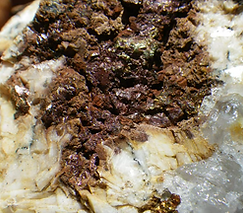
Left: Arsenopyrites on the Richardson property (Eldorado)
Right: The mustard colored layer that runs along the fissure that was said to have yielded the gold. Kim Woodward says its fabulously rich in many valuable elements.

Right: The last ice sheet was up to 4 km (over 2 miles) thick in some places, exerting immense pressure that removed immense volumes of surface material. Generally it is estimated to have been at least 100 meters of overburden across the province.


Left: Deposition by super-heated waters
Above: Bodie - old gold rush ghost town in California


Above: Grant Rose looks down into one of the pits on the Richardson property.


Above: pyrite and arsenopyrites on the Eldorado Property
Right: arsenic has a property of tying up gold so it is not visible to the naked eye.