


Discover how to find crystal-rich vein dykes in Ontario’s pegmatites and fractured bedrock with this practical rockhound’s field guide focused on the Bancroft area—Canada’s most famous region for apatite, titanite, feldspar, amphibole, and calcite crystals. Blending solid geology with real-world prospecting techniques, this guide shows you how to read bedrock structures, follow fissures and shear zones, and recognize the surface clues that lead to productive crystal veins. Built from hands-on experience on active mineral claims, it’s designed for serious collectors who want to locate, identify, and ethically recover high-quality Canadian crystals.


Far Left: Mark reaches deep in a fissure for crystals - we can feel them with our finger tips so we take the soft extraction approach.
Middle: Pyroxene and feldspar from the Hubbart's Hole fissure.
Left.: Probing around for a fissure so as to begin the morning's dig.
Crystal Vein Dykes in the Bancroft Area of Ontario: A Rockhound’s Guide to Finding Crystals
The Bancroft area of Ontario is renowned for crystal-bearing vein dykes that cut through Precambrian bedrock and host quartz, feldspar, calcite, and accessory minerals prized by rockhounds.
The Bancroft area of Ontario is widely recognized as the premier destination for crystal collecting and rockhounding in Canada, and at the heart of this reputation are crystal-bearing vein dykes that cut through Ontario’s ancient Precambrian bedrock. For rockhounds searching for apatite, titanite, feldspar, amphibole, quartz, and rare calcite-hosted crystals, learning how to find and interpret these vein dykes is one of the most reliable paths to success.
Table of Contents
-
Why Bancroft, Ontario Is Canada’s Premier Crystal Collecting Destination
-
The Grenville Province and Its Role in Crystal Formation
-
Why Vein Dykes Are the “Bread and Butter” of Ontario Rockhounding
-
Historical Mineral Production from Ontario’s Crystal Vein Dykes
-
What Crystal Vein Dykes Really Are in Ontario Geology
-
Where to Begin Your Search for Crystal Vein Dykes in Ontario
-
Vein Dykes vs. Igneous Dykes – What’s the Difference?
-
Why Metamorphic Rock Hosts the Best Crystal Vein Dykes
-
The Role of Calcite in Crystal Vein Dyke Formation
-
Notable Crystal Vein Dyke Occurrences in the Bancroft Area
-
Surface Clues That Reveal Mineralized Crystal Vein Dykes
-
Understanding Country Rock and Its Role in Vein Dyke Formation
-
Exploring and Collecting from Crystal-Bearing Fissures
-
How Different Country Rocks Control Mineral Behavior in Vein Dykes
-
Low-Temperature vs. High-Temperature Fissures
-
Frequently Asked Questions About Crystal Vein Dykes in Ontario
-
Final Thoughts for Ontario Rockhounds Exploring Crystal Vein Dykes
Why Bancroft, Ontario Is Canada’s Premier Crystal Collecting Destination
This field guide explains how to find crystal vein dykes in Ontario pegmatites and bedrock, with a strong focus on the Bancroft region of the Ontario Highlands. Unlike simple quartz veins or large pegmatite bodies, vein dykes are narrow, fracture-controlled features formed when super-heated, mineral-rich fluids moved upward through deep fissures connected to underlying plutons. As these fluids cooled, they deposited calcite and a suite of associated crystals, creating some of the most productive and rewarding rockhounding targets in the province.
The Grenville Province and Its Role in Crystal Formation
Ontario is one of the most mineral-rich regions in North America, and nowhere is this more evident than in the Grenville Province between Bancroft and Madoc, where dozens of plutons fueled repeated episodes of mineralization. In this region, vein dykes are especially abundant and often weather in a way that frees crystals from their calcite host, allowing collectors to recover exceptionally well-formed specimens with minimal damage—something rarely possible when chiseling crystals directly from hard bedrock.
Why Vein Dykes Are the “Bread and Butter” of Ontario Rockhounding
For collectors rockhounding in Bancroft, vein dykes are truly the bread and butter of Ontario rockhounding. There are dozens of well-known vein-dyke localities, each famous for specific minerals or crystal habits, and many more that remain poorly documented or completely undiscovered beneath forest soils. The techniques outlined in this guide are drawn from hands-on exploration, geological map analysis, and active work on mineral claims currently controlled by Dark Star Crystal Mines, making this not just a geological overview, but a practical, field-tested guide to finding crystals in Ontario bedrock.
Historical Mineral Production from Ontario’s Crystal Vein Dykes
Ontario’s crystal vein dykes have historically produced quartz, feldspar, mica, and rare mineral specimens that contributed to both small-scale mining and modern mineral collecting.
Ontario’s apatite industry emerged in the mid-19th century, built upon the widespread calcite vein-dykes that thread through the forests of the Grenville Province. These features are abnormally abundant around Bancroft, Ontario and few rockhounds leave the area without an apatite prism as a souvenir.
Vein dykes appear as coarse-grained carbonatite-like dikes, known since early prospecting days, they were prime sources of brilliant apatite crystals that helped launch a short but significant mining boom supplying phosphate to North America and Great Britain. The first commercial shipments came from North Burgess Township in 1860, and production peaked between 1878 and 1892—as small pits such as the Kent Mine and Lacey Mine worked these fissure-fillings for both apatite and, later, phlogopite mica.
Formed 1.3–1 billion years ago during the intense tectonic and metamorphic events that shaped the Grenville, apatite occurs not only in the iconic calcite vein-dykes but also in diopside-rich metamorphic pyroxenites, marbles, and calc-silicate bands. Some say it is the signature gem of the Ottawa Valley.
Today, these same geological features that once sustained a thriving phosphate industry continue to captivate rockhounds, offering vibrant windows into Ontario’s mineral-rich past.
Mark and I are at this very minute scouring local geological maps for undiscovered vein dykes in our area. Our ability to locate vein dykes has been the reason for our success in the Dark Star project that some of you have been involved with. At this time we control the foremost crystal collecting localities in Ontario and you can visit and collect your own at our pay to dig mine - Dark star crystal Mines.
What Crystal Vein Dykes Really Are in Ontario Geology
Crystal vein dykes are mineral-filled fractures formed by late-stage magmatic and hydrothermal fluids that solidified within cracks in Ontario’s ancient bedrock.
How Hydrothermal Fluids Form Calcite-Rich Fissures
Vein dykes in the Bancroft and wider Ontario Highlands region are essentially carbonatite-like fissure systems—fractures filled predominantly with calcite that migrated upward from deep plutonic intrusions.
We often wonder as to the cause of the fissures on our claim. Most are aligned along an orientation of 292 degrees. A visiting geologist suggested that the predictable cracking in our heavily masticated local rock could well be due to its being folded and then despite metamorphosed rock, it broke with some regularity along the most extreme folds.
Structural Controls: Why Vein Dykes Run in Parallel Trends
Although each fissure is unique, most fall within a predictable geological expression: narrow linear depressions running across the forest floor, often aligned parallel to each other due to regional structural controls.
Lets not forget the glaciers, these fissures would have formed deep within the rock, but glaciers removed the overburden and now vein dykes are exposed on the surface. Some trace of the glacier still remains in deep gouges on smooth rock surfaces, the shallow soils and water rounded cobbles that clog the upper reaches of the dykes and veins. If you are finding glacial boulders in your dyke, it means you are still above the level where crystals have weathered from the calcite and deposited.
Where to Begin Your Search for Crystal Vein Dykes in Ontario
Successful searches for crystal vein dykes in Ontario begin with exposed bedrock, historic workings, structural lineaments, and areas where erosion reveals mineralized fractures.
The methods described here are based on decades of hands-on collecting by the author (Michael Gordon) and active exploration on mineral claims currently controlled by Dark Star Crystal Mines.
Using Geological Maps to Find Mineralized Structures
Rockhounding success starts long before the first shovel hits the ground. The best way to locate promising vein dykes when rockhounding in the Bancroft area is to study geological maps and compare known mineralized occurrences with the structural patterns visible across neighboring terrain. I usually do this during the winter when I dream of lovely summer days where I spend that idyllic time prospecting and rockhounding among the pines. During the winter I spend my time looking at the local geology on government maps, several vein dykes are marked near our current claim, but none appear prolific. Several more remain on my to-do list with plans to check on them as soon as the snow melts.
Exposed Bedrock, Plutons, and Historic Workings
The thinner the soil and the more exposed the bedrock, the quicker you will find your vein dykes. knowing where plutons underlie limestones and dolostones clearly speaks of where the fissure content might come from - the solution of calcite from those rocks and never overlook the presence of old assessments and historical documentation that might point you in the right direction. Bancroft mineral deposits and in particular its pegmatites, skarns and vein dykes went through several periods of re-invention and as technology changed and substitutes or changes in need happened, the mines of eastern and central Ontario waxed and waned in importance. One example would be the importance of apatite for its phosphate fertilizer component and then decline with discoveries of more yielding deposits to the south.
Two examples of vein dykes that are recorded in old documents are
-
Silver Crater Mine (Faraday Township): Assessment and scientific literature note that this mine’s workings are associated with a calcite vein-dyke complex that was examined for radioactivity.
-
Dwyer Occurrence (Monmouth Township): Old reports identify this as a calcite vein-dyke complex, which assessment records from the 1990s and earlier describe as having uranium mineralization associated with massive purple fluorite stringers within a calcite core.
Vein Dykes vs. Igneous Dykes – What’s the Difference?
Magmatic Dykes vs. Hydrothermal Vein Dykes
The main difference between igneous dykes and vein dykes is that igneous dykes fill by magma squeezed up from a pluton. Typically an igneous dyke has basalt or granite in it. Vein-dykes and igneous dykes share some similarities in that both can be located by reading the structural and mineralogical clues in the surrounding geology. These features tend to form where pre-existing fractures, faults, and joints provided pathways for hot, mineral-rich fluids or magma to move through the rock.
Field Clues That Separate Basalt Dykes from Crystal Veins
Both dyke features are commonly associated with metamorphic terrains—especially metasedimentary belts like Ontario’s Grenville Province—where they cut through amphibolite, syenitized biotite-gneiss, and marble. Field indicators include coarse, well-formed crystals such as calcite, fluorapatite, and phlogopite, strong alteration halos, and their close proximity to igneous intrusions like pegmatites or plutons that supplied the heat and fluids needed for metasomatism.
Unlike typical igneous dikes, vein-dykes show evidence of hydrothermal activity and mineral replacement, making areas with recrystallized country rock, fluid-altered zones, and structural lineaments prime targets for finding them in the field.
I suspect that not being the country rock which appears to stretch like pulled taffy over wide areas, the vein dykes were simply noted by past prospectors for the appearance of a singular trench and then the full extent was never really measured. Ontario has been both scoured and deposited upon during the last Ice Age. I’m sure that there are plenty of vein dyke occurrences deeper down, but the ones on the map must lie beneath shallow soil, the remnants of a retreating ice sheet—somebody had to have seen them to have been marked as occurrences on a geological map.
Why Metamorphic Rock Hosts the Best Crystal Vein Dykes
How Fracturing Creates Fluid Pathways
Finding vein dykes without prior knowledge is a difficult task. Metamorphic rock is a good place to start because of the fracturing and folding, but there is no real rhyme or reason as to where the vein dykes pop up aside from the pluton below and the folded metamorphic rock above.
Fractures, including joints and faults, are the most effective creators of fluid pathways because they introduce discontinuities that bypass the intrinsic low permeability of intact rock.
-
Opening of Voids: Fractures create open fissures, cracks, or crevices. These spaces allow fluids to move through rock that would otherwise act as a seal, such as dense shale or crystalline rock.
-
Enhanced Connectivity: The intersection of natural fractures creates a network. A higher density and length of fractures increase connectivity, allowing for significant fluid flow.
-
Mismatches in Faults: Subsequent movements along fault surfaces can cause irregularities and mismatches between rock faces, which creates open channels.
-
How Fracturing Creates Fluid Pathways
Folding creates fluid pathways primarily through the tension and stress differences that arise during the bending of rock layers.
-
Hinge Region Fracturing: Tangential longitudinal folding causes tension on the outer arc of a fold, which results in fracturing, especially within the hinge zones. These hinge zones become major channels for fluid migration.
-
Accommodation Thrusts: As folds grow, accommodation thrust faults can break through the hinges, providing vertical conduits that connect different geological layers.
-
Flexural Slip: Layers of rock can slip over one another during bending. This movement (flexural-slip folding) can generate fractures and open spaces along bedding planes.
-
Brecciation at Boundaries: When rigid, competent rock (e.g., limestone) is folded with weak, ductile rock (e.g., shale), the stress contrast can cause the brittle rock to break and brecciate at the interface, creating a permeable boundary.
Save yourself some time and begin with a map. As Sinkankas confirms in his notable geology and rockhounding text, metamorphic rocks seem to most commonly host vein dykes, gneiss and mica schist usually being the host rocks. In our experience it is usually the case.
A single mark on the map might actually indicate a place where these vein dykes stretch out over a sizable area. For us, we need to find our target geology (vein dykes) close to a road and it must harbor the kind of crystals that people would want to dig. Thus far our claims tend to be rich in the silicate crystals that evolve from the Bowen’s reaction series; representative of the kind of elements granitic gneisses hold.
The Role of Calcite in Crystal Vein Dyke Formation
Calcite commonly occurs within Ontario crystal vein dykes and can influence crystal growth, mineral zoning, and the preservation of well-formed specimens.
What part does calcite play in the formation of vein dyke minerals?
The calcite coming up in the fissure is also a big player in the crystal species that our clients find – diopside, tremolite and edenite to name a few crystals that have a calcite content. Seeing calcite on or near the surface is potentially a big give away as to the location of vein dykes. And then there are the rare earths that come up with the calcite and are often entrapped within apatite or monazite ores. There is a new dyke complex that we are soon to investigate if the snow holds off. It has the promise of fluorite and that we think would be a hit amongst our clients, but again having spotted the location of a vein dyke marked on a map we now need to comb the land and find that elusive crevice and all of what we might surmise to be its cousins.
How does calcite influence the formation of vein-Dyke Minerals?
Calcite primarily influences the formation of various minerals through dissolution and precipitation processes, acting as both a source of material and a control on the local chemical environment (like pH and ion concentration). Its influence can be broken down into several key mechanisms:
Calcite as a Transport Medium for Crystal Growth
• Source of Calcium and Carbonate Ions: The dissolution of existing calcite in slightly acidic waters releases abundant calcium. At depth we are speaking of limestone and dolostone as they are acted upon by hydrothermal processes.
• Formation of Other Carbonates: This released material can then be a source for the formation of other carbonate minerals. For example, the dissolution of calcite can provide the calcium carbonate fluid necessary for the formation of dolomite crystals and ferrocalcite under specific diagenetic conditions.
pH, Temperature, and Mineral Zoning in Vein Dykes
• Recrystallization and Cementation: Calcite can precipitate from supersaturated solutions, forming mineral coatings that cement rock grains together (e.g., in sedimentary rocks like limestone).
• When acidic (low pH) water comes into contact with calcite (CaCO₃) it will neutralize the acidity and raise the pH of the water toward a neutral or slightly basic equilibrium.
• pH Buffering: Calcite acts as a natural buffer. Changes in pH are critical for the solubility of many minerals.
• Influence on Solubility: Its unique retrograde solubility (less soluble in warm water) affects where and when it precipitates or dissolves.
Why Calcite Preserved Crystals Are Often Undamaged
• In certain environments, coatings create a protective barrier that fossilizes crystal boundaries.
• As calcite dissolves in a vein dyke trench it releases crystals that drop out in perfect condition—no hammer and chisel required.
Notable Crystal Vein Dyke Occurrences in the Bancroft Area
Several well-known vein dyke occurrences around Bancroft showcase classic crystal-bearing structures that illustrate how regional geology controls mineral deposition. There are still many old mines and digging occurrences that are lost and forgotten in the Bancroft area.
Bear Lake Diggings and Dark Star Crystal Mines
-
Bear Lake Diggings – offers another model. The surrounding forest contains numerous parallel fissures, many partially filled with soil but still detectable as shallow trenches. This is possibly the most famous of Canadian vein dykes for the proliferation of museum quality finds from here.
-
Dark Star Crystal Mines – Situated adjacent to the Bear Lake Diggings and open seasonally to paid collection. Dark Star Crystal Mines regularly yields world class silicate minerals.
Titanite Hill, Davis Hill, and Silver Crater Mine
-
Titanite Hill – is known for its fluor-richterite and a few kilometers from the Bear Lake area, these fissures are exposed along a hillside and it illustrates how heavy crystals might move when freed from calcite onto a hillside (the tree roots are your friends).
-
Davis Hill – Just east of Bancroft and known for its nepheline and sodalite mineralogy.
-
Silver Crater Mine – a short hike brings you to an adit and tailings from which can be found various radioactives.
Schickler, Richardson Fissure, and Quirk Lake
-
Richardson fissure Mine and the Dwyer Occurrence – this area yielded the largest square uranite cube ever found and also purple smears of fetid fluoride in the rock.
-
Quirk Lake – fissures run beneath the Musclow-Grenview Road and at one time it was a popular spot for hematite splattered quartz.
-
The Schickler occurrence – is an excellent reference. If you examine surrounding territory with similar marble and gneiss geology, you can often project where additional fissures may lie. The Schickler Occurrence is known for its purple fluorite cubes in matrix with apatite.
Are vein dykes predictably situated within their areas of concentration above plutons?
You see the thing is to recognize the proliferation of plutons in the Bancroft area and realize that a geological map shows country rock and yet the vein dykes intrude into the country rock in such a way that as much as they tend to swarm together, they are in no way predictably situated based on the areas rock formations. Alternately, the type of crystals that you find are somewhat predictable depending upon the elements in the local rock. The crystals grow along the contact margins and reflect the content of the country rock. Little aside from calcite comes up from deep below. This super-heated fluid contributes calcite to the crystal makeup, but most importantly the calcite is a cooling medium that supports crystal growth. The less crowded the crystal and the slower it cools, the bigger and more impressive it is.
Surface Clues That Reveal Mineralized Crystal Vein Dykes
Mineralized vein dykes can often be identified by surface indicators such as quartz stringers, iron staining, calcite fragments, and fracture-controlled float material.
Vegetation Patterns and Root Tracing
Once you are on foot, as a prospector eventually should be, begin by scanning the forest floor for elongated depressions. Shallow trenches, and long dips no more than a few feet wide are a start – early Spring is best for this as sodden leaves stick to the forest contours and are most revealing. Remote scanning with aerial photos is no good. You need to rely on the sun's angle being "just so" to have shallow depressions revealed from a distance. In thin-soiled forests (as many are in the Shield), large trees often anchor themselves directly in these fissures, since roots can follow the softer, calcite-rich fill downward. Large trees lined up along the orientation of the fissure are a good indication of where the fissure leads and the probability of its size.
Soil Texture and Glacial Residue Indicators
Tree roots are both a curse and a blessing. A curse because you must hack through them as you excavate and a blessing because roots tell you where the fissure is. When it appears that you’ve reached the fissure floor a sly root might lead you on to a hole that drops down to a deeper level. A big thick root following down a narrow hole tells you that there is water and soil space still hiding beneath the rock.
Calcite floors are notoriously undermined by further cavities and floors. Also fissures sometimes fill with water and yet drain the following day, it suggests unseen cavities that may be choked by soil and yet continue to drain and lead on to further crystal bearing material. Roots don’t go somewhere for no reason so pay attention when they slip off down a hole in the rock - they follow water and nutrient. The thicker the root the greater the space they tend to lead to.
Soils in a dyke that have evaded the purge of glaciations tend to be super-fine, almost dust-like and they seldom hold the heavier crystals which have slid down through these fine soils to the very lowest point in a dyke. A dam-like trap might catch sliding crystals and then that’s where they remain. Obvious channels of water flow might also suggest places where buried crystals might gather, but beware. Crystals are sometimes corroded from constant water contact (remember we are talking of things that take place over 100’s of millions of years).
Using Probing Tools to Locate Buried Fissures
Where soils are slightly thicker, a thin metal pole can be used to prod for cap rock and the buried trenches that lie just below the surface. I use a thin metal rod with the end capped by a ball of duct tape so I don't get jabbed in the eye when I fall - this happens a lot when I'm tired. A smaller diameter rod provides less resistance and is easier to drive into the ground, especially in hard or rocky soil conditions. However, rods that are too thin may bend too easily during insertion. A bullet-nose or sharpened point on your rod can also aid in penetration.
Pro-tip - Technique: Attach the rod driver to your hammer drill, place it over the top of the rod, and let the hammer do the work.
Understanding Country Rock and Its Role in Vein Dyke Formation
The surrounding country rock plays a critical role in controlling vein dyke width, mineral assemblages, and crystal development within Ontario bedrock.
On the Dark Star claim and similar regions around Bancroft, country rock consists of marble, granite gneiss, syenite gneiss, and mica schist. This heavily metamorphosed environment is ideal for crystal growth—but one rock type stands above the rest.
Why Granite Gneiss Produces the Best Crystals
Granite gneiss produces the best crystal-forming material. When you peel away the topsoil, leaves, and moss along the fissure’s edge, seeing granitic gneiss in combination with abundant loose crystals—especially apatite, feldspar, amphibole, titanite, or quartz—means you are in the right place. Liquid calcite during the formative time will have drawn elements from within the country rock and in combination with calcite, formed the crystals that line the margin between the country rock and the calcite.
Contact Zones Where Minerals Form
Titanite illustrates this well as it seldom forms in the middle of the calcite melt, it forms at the very edges of the calcite and as the calcite erodes the titanite breaks away from the wall and slides down into the fissure depths. we suspect that certain crystal forming elements are wicked out into the molten calcite. It’s a rare titanite that does not have a scar along its edges where it broke away from the wall. Apatite is most commonly found in calcite, aligned to indicate the flow direction (of the once molten material).
Exploring and Collecting from Crystal-Bearing Fissures
Careful excavation of crystal-bearing fissures allows rockhounds to study vein dyke structure while responsibly recovering mineral specimens.
Safe Excavation Techniques for Vein Dyke Digging
Finding a fissure is only half the battle. The real crystals lie several feet below the surface and you need to understand vein dyke rockhounding techniques if you are to be successful.
-
Most importantly, be aware of what is above you as you dig downward.
-
Rocks propped up by rubble or on an incline can slide suddenly with more weight behind them than you might ever imagine - its happened to us.
-
What might appear to be a solid roof of cystals might be backed by a weak layer of crumbling rock and collapse can be immediate and catastrophic (we had a close call with that one).
-
With natural, unfractured gneiss fissure walls you might be somewhat protected from engulfment, but if it were loose rock, soil or cobbles you could be in a dangerous place.
-
Weight beside a deep fissure might cause the collapse of its edges, especially after rainfall, sitting open for a while or being near vibration.
-
Keep your digging to a fissure between solid rock walls. Loose, granular soil is the most dangerous thing to dig in - its why we stopped digging in Hubbert's Hole.
-
We at Dark Star find that digging in the Bancroft area is sometimes a 2 person operation and to climb back out we use a ladder or a three sided TV antenna - the antenna is better as nobody steals it.
Digging Below the Frost Layer for High-Quality Crystals
A typical productive dig requires excavating 4 feet or more to reach the point at which crystals lie beneath the frost layer. The deeper you go, the closer you get to original crystal-growth zones where minerals have formed undisturbed and have rested without the harmful effects of weathering. In the shallow soils of the Bancroft area tree roots use the underlying fissures for anchorage and water so you will be as much tackling the tangle as the rock and soil. As you get deeper there are also the issues of unstable rock and removal of debris.
How Different Country Rocks Control Mineral Behavior in Vein Dykes
Variations in country rock chemistry and structure directly influence which minerals form, how crystals grow, and where high-quality specimens are preserved.
Mica schist commonly hosts titanite. Titanite crystals usually remain near the wall where they formed and over time they slide downhill along sloping fissure surfaces to the bottom of the trench. Apatite, however, can appear in any vein dyke because its chemical ingredients came upward with the calcite itself.
Low-Temperature vs. High-Temperature Fissures
As is seen in the Bowen’s reaction series, crystals form according to temperature gradients and silica availability. We roughly group our fissures along a spectrum between low- and high-temperature environments:
Low-Temperature Fissures and Large Apatite Crystals
Low temperature fissures produce larger apatites, but they seldom have the color and clarity of the smaller high temperature apatites. You can also find orthoclase feldspar, amphiboles, quartz and biotite mica in low temperature fissures.
High-Temperature Fissures and Titanite-Rich Zones
High temperature fissures are characterized by titanite, as commonly in matrix as as separate crystals, swarms of small apatite crystals still embedded in matrix, pyroxenite and plagioclase feldspar.
Understanding this temperature spectrum helps you predict what minerals will occur before you even begin digging.
Crystal collecting in the Bancroft area will be most successful if you educate yourself in geological theory, because as mentioned in our article on prospecting vs. rockhounding, both practical experience and theory are needed to get the big crystals. A rockhound must also be conversant with the Ontario mineral collecting laws, so that you do not bring the rockhounding community into disrepute.
Do radioactive Minerals appear in Vein Dykes?
The region around Bancroft, Ontario is one of Canada’s best known uranium districts. Uranium mineralization in the area commonly occurs as Uraninite hosted in pegmatites, calcite-rich veins, skarns, and metamorphosed carbonate rocks such as marble. These deposits generally formed when uranium was mobilized by hydrothermal fluids during high-grade metamorphism and concentrated along fractures and contacts between pegmatites and carbonate rocks. The uraninite is frequently associated with heavy accessory minerals including Monazite, Apatite, Zircon, and Titanite, as well as calc-silicate minerals like Pyroxene and Amphibole. Several uranium mines once operated in the district, including the Faraday Uranium Mine, Bicroft Uranium Mine, and Madawaska Mine, reflecting the region’s strong enrichment in radioactive elements and rare earth–bearing minerals.
Uraninite typically appears as:
-
Black to dark brown
-
Sub-metallic to dull luster
-
Massive grains or small cubic crystals
-
Often occurs as small rounded or irregular grains in calcite or dolomite
Weathered uraninite may alter to yellow uranium minerals such as Autunite or Uranophane, which can form coatings or fractures around the primary grains.
In areas like Bancroft, Ontario, uraninite often occurs in calcite-rich veins and carbonate rocks that resemble carbonatites, and it commonly occurs alongside monazite and apatite, which makes heavy-mineral concentrates from streams particularly useful for finding it. One interesting trick used by uranium prospectors is looking for tiny pitch-black grains sitting inside white calcite with a strong Geiger signal—that combination is one of the classic indicators of uraninite in carbonate-rich systems.
When examining radioactive minerals in the field—especially in carbonate-rich rocks like Carbonatite or the marble belts around Bancroft, Ontario—prospectors often try to distinguish between Uraninite, Monazite, and Thorite. These three can all produce strong radiation readings, but a few quick field clues usually separate them.
1. Crystal shape and appearance
Uraninite usually appears as black, opaque grains or masses with a dull to sub-metallic luster and rarely shows clear crystal faces in weathered rocks. Monazite tends to form small reddish-brown to yellowish grains that may look resinous or translucent on edges. Thorite is often dark brown to black, but it commonly shows prismatic or blocky crystal shapes and may have a slightly glassy luster. If you see a pitch-black grain with a metallic look in white calcite or dolomite, uraninite is often the best candidate.
2. Radioactivity strength
All three minerals are radioactive, but uraninite typically produces the strongest Geiger counter response because it contains a high concentration of uranium. Monazite and thorite contain significant thorium and usually give moderate to strong readings, though often slightly weaker than a comparable uraninite grain.
3. Color of weathering products
Weathering can be a helpful clue. Uraninite commonly alters to bright yellow uranium minerals such as Autunite or fibrous yellow coatings like Uranophane along fractures. Monazite usually just becomes duller and crumbly without producing bright secondary minerals. Thorite may alter to earthy brown or reddish alteration products but rarely produces bright yellow coatings.
4. Density in concentrates
If you are panning or working heavy mineral concentrates, uraninite is extremely dense and will behave more like lead shot, settling immediately with minerals such as Magnetite, Zircon, and Titanite. Monazite is also heavy but typically appears as small rounded sand-sized grains, while thorite grains are usually less abundant and more irregular.
5. Mineral associations
Uraninite in carbonate-rich systems commonly occurs with apatite, magnetite, and REE minerals, whereas monazite is often the dominant rare-earth mineral itself. Thorite tends to occur in pegmatites or granitic environments with zircon and feldspar rather than directly in carbonate rock.
In practical field work, many prospectors rely on a simple combination: a very heavy pitch-black grain, sitting in white calcite or marble, giving a strong Geiger signal and sometimes surrounded by yellow alteration minerals—a classic indicator that the mineral is likely uraninite.
Frequently Asked Questions About Crystal Vein Dykes in Ontario
Vein Dykes vs. Pegmatites
What is the difference between a vein dyke and a pegmatite?
Answer: The primary difference is their origin and composition. A pegmatite is an igneous rock formed from a water-rich magma, while a typical vein (or vein dyke) forms from hydrothermal (aqueous) solutions, and is not an igneous rock by definition.
Legal Rockhounding in Ontario
Are vein dykes legal to collect from in Ontario?
Answer: Providing you are on crown land or on a patent claim that you have permission to collect on and you stay within the government provided rockhounding rules it is legal.
Why Bancroft Is Famous for Apatite
Why is Bancroft famous for apatite and vein dykes?
Answer: Bancroft sits in the Precambrian Grenville Province, a region that underwent massive mountain-building (orogeny) about a billion years ago, subjecting rocks to immense heat and pressure. This intense metamorphic event deeply buried and altered the rocks, creating conditions for large mineral grains, including apatite, to grow. Later, hot, mineral-rich fluids filled fractures (veins and dykes) in the rock, depositing abundant calcite, apatite, and other minerals like feldspar, mica, and titanite.
How Deep You Must Dig to Find Crystals
How deep do you usually have to dig to reach crystals?
Answer: Crystals are found scattered in the vicinity of any of several geological features such as pegmatites, skarns and vein dykes, but in lying on the surface they are soon abraided and fractured. Below 4 feet in depth crystals in vein dykes start improving in quality as they have been less exposed to weathering.
Common Minerals in Ontario Vein Dykes
What minerals are most common in Ontario vein dykes?
Answer: Each vein dyke is different despite its potentially close proximity to any other vein dyke, minerals tend to be grouped according to the cooling temperature of a vein dyke, but to generalize you should expect to find apatite, feldspar (plagioclase and microcline), titanite, mica, zircon, edenite, monazite, diopside, amphibole and pyroxenite
Final Thoughts for Ontario Rockhounds Exploring Crystal Vein Dykes
By understanding geology, surface indicators, and legal collecting practices, Ontario rockhounds can safely and responsibly enjoy the challenge of exploring crystal vein dykes.
Ontario’s vein dykes remain unchallenged as a premiere collecting geology in Ontario. Most experienced rockhounds consider vein dykes as the most giving of Provincial rockhounding destinations. With patience, geological awareness, and careful observation, rockhounds can uncover fissures that have not been exposed for millions of years. Each one tells a unique geological story—and may hold spectacular mineral treasures just a few feet below the forest floor. The most significant determinant in your success is applying the knowledge that we have shared and digging with utmost determination. Sometimes you find nothing and at other times the treasure is just too amazing.
Author Bio
Michael Gordon has been rockhounding and studying Ontario pegmatites for over 30 years, he has a degree in geography and a Diploma in gemology and is author of the Rockhound Series which can be purchased on the Lulu website. As a licensed prospector Michael has been active in staking claims on Ontario skarns and pegmatites in the recent years.
Works cited
John Sinkankas. Prospecting for Gemstones and Minerals. Echo Point Books and Media, 2018
Last updated 202

Left: Amphibole and microcline found in the whale hole, a pocket at the far end of a long fissure that was mainly capped by a 1 foot thick layer of marble. The "Whale Hole" is a vein dyke on the Dark Star crystal Mines property.
Below: small apatite and pyroxene


Left: apatite from a Titanite Hill vein dyke. The titanite Hill vein dyke is in close proximity to Bear Lake and Dark Star crystal Mine vein dykes, but each is a little different in diversity and yield. Bear Lake vein dykes are the deepest, and Titanite Hill vein dykes tend to be shallow. Dark Star Crystal Mine vein dykes seem to be the most varied. titanite Hill is known for its fluor-richterite, Bear lake is known for its ferri - fluoro-katophorite.
Right: Kathy points out a fissure on the Dark Star property.


Far left: Kirk McGregor packs his carbide lamp in preparation for a trip into the Friar's Hole Cavern System in West Virginia. It was these southern caves and their guano deposits that replaced the phosphate being mined in Ontario's pegmatites and vein dykes. Read about the exploration that day in friar's hole in the "Rockhound Series".
Left: Kirk is climbing in a shaft in the Friar's Hole system - close to the "Snedgar's Saltpetre entrance".

Left: "Dyke" refers to the main intrusive body, and the veins are all the little stringers protruding from it. Here we have a magmatic intrusion, probably basaltic
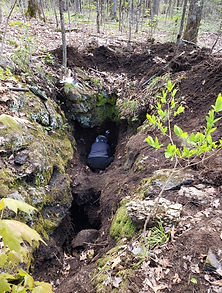
Right: A vein dyke on the Dark Star property that was filled by calcite that is now eroding and leaving a soil filled trench in its place. The filling in this fissure is due to hydrothermal action, in the fissure to the left it is a filling of molten rock.

Left: The Richardson Mine (also known as the Fission Mine) in Cardiff Township near Bancroft, Ontario, was a significant early uranium prospect, famous for producing very large uraninite crystals, including one displayed at the Royal Ontario Museum (ROM). Standing at the entrance there is a strong breeze as air is sucked inwards by a chimney effect and blown onto the surface deeper in by way of a shaft. Discovered in 1922 for uranium (though also historically linked to gold), it saw exploration by companies like Fission Mines in the 1940s and 50s, featuring shafts, trenches, and a small mill.
Right: Fetid fluorite from the Richardson Fission Mine. Fetid fluorite, also called antozonite or stinkspar, is a dark, often violet or black variety of fluorite (calcium fluoride) that releases a strong, pungent odor, like garlic or ozone, when crushed. This distinctive smell comes from trapped elemental fluorine gas. "Stinkspar is often associated with uranium deposits.


Above: Betafite, a radioactive oxide mineral that belongs to the pyrochlore super-group and is a potential source of uranium and niobium. This was found in the Silver Crater Mine and these specimens typically are brown or black with a greasy luster. Betafite crystals from the mine contain 15-20% uranium so they are highly radioactive.
The Silver Crater Mine near Bancroft, Ontario, is a famous, active mineral collecting site known for its carbonatite deposit and radioactive minerals, especially betafite, alongside large mica books, apatite, and zircon. Pits have been dug atop the mine and a 4 foot sheet of pure mica crystal was extracted from one.


Right: The land-bridge over the famous Hubbert's Hole. Granular soil that is wet is amongst the most dangerous of environments in which to dig. We stay within the walls of rock fissures to ensure safety - and check on our clients constantly.
Far Right: Tree roots are both a blessing and a curse. Often they show the route to follow and help us predict what's lower down. Clearing tree roots in the top 2 feet of soil can be tedious.


Left: Using a steel rod to probe for fissures beneath this soils in the Bancroft area vein dyke plains.
Above: Beginning to excavate a fissure that is walled on either side by rock and filled with lose soil and lose crystals down below the frost line.


Left: High temperature fissures are typified by finding titanite crystals and clusters of small apatite crystals. These finds assure you as to what the other minerals are that you will find in your fissure that you are digging. e.g. there are also associations with small richly colored feldspars and pyroxenes. If you are fortunate you will find mixed clusters of several different minerals.
Left: The apatite tends to be much larger and better formed in low temperature fissures.
-
Lower temperatures reduce the rate of nucleation (the formation of new, tiny crystals) relative to the rate of crystal growth (the enlargement of existing crystals). Fewer nuclei mean the available material is used to enlarge existing crystals rather than starting new ones.
-
Apatite crystals, like many minerals, tend to grow larger at lower temperatures—specifically during slow cooling scenarios—because the reduced thermal energy provides more time for atoms to migrate and arrange themselves into an ordered, stable crystal lattice rather than forming many small, quick crystals.
-
In metamorphic or hydrothermal environments, apatite can coarsen (get larger) through a process called Ostwald ripening, where larger crystals grow at the expense of smaller ones, a process often driven by chemical changes at lower temperatures.
.


Upper Left: Dolostone overlies the plutons in the Bancroft area and it is from that rock that calcite is leached to form the filler in the vein dykes.
Lower left: It is within the calcite medium that titanite is wicked from the gneisses near the surface and they grow outward from the fissure walls.
Right: Ralph schroetter holds a rock that shows delicate spines of tourmaline, broken and shifted by once- flowing superheated fluids. Likewise, most of the titanite specimens were once attached to fissure walls, but by way of time or fluid movement they've been snapped off and re-deposited.

Left: This specimen was hauled out of one of the Dark Star vein - dykes, it is a pyroxenite as can be seen by the near 90 degree faces on the prisms. Most of the Dark star fissures are abundant in their yield, though they seem to each be quite unique from any others. Some fissures do titanite, others amphibole and others feldspar.