


In the Simplicity of it's Beauty it has such Amazing Complexity
Quartz is the second most abundant mineral after feldspar. It occurs in nearly all acid igneous, metamorphic, and sedimentary rocks. Basically it's everywhere, its beautiful and its complexity is a source of endless fascination to those of us who mine it.
How to Identify Quartz Crystals in the Field – A Rockhound’s Guide
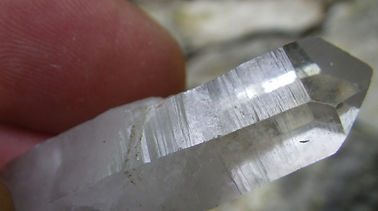
Quartz is one of the most common yet frequently misidentified minerals in Ontario, and this guide explains how to recognize quartz crystals in bedrock, vein dykes, and glacial float using real-world rockhounding techniques.
Quartz on the Dark Star Claim
Our last article on the scarcity of rare earths had a bit of a geopolitical angle – looking at developments in Ontario around critical minerals. Today the angles will be more around quartz crystal identification. I say this because we now face a regular supply of amazing quartz crystals from our Quartz claim and if you are in any way active in rockhounding in Ontario you are sure to see crystals that could be quartz, or might not be. You must be aware of how to identify quartz crystals if you are to be a proficient rock hound in Ontario, it is a common element in Ontario's pegmatites, vein dykes and skarns.
Typically what we find on our Dark star Crystal Mines South claim is set in with feldspar crystals, Hubbart's hole, a vein dyke fissure that yielded a great profusion of titanite was also a huge supplier of the feldspar quartz matrix. Our Quartz claim is in an entirely different geological setting; it's crystals are coated with magnetite or hematite. In certain very special cases we find smokey quartz in beautiful euhedral clusters or amethyst that's riven with orange goethite inclusions. We call those inclusions "Martian Pumpkins".
Like all crystals, the angles between quartz faces are quite distinctive and as you will soon come to realize, there are distinctive faces that are quite typical of quartz and they serve to make quartz identification more definite. Some are left wondering in a crystal shop whether their crystal is even real. In reading this article you will be assured of what you are looking at.
Four approaches to identification and the internal structure of quartz
Today we’ll look at four different approaches to identification that anyone can do with equipment of the most basic variety, the fracture of quartz, its specific gravity, its hardness and its form.
Of the many different varieties of quartz, we are simply going to focus on the rock crystal variety as it encompasses much of commonality between what you are likely to see, and in learning about the simple crystal, there is much that can then be extrapolated to the other varieties, like amethyst, citrine and chalcedony. Habit and color may change, but you will still have a knowledge of the underlying mineral.
1. fracture
Simple as it may seem, there are so many varieties habits and distorted crystal forms with quartz, but all have the chemical formula of SiO2, but in crystal lattice the quartz is composed of a tetrahedron, a pyramid shape with a silicon atom at the center of the pyramid and four oxygen atoms at each corner of the pyramid, each oxygen atom being shared by 2 other tetrahedra, thus forming a 3D lattice with no particular planes of cleavage; it’s the same cohesive strength in every direction and so when quartz breaks it fractures like glass, with a concoidal scoop, its insides wavy and much as you would see in chipped glass.
In the case of glass, it also has no particular direction that is more strongly bonded than any other direction, its atoms are entirely random so you would refer to it being amorphous (without internal structure) – so for totally opposite reasons (no structure thus equal bonding strength in every direction), it also breaks with concoidal fractures.
2. Specific Gravity:
Quartz is a common mineral and it comprises about 20% of the earth’s crust. Unlike gold it cannot be separated from the common river pebbles by weight as most of them are very similar by weight and appearance to casual comparison. You’ll not find quartz accumulating in a deep crack in the river bed or where the water slows down as minerals that are relatively heavier do. In a flowing stream quartz just acts like every other pebble around it.
Now if you are looking at a hand full of pebbles you might have the urge to separate out your quartz crystal from other lookalikes and to do this you would need a balance scale much as would be used in a high school chemistry class, I found mine at value village. In using this scale you will be comparing the density of the substance that you are weighing to that of water. Simply put, you weigh your crystal as you usually would and then weigh it again in distilled water at 4 degrees Celsius. That temperature was chosen as a standard as it is at that point that water is most dense.
When weighing your crystal in water it will displace a certain amount of liquid and it is the weight of that volume of liquid that you are intending to measure your crystal against. It is a basic scientific principle that has been attributed to the observations of the ancient Greek physicist known as Archimedes.
Plugging your two measurements into the required formula you obtain the specific gravity of whatever you are weighing – its weight relative to the volume of water that it has displaced. Quartz is relatively light with an SG of 2.65, whereas sapphire comes in much heavier at 3.98 – 4.06. This measurement can certainly distinguish between quartz and almost any other mineral, however, the smaller the specimen being measured, the less accurate your weighing becomes.
3. Luster and Hardness:
Hardness and refractive index on a standard polished surface will combine to present the luster of a stone. Quartz has a hardness of 7 and a luster that is said to be vitreous. Hardness is a relative measure in its most basic sense when we are talking about gemology. With a hardness of 7 quartz can scratch softer substances like fluorite, calcite or glass, but it cannot scratch topaz. Admittedly most people don’t have a topaz lying around, but the fact it can scratch glass (hardness 5-5.5) at least eliminates the softer minerals from the possibilities.
Luster is best judged by looking at the reflected light on the surface of a face or facet. Again it’s a comparative measure. Looking at the luster of amber its said to be resinous – quite dull in fact, and at the other end of the spectrum is a diamond’s luster which is quite brilliant due to its hardness (10) and refractive index which is also high. A diamond is said to have a luster that is adamantine. Keep in mind, without a refractometer, the sum total of these results need to be considered when determining the possible composition of the crystal in front of you. A vitreous luster is something similar to what you would see in the reflection of light from a flat glass surface.
4. Form
What now remains is a determination that is to be made by the most valuable instrument that you've got – your eyes!. What does the crystal look like? What is the crystal system and how are the crystal faces arranged?
So two words to understand before we proceed on, habit and form. Habit is how the crystal appears in a general sense, it has nothing to do with geometry of the individual crystal and everything to do with a relative comparison to the overall appearance in relation to the perfect crystal. So by habit you might describe the crystal as being blocky, botroidal or needle like. Quite clearly the crystal in being called needle like deviates from the usual expectation of a quartz crystal, while when we talk of form we are speaking of the symmetry of the crystal and the angles that the faces meet at. And in the case of quartz there are easily identifiable faces that occur in predictable proximity to each other.
All crystals fall into one of seven crystal systems and each system is defined by certain symmetries and combinations of forms. A form is either open or closed and the determination is based around whether the form could hold water if poured into it. A closed form would be able to hold water an open form cannot hold water.
There are 30 closed forms and 18 open forms. So in the first of the crystal systems, the isometric system, you have only closed forms such as the cube, the octahedron , the dodecahedron etc. and within that system you would get diamond, garnet and fluorite to name a few. All of those crystals can come in a cube shape, or as an octahedron or any of several other shapes.
Identification of Quartz in 2 different crystal systems
If you want to know how to identify quartz crystals you must be aware that it is found in 2 specific crystal systems, the trigonal system in which alpha – quartz is found and the hexagonal system in which beta quartz is found. Alpha quartz forms at temperatures under 573 degrees Celsius and has a 3 fold symmetry, meaning the arrangement of faces repeats itself 3 times as the crystal is rotated around the c axis – the axis running up its central prism. You would also describe the alpha quartz as being comprised of a 3 sided prism (an open form) and terminated by another open form such as a 3 sided pyramid, a flatted pinacoid or possibly another form that typically terminates a prism.
Beta quartz has formed between 573 degrees and 870 degrees. It shows itself as this variety by its 6 fold symmetry. So as you rotate the upright crystal in front of you the same image of termination and prism face repeats itself 6 times to your view.
So it is not so much in the prism that you will see the distinctive quartz shapes, but rather in the terminations. The prism could be terminated at both ends which is quite unusual and indicative of a crystal that grew in a cavity with plenty of space to spare. In the case of Herkimer diamonds it is the norm as opposed to the exception, however there is one aspect of the quartz prism that is quite distinctive and that is the horizontal striations across the main prism faces. It is important to understand that depending upon the growing conditions face sizes will vary and this explains the many shaped varieties of quartz.
In the basic quartz there are 3 crystal faces, the ‘m’ face which repeats itself around the prism, the ‘r’ face which is 7 sided and typically the biggest of the termination faces and the ‘z’ face which is a small triangular face between the r faces. Look at your crystal from above its termination, it is probably the easiest way to determine symmetry. Looking from the side, it’s not a question of whether you see the prism or m face repeating itself 6 times, it is the combination of all 3 faces repeating themselves. So in the alpha crystal you will see 6 M faces, but in combination with the Z and R faces you see the same image only 3 times.
Now comes the really funky part of the quartz crystal, its basic tetrahedrons tend to spiral as they bond in their 3D lattice. It’s called a helix and the spiral can go either to the left or right and the direction is sometimes represented by small x and S faces set along the edge of the R face. Depending upon the placement of the X and S faces - to the right or left of the top of the prism face you would say that you have a right or left handed crystal. The split is about 50/50 and I am unable to determine why the helix would spiral one way or the other.
Twin crystals can hamper simple visual identification, but in short what the call the Brazil twin is the most common and it is represented by the X face being on both the left and right of the prism. It represents where both right and left handed crystals have inter-grown.
So confusing as it might seem, quartz though being common is far from simple. There are many different twinning possibilities aside from the Brazil Twin and as much as you can develop a certain level of confidence in a crystal’s identity, you cannot be certain unless in the case of quartz it is faceted and you employ a refractometer which is beyond the scope of this article.
Important questions about quartz
What is chalcedony?
-
Chalcedony is a micro-crystalline variety of silica (quartz - SiO2) known for its waxy luster, translucence, and wide range of colors, formed from tiny interlocking quartz and moganite crystals. It's a broad term encompassing many popular gemstones like agate, jasper, onyx, and chrysoprase, varying in color from white to gray, blue, pink, and green due to impurities.
What happens to quartz if it is heated?
-
Quartz undergoes a significant, reversible phase transition between its low-temperature alpha (α)-quartz (trigonal) and high-temperature beta (β)-quartz (hexagonal) forms at approximately 573°C (1063°F) at atmospheric pressure
-
Amethyst (purple) Can turn yellow, orange, or brown (becoming citrine) when heated above 450°C (842°F).
-
Smoky Quartz (brown/black): Can become colorless or greenish-yellow with prolonged heating as impurities shift.
-
Rose Quartz (pink): Can become milky white or opaque, sometimes reversibly, with mild temperature changes, but extreme heat can permanently alter it.
What is the most valuable kind of quartz?
-
The most valuable quartz varieties aren't always the most common; while Amethyst (deep purple) is popular and can fetch high prices for large, high-quality specimens or cathedrals, the rarest and potentially most valuable includes unique types like Cotterite (historically significant) or exceptional Sagenitic Quartz (with unique needle inclusions), though prices vary wildly based on quality, rarity, and market demand, with high-grade Ametrine and vivid Carnelian also highly prized
What is meant by the piezoelectric property of quartz?
-
A unique characteristic is its piezoelectric property, meaning it generates an electrical charge under mechanical stress, which is why it is widely used in electronics like watches and clocks.
Are quartz crystals used for healing or spiritual purposes?
-
Yes, in various cultures, quartz crystals, particularly clear quartz, have been used as healing or energy stones to promote emotional balance, mental clarity, and protection from negative energy. While popular in spiritual practices, there is no scientific data to support these uses.
Conclusion
Correctly identifying quartz is a foundational skill for any rockhound or mineral prospector, especially in crystal-rich regions like Ontario where quartz occurs in vein dykes such as at Dark star Crystal mine's South claim, or in pegmatites, and glacial float. By learning to recognize quartz through its hardness, crystal habit, fracture, and geological setting, collectors can avoid common mis-identifications and better understand the mineralized systems they are exploring.
At Dark Star Crystal Mines, quartz identification is more than a visual exercise—it is part of reading the rock record and interpreting how fluids moved through ancient bedrock to form crystal pockets. Whether you are encountering clear quartz, smoky quartz, or iron-stained varieties in the field, these identification techniques help you prospect more effectively and collect responsibly.
With practice, quartz becomes one of the easiest minerals to recognize, and once mastered, it opens the door to identifying associated crystals and more complex mineral assemblages found in Ontario’s historic mining districts.
Author Bio
Michael Gordon has been rockhounding and studying Ontario pegmatites for over 30 years, he has a degree in geography and a Diploma in gemology and is author of the Rockhound Series which can be purchased on the Lulu website.
Last updated 2026


Lemon Quartz is a bright yellow variety of quartz (silicon dioxide) valued in jewelry for its sunny color, achieved naturally by iron traces or enhanced through heat and gamma-ray treatments, often called "Oro Verde" (Green Gold) and used in jewelry for its clarity, focus, and cheerful energy, making it a durable alternative to yellow sapphire.
Left: A typical six sided prism with a right handed twist.
Right side of left: Looking at the termination (top of prism) you can see the R and Z faces.
Above Right: Magnetite spheres on and within quartz crystals that are found on Dark Star's "Quartz claim". Hematite tends to be red or brown and goethite more possibly orange. We call these inclusions of magnetite and hematite "Martian Blueberries and when there are billowing orange inclusions we call them "Martian Pumpkins".
Above left: Quartz from the "Quartz claim" that is darkening as a result of radioactive influence.
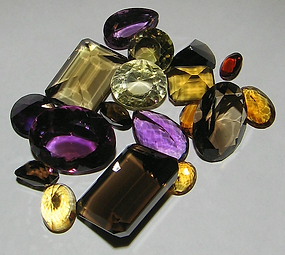
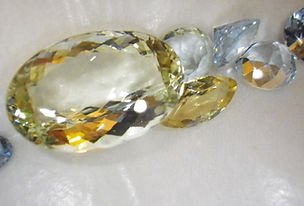
Can you tell the difference? Once faceted a crystal loses its surficial identifying features so aside from an experienced eye, visual optics or a refractometer and microscope you are stuck out on a limb.
Left: aquamarine and helidore
Right: amethyst, citrine and smokey quartz. If its not jumping out at you consult a gemologist.
Above: I use a Dial-o-gram triple beam mechanical balance to do SG weighing at home.
