


The Metaphysical Approach
In metaphysics, crystals are understood as objects possessing unique vibrational frequencies that can interact with a person's energy field to promote physical, emotional, and spiritual well-being. While scientifically unproven, this tradition, which dates back thousands of years, holds that crystals can help balance chakras, facilitate meditation, attract positive energy, and serve as tools for intention setting and emotional grounding.


Is Your Crystal Real? Understanding Natural, Ethical Earth Crystals from a Rockhound’s Perspective
Table of Contents
-
Two Ways of Loving Crystals
-
The Growth of the Crystal & Metaphysical Market
-
What Metaphysical Buyers Are Really Looking For
-
The Problem of Supplier Integrity
-
Fake, Synthetic & Treated Crystals Explained
-
What Makes a Crystal a Crystal?
-
Crystal Faces, Systems & Light Behavior
-
How does light travel in a crystal?
-
What are crystal axes?
-
What is refraction?
-
Why Authenticity Matters
-
Adulterated forms of Chalcedony
-
Dark Star Crystal Mines: Ethical, Local & Real
-
FAQ: Is Your Crystal Real?
Two Ways of Loving Crystals
If you are reading this you are likely to be a millennial and of the opinion that crystals are a powerful arm of the alternative wellness movement. The other option is that you might also be a ‘rockhound’ – a person who approaches the crystal world with entirely different motivations and knowledge base than the ‘metaphysical practitioner.
This article is specifically for those of you who are of the metaphysical mindset. The intent is to help you understand a little bit of the rockhound side of things. We believe both mindsets can exist together, and that there should be a certain harmony between those who live in the crystal world, a deference from either side to the central thing that both views share, a love of nature and natural beauty.
The Growth of the Crystal & Metaphysical Market
Well you’re not alone as a person who loves crystals, be you metaphysical or a rockhound; the North American market grows at 5% /year and by 2027 it’s expected to be topping 2.3B. Everyone who handles crystals has seen this sudden growth in interest. As Chris Fouts, geological expert in the Bancroft area and owner of “Lakeside Gems points out, “Things were looking pretty grim until COVID, then the interest in crystals seemed to blossom”.
2026 promises to be an outstanding year in the crystal world and trends are toward partnering with local mines and building ethical supply chains.
What Metaphysical Buyers Are Really Looking For
As the current trends indicate, people like you are looking for a product that’s authentic, eco-friendly, ethically sourced and glowing with what’s needed to meet your metaphysical demands. Those who accept crystals as an integral part of their well being are also looking for more, for unique and individual crystal specimens that stand out from others of a common type. We at Dark Star Crystal Mines endeavor to supply those unique and beautiful crystals and if you live in Southern Ontario we could well be your partner.
As I learned from Steve, our metaphysical guru in the article, "What are earth crystals?", your crystals are personal; they must speak to you and draw you to their power. What might be good for one could well be meaningless to another. So is it all tinsel and sparkling surfaces cut to a crystal ideal that you imagine, or is it authenticity, the real thing, a thing of greater power for the purposes that you need? without authenticity your crystals are just smoke and mirrors. A fake crystal deceives as fake metaphysics.
The Problem of Supplier Integrity
Now arises the problem of supplier integrity. What kind of retail masochist advertises their product as crap? Out front of their store they post that children mine their product in dangerous, low paid servitude with few ever reaching their teen-aged years without a missing limb. And in a factory, less than impressive agate lumps are shaped into pillars of pseudo-quartz appearance, six sided but missing the real internal and external features of a natural being. Is that the kind of vibe you want hanging over what you understand to be a pure and beautiful thing?
Because the market is so totally infused with dirty crystals, those that have a past that a conscientious metaphysical practitioner would not want, there are few choices to an ethical and authentic supply chain. Some experts suggest that in the context of the metaphysical non-certified market, the proportion of truly ethical and authentic stones is extremely low, with up to 80%–90% of mining operations failing to meet all ethical criteria regarding labor and environmental standards. and then there are the lumps that are carved to look like skulls, wands and massagers. If the starting material were a naturally faceted crystal, no stone worker would destroy it by cutting away its faces.
Fake, Synthetic & Treated Crystals Explained
You think that you have a natural ruby crystal, but it is possibly grown from any of several artificial means. It is usually the trained gemologist who can distinguish from the inclusions that the stone was grown by humans in ‘flame fusion’ or ‘flux’ processes. A microscope in dark field lighting mode might show swirling smoky structures of flux as opposed to the ‘flattened plains of finger prints or feathers’ of a natural stone. Zircons are often heated, emeralds can be oiled and when quartz contains iron it can be irradiated to go purple or with aluminum it can become smoky. Heating or radiation can turn an amethyst to citrine.
Amorphous garbage is out there everywhere posing in fake-crystal form. Chalcedony is a common culprit, its dyed and treated to take your money and reduce your attempts at healing. With an adulterated stone your efforts become ineffective and after spending and meditating you remain wrought with anxiety and wondering where it all went wrong. Let me tell you, you need the real thing to get legitimate results. Healing should not be a circus side-show with artificially shaped and dyed materials. It's meant to be a deep and personal thing.
Yes, there’s a huge amount of deception in this industry. Being a trained gemologist and partner in “Dark Star Crystal Mines”, I can assure you that a great deal of what you imagine to be ethical, eco-friendly and real is just a shabby smoke screen. Do your stones really draw you or are they just pretty colored lumps that you try so hard to feel an affinity to. Without real unmodified crystals you’re wondering what’s going wrong. Forgery has long been a part of the precious mineral world. Where you draw your crystals from the ground yourself, at least you know you are getting the real thing.
What Makes a Crystal a Crystal?
So as a buyer you clearly want natural material and preferably natural crystal faces. The unit cell is the basic building block of a crystal. The cell is an imaginary box with several atoms in a specific spacial arrangement. Stacked in a 3 dimensional way the unit cells form a crystal and the expected external faces will be predictable based upon the unit cell. A cubic unit cell cannot form a hexagonal prismatic set of faces unless there is that very special situation of a pseudomorph.
A pseudomorph is a "false form" mineral that retains the outward crystal shape of a previous, original mineral while its internal structure and chemistry have been replaced by a new substance. They occur when minerals undergo substitution, dissolution, or structural changes, such as petrified wood or silica replacing calcite.
Crystals have properties that amorphous stones do not, but it’s also important to understand that appearance isn’t everything. It’s possible to have a perfect crystal with a dull and dreary exterior. A lump or tumbled stone, despite its lack of faces can still be a crystal. The ordered internal structure makes a stone a crystal. A quick few turns on the polarascope often clarifies the situation of a crystal or amorphous material.
An amorphous stone has no internal order (e.g. glass) Steve tells us that external faces are crucial to the power of the stone and once broken the crystal dies, but others say it is just the material that matters – you decide.
Crystal Faces, Systems & Light Behavior
So what is a crystal? They can come as great ‘euhedral’ spikes or blocks with perfect well-formed faces. Like people who have had every opportunity, these crystals have grown in ideal situations and have reached their full potential (remember the movie ‘Twins’). The flip side of the equation is the ‘anhedral’ crystals that struggled to express its form in a tight and possibly mal-nourished vug. Personally I think these are the more interesting situations, where possibly your specimen is lanced with inclusions and grown in ways that distort their immediate identity, but that’s just me as a collector. One of my favorite specimens is an amphibole matrix with blocky feldspar lumps that for their imperfect form look like corroded teeth.
Crystal Faces & Identification
It’s usually crystal faces that tell you that you’re looking at a crystal and they can be both of mineral or organic origin – case in point the sharp geometric spires of a ‘weddellite crystal grown on the surface of a human kidney stone. You’ll know of their existence as they tear along your urethra toward their agonizing birth, a toilet bowl being the receptacle into which they fall. As a mineral collector you should consider the birth of your crystal when you lift it from the walls of its natural fissure.
Usually a crystal’s external faces are smooth and they reflect the inner building blocks which is an ordered atomic arrangement - though lets not forget the issue of growth features - like the trigon on a diamond. Growth features typically indicate a crystal face of natural origion.
The faces in a crystal occur in predictably defined proximities and orientations. In quartz you know its quartz because of the appearance of a little window atop the column that by its placement to the left or right of the structure makes your quartz crystal a left or right handed specimen (who’d have guessed)? facet edges should be sharp. Rounded facet edges on what you imagine to be a natural crystal indicates glass or stones that have been worked. A facet sunken in the middle is also a sure give away. Glass does this as it cools and it potentially indicates that what you think is a crystal was possibly cast in a mold.
Crystal Systems & Optical Properties
Crystal faces might not always be smooth and could represent certain transitional or unique features. Vertical striations can be seen up the length of a tourmaline prism and it’s not unusual to see trigon pyramids on a diamond. Diamonds grow within the boundaries of the isometric system, and they display certain external forms that others of its system might also display. Growth Hillocks and Spiral Layers can be seen as geometric, elevated, or pyramid-shaped mounds formed during crystal growth. They are frequently observed as step patterns on what appear to be "mirror-flat" faces when viewed at high magnification.
So a sapphire being in the trigonal crystal system will not naturally come in a cube or octahedron shape, but like diamond, fluorite, garnet and spinel they could all be represented by one of those two geometries (or any one of several others) because they are all isometric crystals. Those shapes (cube etc.) are unique to the isometric crystal system.
How does light travel in a crystal?
Upon first entering a transparent crystal, light immediately refracts and splits into 2 separate rays in all but one of the crystal systems. This splitting of paths is measured on a refractometer and individual rays might both move or only one of them might vary in its path. This movement is entirely dependent upon the presence of the optic axis. So for example, a sapphire will be described as having a refractive index of 1.76 – 1.77 and it is said to be ‘positive uni axial’, that is, only one of the light rays appear to be varying and the fact that it is the ray with the higher reading makes it a uni axial positive stone. The unvarying ray is traveling along the optic axis, the other ray roves through a defined but varying path.
What are crystal axes?
Symmetry of the external form is probably one of the most common ways to determine which crystal system a crystal belongs to. Simply put most crystals have 3 axes that penetrate invisibly out through the external form; they define the proximity and angle of the faces and also the stone’s relative dimensions. So for example, 3 axis all at 90 degrees to each other and of equal length describe the geometry of an isometric crystal (cube shaped), but with varying lengths and slopes the axis might also define a trigonal, orthorhombic or triclinic crystal amongst several other possibilities.
As for crystal faces, quartz sometimes has striations across the length of its prism, it is said to be from the juxtaposition during growth of the rhombohedra and prism faces. The 3 sided tourmaline prism has faces that bow outwards like the crystal has been overfed and deep striations have formed lengthways because of oscillations in growth between the different prism faces. Diamond often has little pyramidal growth features called trigons. Sometimes they are left on the girdle and are features that are used for easy identification.
What is Refraction?
Now as much as the surface of a stone gives you a good clue as to the stone’s identity, it is the internal properties that really reveal the crystal’s true nature. In lab analysis light is used to measure certain features that are unique to every crystal species. As optical density increases, so in turn is the degree to which a light ray is further bent in its path through a crystal - its called refraction.
Refraction is a predictable thing that’s mathematically defined and so in a transparent stone you can determine exactly what it is by the way it modifies light rays (mainly the degree to which a light ray bends in a substance of greater optical density) and the maximum separation between the roving ray and the optic axis. This separation is called the crystal’s birefringence.
So you see, crystals are a complex variety of natural wonder. Not every shiny or colored stone is a crystal; many are simulants, or synthetics. Conversely, some pretty rough looking specimens are real and valuable despite appearances to the contrary.
Why Authenticity Matters: Simulants and Synthetics
A stimulant looks like what it is supposed to imitate, a synthetic has been made in a lab, it’s the material that you are expecting with the same properties, but it’s artificial. So back to sapphire, it has the chemical formula of Al2O3, but it can come from a Sri Lankan stream or equally a lab where its grown in sterile measured exactitude. Which one has the power or do they both? Is it simply the material that counts, or the whole process of birth in the womb of the earth?
In a faceted stone the inclusions or cheap cut often give it away as an imposter, but if you are looking at the raw crystal, with extraction dirt, a base of country rock and various imperfections they give a better clue as to authenticity. A Kashmir Sapphire's external crystal form is a great value in determining the authenticity of the crystal. A tabular crystal is hardly as expected as a spindle or barrel.
Adulterated forms of chalcedony
Doing our market research we as partners in the Dark Star enterprise have entered several metaphysical shops and seen as a staple the towers and wands of striated chalcedony. Invariably they are shaped artificially to seem like some fanciful crystal. Admittedly some people want that, but if you are looking for authenticity these knock-offs are not for you. The agate has been dyed and heated and you’ll never see a shape like that in nature. Admittedly chalcedony is crystalline (composed of millions of tiny, randomly oriented crystals), but a geometric crystal form should not be appearing in a crystalline substance.
These fake crystals are often sold to buyers who base the worth of a crystal on how bright and sparkly it is. Bright and sparkly is great in a circus, but I’d wonder whether that’s a rule to follow when looking for powerful ‘earth crystals’. Your crystals need to possess the ordered internal structure of something that’s made by nature – something real not a decoration.
Quite clearly there is an established understanding as to what it is exactly that comprises that wonderful thing that we call a crystal. You do your practice or collection an injustice by embracing an imitation.
Thus far I have explained some basic properties from a scientific angle as to what comprises a crystal, but with some thought its possible to see the links and commonalities with the spiritual approach as well. To link the two views as one and the same is still a little way off in our collective understanding, but we believe this will eventually become a reality if everyone understands exactly what they are dealing with.
Just like fake science does not work to build a repeatable theory, so in turn fake crystals do not work to build a real and working metaphysical practice.
Dark Star Crystal Mines: Ethical, Local & Real
We at Dark Star Crystal Mine harvest our crystals from a world class vein-dyke complex. We specialize in rockhounding in Bancroft, Ontario. We have an enormous stock from what was once Bear Lake 1 diggings and in time will hopefully also reach lease on our current claim and be able to offer you what we find from there. For now you have to dig it for yourself and that works for both of us as we have the requirements of our assessments met and you find amazing crystals.
We can personally vouch for our extraction practices and as we are our own employees we endeavor to pay ourselves as fairly as possible (and maybe even an unwarranted bonus from time to time). We do what we do because we love crystals and it’s not our only choice for a living (but it’s the choice we like).
There is nothing that we sell from our mines that has been adulterated in any way and if you are looking for a one of a kind specimen we are the people to provide. Everything that comes from us is authentic. You need not travel to Brazil or Afghanistan to check up on our source of supply, we are just a short 3 hours from Toronto.
There is no one specimen that comes from the vein dykes on our property that is the same and with 72 varieties of amphibole those black power clumps likely contain a variety of amazing species, some of which at this time might still be unknown to science. We can even tell you the fissure from which your crystal came.
Most of our crystals are from the microcline system, formed with an internal structure of double chain tetrahedron. We guarantee our product’s natural origin because we, or you are the ones who lift it from the ground.
Just because it’s colorful and sparkly doesn’t mean it’s good.
FAQ: Is Your Crystal Real?
1. How can I tell if my crystal is natural or fake?
Look for country rock, natural inclusions, uneven growth, and irregular faces. Perfect color and symmetry usually mean lab-grown or treated. Check your crystal in a polariscope and look at face edges to see if they are rounded.
2. Are lab-grown crystals chemically the same as natural ones?
Yes — but they are formed artificially, not in the Earth and inclusions are often different.
3. Are dyed agate towers real crystals?
They are crystalline material, but the shape and color are artificial and not naturally occurring.
4. Does heating or treating a crystal change it energetically?
Many metaphysical practitioners believe treatment alters a stone’s energetic integrity. The stone should follow along the principle of how we have defined earth crystals.
5. Why source our metaphysical crystals from Dark Star Crystal Mines?
Everything from our mine is natural, authentic and unadulterated. We are a pay to dig mine and you can mine your own crystals and we are strongly principled as to the way in which we work and our consideration of the environment.
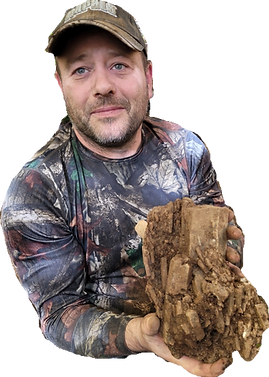


Right: Authenticity increases as you get closer to the source - pyroxene and apatite from the Dark star Crystal Mine.

For each person the expectation changes. Natural crystals may not always be the most appealing to look at. Some like it shiny and colorful, some like authenticity.

Right: The Anahi Mine in Bolivia. They keep this section untouched as a show mine for visitors.
Above: Traditionally the fate of high quality crystals was to facet them. now they end up in any of a great number of metaphysical forms. These metaphysical forms usually disguise inferior material.

Real or fake?
Geology is wrong, location is wrong, crystal shape is wrong, fractures are wrong. Boots are not attached to a body.
Lesson: The dolostone of Clifton Hill hardly supports the presence of apatite crystals.


Left: Real apatite crystal
Right: Fluorite crystal that has been cut to appear sort of quartz-like, but they have not got the exact nature of quartz crystal faces right.
Above: Looking for inclusions to establish authenticity.
Above Right: Using the Chelsea filter to check for chromium content
Below Right: Using a balance scale to check for Specific Gravity
Right: Both stones exhibit an asterism, the sapphire was too perfect and in looking at its base it clearly was synthetic.
Left: massive quartz fashioned into a ball. If it had been a crystal they never would have done this.


Above: Amethyst warehouse in Brazil.
Right: Once you are buying semi-precious beads there is no expectation of crystal, the material may or may not be authentic, but they are usually made from trimming cast offs.


Above: Devil's dice, a cubic crystal of iron and sulfur.
Above: I descended by an old TV antenna tower to get into the mine - Eldorado, Ontario.
