


Finding placer diamonds in Ontario is a growing interest among rockhounds, as glacial processes have transported diamonds far from their original sources in kimberlite pipes into rivers, eskers, and gravel deposits. The best places to search for diamonds in Ontario include regions around Lake Timiskaming, the Wawa district, and the Temagami area, where indicator minerals such as pyrope garnet (G9/G10), chromite, and ilmenite suggest potential diamond-bearing geology. Prospecting rockhounds should focus on placer deposits, especially in stream beds, gravel bars, and glacial till, using techniques similar to gold panning to concentrate heavier materials. Understanding glacial dispersion patterns and targeting down-ice directions from known kimberlite occurrences significantly improves success. While large commercial discoveries are rare, persistent searching in the right geological settings can yield small but exciting diamond finds in Ontario’s vast and underexplored terrain.
Left: Rough Diamonds as found in kimberlites


How to Find Placer Diamonds in Ontario
How Glacial Ice Movement Helps You Find Diamonds in Ontario
Much as gold is a hotly sought-after commodity in Ontario’s Quaternary deposits, diamonds are equally intriguing for rockhounds searching the province’s rivers, eskers, and glacial tills. Learning how to find placer diamonds in Ontario combines geology, patience, and a trained eye; you are looking for subtle clues hidden within Ontario's gravel deposits. Who wouldn’t love to pull a diamond from a stream bed? It represents the pinnacle of gem discoveries. In this guide, we’ll break down exactly how placer diamonds form, how they are transported by glaciers and water systems, and the proven prospecting techniques used by enthusiasts to increase their chances of success in Ontario’s diamond-bearing terrains.
They say a diamond is forever—and in Ontario’s glacial sediments, that statement is especially true. Locked within ancient tills and river gravels, these gemstones can remain undisturbed for thousands of years, waiting to be uncovered. Historical finds like the Nipissing diamond and the Peterborough diamond demonstrate that diamonds do occur in Ontario and can be recovered from secondary deposits. For those wondering where to find diamonds in Ontario and how to identify promising locations, understanding indicator minerals, glacial pathways, and sediment concentration zones is essential. With the right knowledge, Ontario’s landscape offers real potential for discovering placer diamonds hidden in plain sight.
Why Finding Placer Diamonds in Ontario Is So Difficult
Unlike gold, which tends to concentrate close to its source, diamonds are easily transported and can end up scattered across the North American heartland. Glacial ice has eroded enormous quantities of kimberlite from where it protrudes in Ontario’s northern landscapes, and logically diamonds will be found scattered in a down-ice direction from those kimberlites, many of which have yet to be discovered. So if you wonder where to look in a general sense, its in the glacial deposition.
Ontario’s gravel and aggregate industry extracts roughly 160 million tons of sand and gravel each year. Yet this amount is tiny compared to the estimated 93 billion tons of glacially deposited sand and gravel contained within the province’s eskers, drumlins, and moraines. In fact, less than 0.1% of Ontario’s glacial deposits have ever been mined, and even that material is processed purely for construction gravel.
It raises an interesting thought for anyone wondering about finding diamonds: how many beautiful diamonds may have already passed unnoticed through gravel sorters and ended up beneath highways and asphalt? How many more life-changing placer diamond discoveries still lie within the province’s unprocessed gravel? You can bet that we haven't seen the last.
Table of Contents
1.How Glacial Ice Movement Helps You Find Diamonds in Ontario
2. Why Finding Placer Diamonds in Ontario Is So Difficult
3. What is Kimberlite?
4. What does Kimberlite Look Like?
5. How do Glaciers Disperse Placer diamonds?
6. How Rivers Concentrate Placer Diamonds in Ontario
7. Are Diamond Placers Similar to Gold Placers?
8. Why is it so Hard to find Kimberlite Pipes?
9. What are Kimberlite Indicator Minerals?
10. Andy and Ralph use Fluorescent Light to Find Placer Diamonds
11. Are Diamonds Transported Further than Gold?
12. Diamonds Found in Glacial Drift Around the Great Lakes
13. Canadian Diamonds Found in US States
14. Diamond Discoveries in Ontario
15. The New Liskeard Experience
16. Diamonds and Indicator Minerals in the Wawa Region
17. Placer Diamond Discoveries Near Wawa
18. How are Diamonds Separated from Gravel?
19. FAQ: How to find Placer Diamonds in Ontario
20. Conclusion: How to Find Placer Diamonds in Ontario's Glacial Terrain
What Is Kimberlite?
Anyone attempting to understand placer diamonds in Ontario, must first understand the rock that brings diamonds to the surface: kimberlite. If you follow a trail of diamond indicator minerals up-ice, you might eventually find yourself standing above a kimberlite intrusion—although it is always a long shot given how far diamonds can travel in glacial systems.
Kimberlite is a bluish igneous rock found almost exclusively in volcanic structures called kimberlite pipes, and it plays a central role in the geology behind how to find diamonds.
Geologically, kimberlite is considered a rare variety of peridotite, an olivine-rich mantle rock that is also the source of the gemstone peridot. Because kimberlite is composed of many minerals rather than a single mineral species, its chemistry and appearance can vary widely. However, it is typically rich in magnesium and potassium and relatively low in silica.
What does Kimberlite Look Like?
Fresh kimberlite is often referred to as “blue ground,” a tougher rock that requires heavy machinery to extract the diamonds it may contain. Yellow rock / yellow ground is the weathered, clay-rich upper layer of a kimberlite pipe.
-
Primary minerals like olivine, phlogopite, and garnet begin to alter into secondary minerals such as serpentine, calcite, or clay minerals.
-
Iron-bearing minerals may oxidize, giving the rock a yellow, brown, or reddish hue.
-
The texture becomes soft, friable, and easily dug, unlike the hard unweathered kimberlite beneath.
This weathered kimberlite is called yellow ground because of its characteristic color, which contrasts with the tougher blue ground below. It often lies under a layer of glacial till or soil and can still contain diamonds that survive weathering.
Unlike most igneous rocks that form in broad layers, kimberlite erupts violently from deep within the Earth’s mantle and solidifies in carrot-shaped volcanic conduits known as kimberlite pipes. These ancient volcanic structures are the primary source of natural diamonds and also supply the indicator minerals used in diamond exploration.
Although more than 6,000 kimberlite pipes have been identified worldwide, only about 900 contain significant diamonds, and roughly 30 are rich enough to mine commercially. The erosion of these pipes is what ultimately creates diamond placers and explains how prospectors can sometimes find diamonds in river gravels and glacial sediments.
How do Glaciers Disperse Placer Diamonds?
The 1980s marked a peak in Ontario’s diamond exploration and signaled the spread of such efforts across Canada. Mining companies quickly realized that a major obstacle had hindered their activities: diamond experts from other countries, such as southern Africa and Australia, often lacked experience in glacial geology. Consequently, some early Canadian sampling programs were conducted without fully understanding the nature of the glacial materials, like eskers and till, leading to limited insight into how far these materials had been transported. During this decade, however, advances in airborne geophysical surveys, combined with a deeper understanding of glacial deposits and targeted sampling for diamond indicator minerals, facilitated numerous significant discoveries.
In Ontario, glacial activity has played a major role in transporting diamonds from their original kimberlite sources to more accessible locations. During the last Ice Age, massive continental glaciers advanced across the Canadian Shield, eroding bedrock and kimberlite pipes along their path. As they moved, the glaciers picked up kimberlite fragments, diamonds, and associated indicator minerals such as G9 and G10 garnets, chromite, and olivine. When the glaciers eventually melted, they deposited this material in moraines, eskers, and glacial till, effectively scattering diamond-bearing sediments over vast areas far from the original kimberlite pipes.
Exploration in Ontario often focuses on these glacially deposited sediments because diamonds are relatively rare and hard to locate in situ. Indicator minerals serve as critical clues: G10 garnets, for example, are chemically rich and commonly associated with diamond-bearing kimberlite, while olivine and chromite indicate mantle-derived sources. Geologists can trace the direction of glacial movement using these minerals, which helps narrow down areas likely to contain diamonds. In regions like the Lake Timiskaming area, early discoveries of kimberlite pipes were guided precisely by following these glacially transported minerals rather than relying on accidental finds.
Glacial deposition also creates natural concentration zones for diamonds in Ontario’s placer deposits. Meltwater streams flowing from glaciers sorted sediments by density, allowing heavy minerals and diamonds to accumulate in certain layers or gravel beds. Eskers and outwash plains are particularly important because the flowing water sorted and concentrated these minerals over long distances. As a result, diamond prospectors in Ontario often target these glacial landforms, which act as natural traps for diamonds, offering a practical and historically productive method of exploring for Canada’s most precious gemstones.
How Rivers Concentrate Placer Diamonds in Ontario
Diamonds are relatively dense (though not as heavy as gold), so they behave according to placer deposition, a process similar to gold concentration. In flowing water:
-
Lighter materials (sand, silt) are carried away
-
Heavier minerals (including diamonds, garnet, magnetite) settle out
-
Diamonds accumulate in low-energy zones, such as:
-
Inside bends of rivers
-
Behind large boulders
-
In cracks and crevices in bedrock
-
At the base of waterfalls or rapids
-
Are Diamond Placers Similar to Gold Placers?
Not usually. Compared to gold:
-
Diamonds are less dense, so they don’t settle as aggressively
-
They are typically far rarer, even in favorable areas
-
Economic deposits require very specific conditions and long transport histories
Why Is It So Hard to Find Kimberlite Pipes?
Anyone researching kimberlite quickly discovers that these pipes are notoriously difficult to locate. Serious diamond exploration in Canada did not begin until the 1960s, and major kimberlite discoveries were not made until the 1980s, despite the relative abundance of these pipes. The delay reflects both logistical and glacial challenges. Logistically, the most favorable regions—such as Archean cratonic areas in the NWT, Nunavut, northern Ontario, and Quebec—are extremely remote and often inaccessible, with large sections covered by small, shallow lakes that prevent floatplane landings common elsewhere in Canada.
Additionally, the short field season, typically limited to May through September, further restricts exploration, making surveys both difficult and expensive. Glacial processes compounded the challenge: most kimberlites formed millions of years ago and have since been eroded or buried under soil, sediment, or thick layers of glacial till, sand, and clay, completely obscuring them from view. Even when exposed at the surface, kimberlite pipes are often small and inconspicuous, sometimes rising only a few meters above the surrounding terrain, and weathering can alter the rock to resemble ordinary soil or clay.
To overcome these obstacles, geologists rely on indicator minerals to trace kimberlites, supported by magnetic, gravity, and seismic surveys, although not all pipes generate strong geophysical signals. Glacial transport further complicates exploration, as ice sheets moved kimberlite fragments and indicator minerals tens to hundreds of kilometers from their original source, meaning a placer diamond may appear long before the kimberlite pipe that produced it is located. For these reasons, careful studies of indicator minerals, combined with geophysical surveys and drilling, remain essential tools for prospectors attempting to locate kimberlite sources.
What are Kimberlite Indicator Minerals
When prospectors learn how to find placer diamonds, they rarely search directly for diamonds. Instead, they look for kimberlite indicator minerals, which are far more abundant and easier to recognize.
In the 1870s it was discovered in South Africa that at garnets were associated with diamonds. From there the way of prospecting diamonds eveolved. In the early 1960s, De Beers traced a trail of indicator minerals through an esker and surrounding glacial till to locate the Guigues pipe in the Lake Timiskaming area of Quebec (figure 2 [27]). This marked the first kimberlite pipe discovered through deliberate geological exploration rather than by chance. However, a multi-tonne sample of glacial material taken immediately “down-ice” from the kimberlite contained no diamonds, which ruled out the possibility of drilling or sampling the pipe at that time.
Important indicator minerals include:
Pyrope Garnet (G10 and G9)
This deep-red to purple garnet is one of the most important diamond indicators. Certain varieties form at the same high pressures and temperatures where diamonds crystallize deep in the mantle. When geologists find chrome-rich pyrope garnets in glacial sediments, they often trace them back up-ice toward a potential kimberlite source. G9 and G10 garnets are chromium-rich pyropes that serve as prime diamond indicator minerals. Their presence in sediments is one of the best clues for diamond exploration in glaciated terrains like Ontario, especially when combined with other DIMs like chrome diopside, magnesian ilmenite, and olivine.
Chromite
Chromite is a black, heavy mineral rich in chromium. Some types of chromite occur in kimberlite pipes and can accompany diamond-bearing material. Although chromite alone does not prove diamonds are present, it is often found alongside other indicator minerals.
Ilmenite
Ilmenite is a dense black mineral composed of iron and titanium. Kimberlite-derived ilmenite often contains elevated magnesium levels, which helps geologists distinguish it from ilmenite formed in ordinary igneous rocks.
Chrome Diopside
This bright green pyroxene mineral is another classic kimberlite indicator. It forms under mantle conditions similar to those that produce diamonds and is commonly recovered during heavy-mineral sampling.
Chromium Spinel
Chromium spinels form in ultramafic and mafic rocks, especially:
-
Peridotite
-
Dunite
-
Layered mafic intrusions
They are strongly associated with the Earth’s mantle and are commonly brought to the surface through tectonic processes or volcanism.
Olivine Olivine is a mantle-derived silicate mineral that occurs in kimberlite and can signal the presence of diamond-bearing rocks. It is green, glassy, and moderately hard. While it weathers faster than garnets or chromite, its presence in glacial or river sediments can guide prospectors toward nearby kimberlite pipes, helping in the search for placer diamonds.
Among these, pyrope garnet is especially useful because of its distinctive violet-red to orange-red color, making it easy to recognize in heavy-mineral concentrates.
Indicator minerals help geologists determine where to find kimberlite, because their distribution often forms a dispersal train pointing back toward the original volcanic pipe.
Transport studies have shown that:
-
Pyrope and ilmenite may persist about one mile downstream with little reduction in quantity.
-
Grain size gradually decreases with transport distance.
-
After 96 miles, only about 10% of the original material remains.
-
Olivine rarely survives more than 3–3.5 miles.
-
Chrome diopside often disappears within a few hundred yards.
These patterns help geologists estimate how far indicator minerals may have travelled from a kimberlite source.
Andy and Ralph use Fluorescent Light to Find Placer Diamonds
On a trip that I made up to Cobalt some time ago I met with Ralph and Andy (Princess sodalite Mine) and learned of their planned expedition that coming night. it was their intention to travel up some local stream beds with UV light to see if they could locate any diamonds. At the time it had just been discovered that there were kimberlite pipes in the area.
Diamonds fluoresce when exposed to ultraviolet (UV) light because of structural defects and trace impurities within their crystal lattice. The most common cause is nitrogen substituting for carbon atoms, which creates energy states that emit visible light when excited by UV radiation. As a result, many diamonds glow blue, though other colors such as yellow, green, or orange can occur depending on the type and arrangement of defects. This phenomenon is closely tied to crystal growth conditions deep in the mantle and subsequent radiation exposure, and is studied within gemology as a diagnostic feature. Fluorescence can vary from very faint to extremely strong, and in rough stones it may appear patchy or uneven across different crystal faces due to variations in impurity distribution.
Yes, certain kimberlite pipes (kimberlite) are known to produce diamonds with more consistent or stronger fluorescence than others, largely due to differences in mantle source chemistry and diamond formation history. For example, deposits like the Argyle Diamond Mine are famous for unusual fluorescence colors (including pink and sometimes inert stones), while many pipes in Canada—such as those in the Ekati Diamond Mine and Diavik Diamond Mine areas—tend to yield a higher proportion of blue-fluorescing stones due to nitrogen-rich diamond populations. However, fluorescence is not uniform even within a single pipe; it can vary widely between individual diamonds depending on their growth zones, deformation history, and exposure to mantle fluids.
Are Diamonds Transported Further Than Gold?
One of the most important concepts in knowing how to find placer diamonds is understanding how diamonds move through glacial systems.
Diamonds are usually transported much farther than gold, mainly because they are light and very durable. The rolling and crushing of boulders entrained within the ice has little effect on a diamond. Other basic minerals are quickly pulverized and worn to sediment.
Gold is extremely dense (19.3 g/cm³) and settles quickly in streams or glacial melt water. Diamonds are much lighter (3.5 g/cm³) and can travel far greater distances within glacial ice.
Because of this difference:
-
Gold placers usually indicate nearby bedrock sources
-
Placer diamonds may originate hundreds of kilometers away
This is why diamonds discovered in glacial sediments often provide the first clue to hidden kimberlite pipes, but those pipes could be half a continent away. You need to know about the local ice flows back about 14,000 years ago. It’s not as straight forward as you’d imagine. Ice generally flowed in a south westerly direction, but somewhere in a relatively central spot the ice humped up and then flowed outward from the node in varying directions and then at what is now the great lakes, the ice was pulled from its southerly flow and pushed through the lake basins, leaving deposits in unexpected places.
Diamonds Found in Glacial Drift Around the Great Lakes
Since the 19th century, more than 80 diamonds have been recovered from glacial deposits around the Great Lakes.
Many were discovered by prospectors panning river gravels for gold.
Finds include:
• 34 in Indiana
• 25 in Illinois
• 16 in Wisconsin
• 2 in Michigan
• 2 in Ohio
• 2 in Ontario
One of Ontario’s discoveries involved a 33-carat rough diamond found before 1920 during railway construction near Peterborough.
As you can see by the stats, Indiana has a relatively higher number of placer diamond finds than most other U.S. states. This is because it lies along the southern margin of the Laurentide Ice Sheet, where glaciers flowing south from the diamond-bearing regions of the Canadian Shield—primarily in Ontario and Quebec—deposited heavy minerals in glacial till and out wash. The Wabash River system and its tributaries then reworked some of this glacial material, creating scattered concentrations in gravel bars and terraces.
Indiana's extensive farmland and shallow soils make glacial erratics, including diamonds, much easier to detect, and a strong history of amateur collecting and geological reporting has documented these finds more thoroughly than in many other glaciated states. As far as glaciated US states. While the diamonds themselves are rare and glacially transported rather than locally sourced, the combination of glacial deposition, secondary river sorting, and high visibility results in Indiana having more recorded placer diamonds than any other U.S. state.
Ontario is entirely opposite from Indiana because We are close to the source - the diamonds come from here, but our heavy forest cover makes them hard to spot. The saying goes that if you find a diamond in Ontario it's because you are looking, if you find a diamond in Indiana its because you are lucky.
Canadian Diamonds Found in U.S. States
Lake Superior Region (Minnesota & Michigan)
Source: Northwest Territories kimberlites (Canadian Shield)
Glacial ice sheets during the last ice age transported material from the Canadian Shield southward. Prospectors in Minnesota and the Upper Peninsula of Michigan have occasionally recovered tiny, gem-quality diamonds from glacial deposits and ancient river terraces. Most finds are small, and the diamonds are often “floats” — loose grains or pebbles transported far from their original kimberlite pipes.
St. Lawrence Valley and Northern New York
Source: Canadian Shield kimberlites in Ontario and Quebec
Glacial meltwater and ice movement carried kimberlitic material southward into New York State. Prospectors have occasionally found indicator minerals like garnet and chromite alongside rare diamond fragments in alluvial sediments. These finds are mostly of academic or collector interest rather than economic.
Glacial Outwash in New England
Source: Northern Ontario and Quebec kimberlites
Glacial transport during the Wisconsinan glaciation spread diamondiferous till into parts of New England. A few historic reports, particularly in Vermont and New Hampshire, document small, water-worn diamonds in river gravels believed to have originated in Canada, although these are extremely rare.
Key Characteristics of Canadian-Derived Diamonds Found in the U.S.
• Size: Usually very small (sub-carat, often millimeter-scale)
• Shape: Well-rounded due to transport in rivers and glacial grinding
• Mineral Associations: Often accompanied by kimberlitic indicator minerals such as pyrope garnet, chromite, and ilmenite
• Rarity: Extremely rare; no known commercial deposits in the U.S. sourced from Canadian kimberlites exist.
Diamond Discoveries in Ontario
Although diamonds are rare in Ontario, several important discoveries and exploration regions exist.
The most significant diamond development occurred at the Victor Diamond Mine in the James Bay Lowlands, where kimberlite pipes were mined commercially beginning in 2008.
The Victor Diamond Mine, located in the James Bay Lowlands of northern Ontario about 90 km west of Attawapiskat, was Canada’s first diamond mine and one of the earliest modern diamond operations in the country. Discovered in the late 1980s, the kimberlite pipes at Victor were developed after feasibility studies and agreements with local Indigenous communities, with construction beginning in 2006 and production starting in July 2008 under De Beers Canada. The open-pit mine extracted ore from the Victor Main and Victor Southwest pipes, processing roughly 2.7 million tonnes of ore annually to yield about 600,000 carats of diamonds at peak production.
The Victor mine provided hundreds of jobs and significant economic activity for northern Ontario while also generating agreements for Indigenous employment, training, and benefits, though environmental and community concerns persisted. Mining operations continued until 2019, after which De Beers began closing the site and undertaking reclamation, including reshaping the pit and restoring natural features, earning recognition for its environmental rehabilitation efforts. The mine remains a notable example of pioneering diamond exploration, production, and responsible closure in Canada’s northern resource sector.
Other exploration areas include:
Temiskaming – Cobalt – Kirkland Lake: This area in northeastern Ontario is known primarily for its gold and silver deposits, but exploration in the mid-20th century also identified kimberlite indicator minerals such as garnets, pyroxenes, and olivine, suggesting potential diamond-bearing kimberlites. While no commercial diamond mines were developed, the region remains of interest for diamond prospecting due to its Archean geology and proximity to glacial transport pathways that concentrate kimberlite indicators.
Madoc region: Situated in southeastern Ontario, the Madoc area has sporadic occurrences of kimberlite dikes and indicator minerals discovered during early diamond exploration. Glacial activity has redistributed these minerals, and prospectors have occasionally recovered microdiamonds from till and stream sediments, though no major deposits have been exploited commercially.
Wawa district: The Wawa region in northern Ontario features greenstone belts and Archean bedrock favorable for kimberlite emplacement. Exploration has uncovered indicator minerals and small kimberlite occurrences, but the scarcity of economic-grade deposits means it has seen limited diamond production; most work has focused on reconnaissance sampling and glacial dispersion studies.
Temagami – North Bay: This area, along the Temagami greenstone belt, contains kimberlite indicator minerals in glacial till and minor dike occurrences. While geologic conditions are compatible with diamondiferous kimberlites, no commercial diamond deposits have been developed, though exploration continues to identify promising anomalies.
Marathon region: Located near Lake Superior in northwestern Ontario, the Marathon area has seen kimberlite discoveries and indicator mineral finds suggesting potential diamond sources. Geological mapping and till sampling indicate that glacial transport has concentrated these minerals in certain areas, making it a target for prospecting, though no large-scale mining has occurred.
Chapleau area: In central-northern Ontario, the Chapleau region exhibits Archean bedrock favorable for kimberlite formation. Indicator minerals have been found in till and outcrop, signaling the potential for diamonds, but exploration has remained mostly at the reconnaissance stage, with no commercial diamond mines established.
The New Liskeard Experience
Tony Bishop, a prospector from the Cobalt–New Liskeard area, describes using aerial photography to identify a perfectly circular lake between Cobalt and New Liskeard, interpreting it as a possible surface expression of a kimberlite pipe. It was not long before he learned that there was a whole swarm of those structures around there.
Older prospecting work was pretty rigid when it came to classifying a kimberlite pipe as diamond bearing or not. What Tony called the "African model" stipulated that there had to be a certain number of G-10 garnets in float samples in order to indicate diamonds. Recent studies in Saskatchewan and Russia show that G10s are just part of the picture. In some Canadian and Russian deposits G10s are all but absent and prospectors need to rely on the chromium minerals as indicative of the possibility of diamonds.
Bitten by the bug - prospector's bug that is, Tony began separating out indicator minerals, stressing that the material must be concentrated down to about a teaspoon of sediment because the target minerals are extremely fine, typically in the 0.25–0.5 mm range. Tony notes that traditional panning is ineffective for this work since indicator minerals do not behave like gold due to their low weight, and instead prefers using a “Gold Cube” style concentrator, which creates gentle eddies that can separate out roughly 95% of indicator minerals. He also uses magnets to remove magnetite and surface garnets, they are higher in iron content and are not indicative of the conditions necessary to form diamonds at about 120km depth.
According to Bishop, certain visual indicators strongly suggest proximity to a kimberlite source. He highlights the presence of beautiful purple garnets as a particularly strong indicator mineral that is often associated with kimberlitic material. He also emphasizes the structural geology of the region, explaining that kimberlites commonly exploit fault systems and are especially likely where major faults intersect with secondary cross-faults. Kimberlite pipes follow the weakest routes to the surface. The Ottawa-Bonnechere Graben is rife with fault lines and tektonic activity. Its not surprising that the Temiskaming area is inundated by kimberlite swarms. Inexplicably, Canadian kimberlites are about 10 times more likely to deliver diamonds than pipes in other countries. In Canada we may be deficient in sunny beaches, but rest assured - we got the crystals.
He further explains that the characteristics of float material can indicate how close one is to the actual pipe. Coarser indicator grains in the 2–3 mm range suggest very proximal sampling, potentially directly over the source. Another key sign is an “orange peel” texture on garnets, which is linked to a mineral alteration known as kelyphite—formed when garnet surfaces are modified under changing pressure and temperature conditions, often producing fine intergrowths of minerals such as amphibole, pyroxene, or spinel. Finally, he notes that fragments of green kimberlite still attached to indicator minerals are a strong confirmation of proximity to the pipe itself.
Diamonds and Indicator Minerals in the Wawa Region
The Wawa region has produced several placer diamond discoveries in river gravels, particularly along the Dead River near the Michipicoten River.
In 1991, prospectors recovered several small diamonds from the gravels, including two industrial-grade stones slightly over 1 carat each.
Later exploration recovered a 1.39-carat gem-quality diamond along with numerous micro-diamonds.
These finds demonstrate that diamond-bearing rocks occur upstream, although no commercial mine has yet been developed.
Placer Diamond Discoveries Near Wawa
Diamond discoveries in the Wawa area of Ontario began with alluvial finds in river gravels, particularly along the Dead River, a tributary of the Michipicoten River. In 1991, prospectors recovered several small diamonds from these gravels, two of which were confirmed as industrial-grade stones weighing just over 1 carat each. These early discoveries demonstrated that upstream sources contained diamondiferous rocks, sparking interest in the region among both hobbyists and professional explorers.
Subsequent sampling and prospecting along creeks and river channels near Wawa continued to yield placer diamonds. The most notable alluvial discoveries occurred at the Leadbetter property, where a 1.39-carat gem-quality diamond and smaller fragments were recovered from creek sediments. Hundreds of micro-diamonds were also found in the gravel, showing that ancient fluvial processes had concentrated and transported diamonds from their primary bedrock sources downstream into accessible river gravels.
These placer diamonds are generally small, water-worn, and associated with sands and gravels, reflecting the long transport from upstream volcanic or lamprophyric sources. While the Wawa area does host bedrock diamond occurrences, the placer finds remain the most tangible evidence of diamond potential in the region, highlighting the importance of rivers and glacially influenced drainage in concentrating diamonds for discovery.
While the region has not produced commercial diamonds like the deposits near Attawapiskat—home to the former Victor Diamond Mine—it remains a geologically promising area that has attracted periodic diamond exploration.
In short, the Wawa district has produced indicator minerals and occasional micro-diamonds, showing that diamond-bearing magma reached the area at some point in geological history, even though an economic deposit has not yet been found.
How Are Diamonds Separated From Gravel?
Most placer diamond mining begins with surface gravel excavation, where overburden is removed to expose the diamond-bearing gravel layer beneath. This work is typically carried out using heavy equipment such as excavators, front-end loaders, bulldozers, and screening plants. The most productive gravel layers often rest directly on bedrock or a compact clay layer, which acts as a natural trap where diamonds accumulate because they cannot sink any deeper. Large commercial operations have used this method to mine vast alluvial diamond deposits in places such as Namibia and South Africa.
After excavation, the gravel is processed through screening and washing systems designed to remove fine sediments and concentrate the heavier materials. The material first passes through primary screens that remove large rocks, then it is washed with water to break apart clay and mud before undergoing secondary screening to separate different gravel sizes.
Diamonds are usually recovered from the coarser gravel fractions rather than fine sand. In modern diamond recovery plants, the remaining material is often processed using dense media separation (DMS), where crushed gravel is mixed in a dense slurry—typically containing ferrosilicon—that allows lighter minerals to float while heavier minerals sink. Because diamonds have a density of about 3.5 g/cm³, they settle with other heavy minerals such as garnet and ilmenite, producing a concentrated heavy-mineral fraction where diamonds can be recovered far more efficiently.
Grease has long been used in diamond mining because diamonds have a natural property that causes them to stick to oily or greasy surfaces while most other minerals do not. This occurs because diamonds are hydrophobic, meaning they repel water, while common minerals such as quartz, feldspar, and garnet are easily wetted and slide past greasy surfaces.
In traditional recovery systems known as grease tables or grease belts, crushed gravel or heavy-mineral concentrates are mixed with water and passed over a slightly inclined metal surface coated with thick grease. As the slurry flows across the table, the diamonds adhere to the grease while the remaining minerals wash away. The grease is then periodically scraped off and heated or dissolved to recover the trapped stones. Although modern diamond mines increasingly use X-ray sorting technology, grease separation remains one of the simplest and historically most effective methods for recovering diamonds from placer deposits, and it was widely used in early diamond operations in regions such as South Africa and Namibia.
FAQ: How to Find Placer Diamonds in Ontario
Q1: What are placer diamonds?
A: Placer diamonds are diamonds that have been naturally released from their original kimberlite source rock and transported by water, ice, or gravity, often ending up in riverbeds, streams, or glacial deposits. These are the types of diamonds most accessible to rockhounds and small-scale prospectors.
Q2: How to find placer diamonds in Ontario?
A: Placer diamonds have been reported in areas influenced by glacial movement from kimberlite-rich regions, including parts of northern Ontario near Timiskaming, Wawa, Temagami, and the James Bay Lowlands. Eskers, glacial till, and streambeds are prime locations to check. In the end knowing where placer diamonds are concentrated is connected to knowing where diamonds have been bought to the surface and knowing where glaciers took them. You must then recognize the glacial features that concentrated them and spend a whole lot of time processing and sorting.
Q3: How can I identify a potential diamond-bearing site?
A: Look for indicator minerals such as garnets (especially G9 and G10), olivine, pyrope, and chromite. Presence of these minerals in sand, gravel, or till can signal nearby kimberlite sources.
Q4: What is “yellow rock” in relation to kimberlite?
A: Yellow rock often refers to weathered kimberlite, which can have a sandy, clay-like, or yellow-brown appearance. This material sometimes contains diamonds, though they are usually sparse, so careful sampling and screening are required.
Q5: How does olivine indicate diamonds?
A: Olivine, particularly bright green crystals, can be a kimberlite indicator mineral. While olivine itself isn’t a diamond, its presence along with other indicator minerals like garnet and pyroxene suggests that diamonds could be nearby.
Q6: What are G9 and G10 garnets?
A: G9 and G10 garnets are specific types of pyrope garnets that are high in chromium. They are considered strong indicators of diamond-bearing kimberlites. Prospectors often target areas where these garnets are concentrated.
Conclusion: How to Find Placer Diamonds in Ontario's Glacial Terrain
Ultimately, where to find placer diamonds in Ontario is a story written by glaciers. Long before modern prospectors began panning gravels and studying heavy-mineral concentrates, the immense ice sheets of the last Ice Age were already doing the work of breaking apart bedrock, transporting minerals, and redistributing them across the landscape. As the ice retreated, it left behind the eskers, outwash plains, and gravel deposits that today serve as natural traps for dense minerals — and occasionally, for diamonds themselves.
Unlike gold, which usually settles close to its bedrock source, diamonds can travel extraordinary distances within glacial systems. Carried southward by the massive movement of the Laurentide Ice Sheet, these crystals were scattered through tills, eskers, and stream gravels across the Canadian Shield and beyond. Because of this long transport history, finding placer diamonds in Ontario often depends on recognizing the subtle clues left behind by that glacial journey: indicator minerals, heavy-mineral concentrations, and the direction of ancient ice flow.
This is why successful diamond prospecting is rarely about chance alone. It is a process of geological detective work. By studying glacial deposits, carefully sampling sediments, and learning to identify the mineral companions that travel with diamonds, prospectors can begin to trace these stones back toward their hidden sources. Each garnet, chromite grain, or unusual heavy-mineral concentrate can represent a clue pointing toward kimberlite bodies buried somewhere within the vast Canadian Shield.
Ontario’s diamond potential has already been proven by discoveries in the far north, including the kimberlite pipes associated with the former Victor Diamond Mine. Yet the province’s glacial sediments still cover enormous areas that remain only lightly explored. For modern rockhounds and amateur prospectors, this means that the story of Ontario diamonds is far from finished.
While true placer diamonds remain rare, possibly for lack of looking, the search itself offers a unique window into the deep geological history of Canada. Each gravel bar, esker ridge, or glacial deposit represents a fragment of that story — a record of volcanic eruptions deep within the Earth’s mantle, ancient ice sheets sweeping across the continent, and the slow natural processes that occasionally deliver a diamond into a prospector’s pan.
For those willing to learn the language of glaciers and minerals, the pursuit of placer diamonds in Ontario is more than a treasure hunt. It is an exploration of the province’s hidden geology — and a reminder that somewhere within those ancient gravels, a diamond may still be waiting to be discovered.
Michael Gordon – Gemologist, Rockhound, and Author
Michael Gordon is a gemologist and cut diamond grader, co-owner of Dark Star Crystal Mines, and author of the three-part Rockhound series which is purchasable on this site. With a degree in Geography from the University of Guelph, he specializes in Bancroft area vein dykes, skarns and pegmatites. Michael is also the founder of Caver461, a YouTube channel dedicated to crystal hunting, mineral exploration, and educational geology, helping hobbyists and collectors discover the natural treasures of Canada’s geologically rich landscapes.
Works Cited,
-
Ontario Geological Survey. Quaternary Geology of Ontario. Ontario Geological Survey, Special Volume 4
-
Charles Fipke and Stewart Blusson. Research papers on kimberlite indicator minerals and diamond exploration in glaciated terrains
-
Nikolai N. Sobolev. Indicator Minerals in Diamond Exploration. Published by Elsevier, 1977.
-
M. B. McClenaghan, and B. A. Kjarsgaard. Year. Indicator Mineral and Surficial Geochemical Exploration Methods for Kimberlite in Glaciated Terrain: Examples from Canada. Ottawa: Geological Survey of Canada
-
Kjarsgaard, B. A., and A. A. Levinson. 2002. “Diamonds in Canada.” Gems & Gemology 38 (3): 208–238.
-
RJK Explorations Ltd. “Tony Bishop Reopens the Search for the Source of the 800 Carat Nipissing Diamond.” YouTube video, 21:00. Published November 12, 2019https://www.youtube.com/watch?v=M08Qw0YG9rs
Last updated 2026


Left: At a diamond mine the diamonds are extracted from deep within the pipe.
Above: a rough diamond with surface features,
Growth Lines and Striations
-
Fine parallel lines or ridges on crystal faces
-
Reflect stages of crystal growth
-
Can sometimes be seen under magnification as subtle surface textures


Left: Core samples from a Kimberlite pipe.
Above: Glaciers swept across the northern landscape eroding the top end of kimberlite pipes and dispersing the diamonds far and wide.


Far Right: Garnets function as diamond indicator minerals. As distance from the source increases the diamonds erode, first losing their sharp faced edges and then diminishing in size.
Right: Eskers are a glacial landform in which diamonds can be concentrated. Gold clearly concentrates because of its weight, but diamonds are much less heavy so the concentration process is much less pronounced.


Right: Andy Christie of the Princess sodalite Mine with a copy of my first book "Rockwatching". Andy was what you might call a fixture in the Bancroft area. Many people stop on summer weekends at his rock farm just east of Bancroft on highway 28.
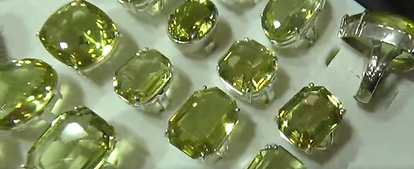
Peridot and olivine are essentially the same mineral, but in different contexts. Peridot is the transparent, gem-quality variety of Olivine, prized for its bright green color. Olivine itself is a common rock-forming mineral found in igneous rocks like basalt and peridotite, and it typically appears as dull, granular green crystals. When olivine forms with exceptional clarity, low iron content, and an attractive olive-green to yellow-green hue, it is classified as peridot and used in jewelry.
Above: Chromium diopside


The difference between hard rock and placer mining.


Left: with hard rock mining kimberlite pipes lie exposed and partially mined. During the last ice age, the surfaces of the pipes were exposed and scraped by ice. Deposition occurs in glacial landforms to the south.
Right: an esker is one form of a glacial deposition in which diamonds can potentially be found.

Left: eskers, morains and terraces are all likely places to find diamonds if you are lucky. Ontario's landscape is surfaced with these features. The question here is whether the gravel was bought to this location from a diamond bearing kimberlite pipe.

Diamond shape is influenced by three main factors:
1. Mantle growth conditions
Different mantle environments (temperature, pressure, fluids) produce different primary shapes:
-
Octahedra → stable, slow growth
-
Cubes → rapid growth, fluid-rich system.
2. Resorption during kimberlite ascent
This is the biggest control on shape variation between pipes.
Different kimberlites have different temperature, Oxidation state, Volatile content
This affects how much diamonds are dissolved on the way up.
Example:
-
Highly resorbed pipe → mostly rounded dodecahedra
-
Gentler ascent → more preserved octahedra
3. Transport and secondary processes
In placer environments (like Ontario glacial deposits):
-
Sharp octahedra become rounded
-
Fragile forms break
-
Only the most durable shapes survive so shape can also reflect distance from source.


Left: Grease table for separating diamonds from gravel.

Right: I met Tony Bishop at the Bancroft Gemboree and he and I spoke history of the Cobalt area. I did not realize at the time that he was an expert in prospecting for Diamonds, but he was playing "low Key" that day. On the table beside him Tony had silver slabs that he'd sliced. You'd be surprised at the people you meet at the gemboree. I'm thinking of presenting this year on vein dykes in the Bancroft area, but lets see how the year is going.

Below: Native silver from Gowganda, Ontario