


Collecting titanite in Bancroft, Ontario is one of Canada’s most exciting rockhounding experiences, drawing mineral enthusiasts from around the world to plumb Ontario's amazing vein dykes. Known as the “Mineral Capital of Canada,” Bancroft offers a rare opportunity to uncover amber, and honey-colored titanite specimens directly from carbonatite-rich outcrops and historic mine sites. Whether you’re a beginner or seasoned collector, the region’s accessible claims—like those operated by Dark Star Crystal Mines—provide hands-on access to some of the finest titanite mineral crystals found anywhere. These highly sought-after specimens are prized for their unique wedge-shaped crystal structure, making every discovery both scientifically fascinating and visually stunning. Many of the crystals are part way in their change to anatase so this adds further excitement to the discovery. If you’re searching for the ultimate Ontario rockhounding adventure, collecting titanite in Bancroft combines geology, exploration, and the thrill of discovery into one unforgettable experience.


Left: Don't worry, we're just starting out
Collecting Titanite in Bancroft, Ontario: The Dark Star Experience
Why Titanite is in High Demand in Bancroft, Ontario
At the heart of Ontario’s mineral-rich landscape, Dark Star Crystal Mines has quickly emerged as a premier destination for collecting titanite in Bancroft, Ontario. Known in the gemstone world as sphene, titanite is one of the most sought-after minerals in the region, prized for its sharp crystal form, brilliant dispersion, and geological significance. For rockhounds, prospectors and collectors, Bancroft offers a rare opportunity to uncover these remarkable crystals in their natural setting.
Over the past year, the Dark Star team has noticed a clear pattern among visitors: most arrive with one of two goals in mind—finding titanite or quartz. While both are abundant, titanite crystals consistently steal the spotlight. Their distinctive wedge-shaped forms and natural brilliance make them a standout find, though Dark Star’s amethyst—featuring the unique “Martian pumpkin” formations—remains a close competitor.
The Dark Star South Claim is particularly productive for titanite collecting. This carbonatite, or calcium-rich vein dyke system, hosts numerous mineralized fissures, many of which contain titanite. The most promising are the high-temperature fissures, formed early in the Bowen reaction series when pyroxene dominated the mineral assemblage. These conditions created an ideal environment for the growth of well-formed titanite crystals, often found along fissure walls or accumulated at depth after breaking free.
My own introduction to collecting titanite in Bancroft began at the historic Bear Lake Diggings, located just across the road from the South Claim. Once a well-known site for titanite, Bear Lake is now private property and closed to rockhounding, making access to productive locations like Dark Star Crystal Mines more valuable than ever.
Table of Contents
-
Why Titanite is in High Demand in Bancroft, Ontario
-
Why Collecting Titanite in Bancroft Becomes Addictive
-
What is Titanite Worth in Bancroft, Ontario?
-
How Provenance Affects Titanite Value in Bancroft
-
How Bancroft Titanite Compares to the Global Market
-
Why Titanite Commands Premium Prices in Idar-Oberstein
-
Does Titanite Hold Its Value on the International Market?
-
How Expert Cutting Increases Titanite Value
-
How to Identify Titanite in Vein Dykes
-
Chemical Relationship Between Titanite and Apatite
-
How to Find Titanite at Dark Star Crystal Mines
-
What is Anatase and How Does It Form from Titanite?
-
Why Titanite Alters into Anatase
-
Key Field Clues For Collecting Titanite
-
Where to Find Titanite in Bancroft, Ontario
-
Best Places to Collect Titanite at Dark Star Crystal Mines
-
What Titanite Looks Like When Found in the Field
-
What is Gem-Quality Titanite?
-
Key Properties of Titanite Crystals
-
Why Bancroft Titanite is Often Opaque or Dark
-
Geological Environments Where Titanite Forms
-
Why In-Situ Titanite Collecting Matters
-
Why Carbonatites Produce Large Titanite Crystals
-
Titanite as a Gemstone in Jewelry
-
Collecting Titanite in Bancroft: The Dark Star Experience
-
FAQ: Collecting Titanite in Bancroft, Ontario
Why Collecting Titanite in Bancroft Becomes Addictive
It was a rainy afternoon and my dad and I arrived and wandered through a moonscape of trenches left by years of foraging rockhounds. In the drizzle we came across a fellow in a yellow rain coat digging with utmost concentration.
It turned out that this collector came up to Bear Lake Diggings every weekend from Ottawa where he ran a factory. In the brief time that he allowed for conversation we learned that his obsession for titanite had ruined his marriage. Nevertheless he chose his own destiny and would have it no other way. Odd to think that 40 years later I would have staked a claim right next to that famous spot.
Apparently the Germans are “Mad for titanite” and the “The Titanite specialists” findings each weekend were of sufficient quantity to pay for a trip to Idar Obrerstien (if he chose to do that). His specimens would sell for a premium in Germany. It was a brief exchange and he was soon back to his addiction – titanite!
What is Titanite worth in Bancroft, Ontario
Canadian titanite from the Bancroft region may carry added appeal domestically, especially when tied to well-known collecting sites like Dark Star, because provenance matters. In essence, minerals behave a lot like art: value isn’t just about what the specimen is, but where it’s being sold, who is buying, and how that material is perceived in that particular market. Quartz, fluorite and jade in China have a similar appeal, its mainly cultural in those places.
Titanite from the Bancroft, Ontario occupies a very interesting position in the mineral market—it’s not typically the highest-priced titanite in the world, but it is highly respected among collectors, especially for its locality, associations, and classic Canadian mineralogy.
At a general level, Bancroft titanite tends to fall into a moderate price range, but with a wide spread depending on quality. Common or small crystals—especially dark brown or black, slightly damaged, or lacking strong luster—can sell quite cheaply, sometimes tens of dollars. Small or mixed specimens from the area can sell in the $25–$100 range, particularly when titanite is not the main feature or is part of a mixed mineral piece.
However, even in these lower ranges, Bancroft material is still considered collectible because the region is known as the “Mineral Capital of Canada,” and titanite itself is one of its more sought-after species.
Where Bancroft titanite really starts to gain value is in aesthetic, well-formed specimens. Sharp wedge-shaped crystals on attractive matrix (calcite, feldspar, or apatite) can move into the $100–$300+ range, especially if they are large, lustrous, and relatively undamaged.
How Provenance Affects Titanite Value in Bancroft
Provenance also plays a role—older collection material or pieces with known history (classic mines, named collections) can push prices higher, as seen in auction results where a single sharp crystal on matrix reached over $100 despite minor damage. Bear Lake area is the pinnacle of provenance for titanite in Ontario.
How Bancroft Titanite Compares to the Global Market
However, compared to global titanite markets, Bancroft material has a distinct limitation and a distinct advantage. The limitation is that most Ontario titanite tends to be darker (brown, black, or grey) and less transparent, which makes it less desirable for faceting and reduces its value in the gemstone trade. The advantage, though, is that Bancroft titanite often occurs in large, well-formed crystals and classic associations (apatite, calcite, pyroxene), which are highly valued by mineral collectors rather than gem buyers. In other words, Bancroft titanite is more of a specimen collector’s mineral than a gem cutter’s mineral.
At the high end, exceptional Bancroft titanite—large, sharp, undamaged crystals with strong luster and good contrast on matrix—can reach several hundred dollars and sometimes higher, especially if:
-
The crystal is large (multi-centimeter or larger)
-
It is aesthetically balanced on matrix
-
It has minimal edge damage (rare for titanite)
-
It comes from a known or classic locality
There is also a strong local premium effect. Within Canada, especially among Ontario collectors, Bancroft titanite carries extra appeal due to accessibility and familiarity. Among international collectors, however, it usually sits below Alpine (Switzerland/Austria) or Pakistani titanite in price because those localities produce more transparent, gem-quality material.
Why Titanite Commands Premium Prices in Idar-Oberstein
Idar-Oberstein has been a major center for gemstone cutting and trading for centuries. Any stone that passes through this market automatically gains a “heritage” value. Collectors trust the expertise, grading, and provenance associated with the city, which boosts prices for titanite compared to the same stones sold elsewhere. Buyers are willing to pay 20–50% or more extra for stones that have been cut, graded, or sold in this historic gemstone center.
The valuation of titanite (sphene) in Idar-Oberstein sits at the intersection of global gem pricing fundamentals and a very specialized, high-end collector market. What makes this market unique is that titanite isn’t treated there as a “mid-tier gemstone” (which it often is elsewhere due to its softness), but rather as a connoisseur’s stone, where exceptional examples are aggressively pursued and priced accordingly.
Similarly the Japanese are born connoisseurs, but not for titanite, it’s a cultural favoritism that they’ve developed for perfection, Japan is a place in which collectors tend to favor highly refined, perfectly formed crystals with exceptional balance and minimal damage. Like Bonsai they see something subtle in a form that we in the west either miss or discount for our different way of seeing things.
At a baseline level, gem titanite valuation follows the same core drivers seen worldwide: color, clarity, size, and cut. The most valuable material is typically bright yellow-green or rare chrome-green, with strong dispersion (“fire”), and as clean as possible—though eye-clean stones are inherently rare. Size is a major multiplier; stones above 5 carats become scarce, and anything clean in the 5–10+ carat range enters collector territory.
Does Titanite Hold Its Value on the International Market?
Even outside Idar-Oberstein, a fine ~1 carat eye-clean stone might sit in the low hundreds of dollars, while larger, high-quality stones can climb into the thousands depending on quality and size . This already tells you the key point: titanite has a steep value curve once quality and size align.
What changes in Idar-Oberstein is how far that curve gets pushed. The city’s cutting expertise plays a huge role—titanite is notoriously difficult to cut due to its brittleness and strong birefringence, but when done well, its dispersion (which actually exceeds diamond) becomes spectacular .
Stones that might look mediocre elsewhere can be transformed into high-fire gems, and that added visual performance directly translates into higher valuation. In practical terms, a well-cut stone in Idar-Oberstein can command a significant premium over identical rough or poorly cut material, sometimes doubling perceived value simply through presentation.
For mineral specimens (not just faceted stones), valuation in this market leans heavily toward aesthetic perfection and rarity of form.
Collectors in the European tradition—especially in Germany—tend to prioritize:
-
Sharp, undamaged wedge-shaped crystals
-
High luster (glassy to adamantine surfaces)
-
Strong, attractive color (green, yellow, or unusual hues)
-
Balanced, display-quality matrix
Top specimens that combine these traits become highly competitive, similar to fine Alpine minerals. While ordinary titanite crystals remain affordable globally, museum-quality or highly aesthetic pieces can escalate quickly in price due to collector competition .
How Expert Cutting Increases Titanite Value
Titanite’s high dispersion (splitting light into rainbow flashes) is one of its most prized features. However, the mineral is brittle, pleochroic (showing different colors from different angles), and soft (Mohs 5–5.5), making cutting tricky. Skilled cutters in Idar-Oberstein can maximize its brilliance, color play, and fire, which dramatically increases the stone’s value. Chrome green is the most valuable; yellow and yellow-green are prized for maximum “fire.” Brown or dark stones are less valuable unless clarity is exceptional.
Poorly cut titanite—even if gem-quality in color—appears dull, reducing market worth. I’m fortunate to own a titanite cut by Brad Wilson of Alpine Gems. I believe he is one of the finest cutters in Ontario, possibly all of Canada.
In short: Idar-Oberstein pays a premium because it is a sophisticated, collector-driven gemstone market. Scarcity, rarity of high-quality crystals, expert cutting, historic prestige, and provenance all combine to make titanite from this market far more valuable than the same stone sold elsewhere.
How to Identify Titanite in Vein Dyke
Titanite tends to accompany pyroxene-rich fissures, making the presence of pyroxene a reliable indicator for collectors. We call titanite fissures, "High temperature fissures". Along with the pyroxene are swarms of small apatite crystals. We believe there is a trade-off here between the growing conditions of apatite and the constituents that go into building a large titanite crystal.
In the other type of fissure, the low temperature variety, apatite can be found in impressive sizes, but no titanite. We initially theorized that each crystal at its varying temperature range was pirating the chemicals needed for the growth of the other crystal, but upon reflection there is not a lot in which they share except calcium.
Chemical Relationship Between Titanite and Apatite
-
Calcium (Ca)
-
Both titanite and apatite are calcium-rich minerals.
-
Calcium is essential for titanite formation and forms the bulk of apatite’s structure.
-
This shared requirement is why titanite often grows in calcium-rich environments like carbonatites or marble walls.
-
-
Oxygen (O)
-
Both minerals contain oxygen as part of their fundamental anionic groups: SiO₄ tetrahedra in titanite, PO₄ tetrahedra in apatite.
-
Distinct Components
-
Titanite requires titanium (Ti) and silicon (Si), which apatite does not contain.
-
Apatite contains phosphorus (P) and often fluorine, chlorine, or hydroxide (F, Cl, OH), which titanite lacks.
-
Implications for Mineral Growth
-
Because they both require calcium, they can coexist in the same fissure or vein, but they compete for available calcium.
-
Again there is the size situation, admittedly both crystals do form together but the apatites are smaller and more numerous with the titanite so that leads us on to suspect that maybe nodes of crystal growth might just be more numerous at higher temperatures and there could possibly not be a connection between the 2 minerals in terms of their growth. In our carbonatites there is plenty of calcium to go around for all.
How to Find Titanite at Dark Star Crystal Mines
Titanite at Dark Star is rarely found pristine on the walls of fissures. Instead, most crystals have experienced a journey—falling from the walls to settle at the deepest points of a fissure, sometimes partially converting to anatase along the way. Their sharp, wedge-like shapes and weight allow them to slide naturally down slopes and fissure walls, invariably showing a broken edge indicating that it snapped off a fissure wall.
Titanite transforms into anatase through a process of chemical alteration rather than direct crystallization, typically driven by hydrothermal fluids or weathering.
Titanite (CaTiSiO₅) contains calcium, titanium, and silica, while anatase (TiO₂) is composed only of titanium dioxide. For this transformation to occur, circulating fluids—often slightly acidic—move through fissures and begin to leach out calcium and silica from the titanite structure. Titanium, being far less mobile, remains behind and eventually recrystallizes into anatase. This process usually happens after the original titanite crystal has formed, either during late-stage hydrothermal activity or near-surface weathering.
In some cases, minor radiation damage from trace uranium or thorium within the titanite can weaken the crystal structure, making it more susceptible to fluid penetration and alteration.
What is Anatase and How Does It Form from Titanite?
Visually, titanite and anatase are quite distinct, especially to a trained eye. Fresh titanite typically forms sharp, wedge-shaped crystals with a resinous to adamantine luster and colors ranging from green and yellow to brown or grey, often showing a bright, lively sparkle. Well that’s our usual thing, but Liz came to us one day with a grey stained titanite and said “Guess what I found.”
As alteration begins, those crisp edges on a fresh titanite may appear etched or frosted, and the surface can lose its shine. Anatase, by contrast, usually appears as dark brown to black material with a more subdued luster, often forming fine-grained coatings, crusts, or small bipyramidal crystals. Instead of the clean, geometric look of titanite, altered areas tend to look dull, granular, or even chalky. Many specimens show partial transformation, where remnants of the original titanite structure are still visible alongside darker, altered zones, effectively preserving a snapshot of the mineral’s chemical evolution.
Why Titanite Alters into Anatase
1. Chemical Instability
Titanite is stable at higher temperatures and specific chemical conditions (Ca-rich, silica-present systems). When conditions shift—especially when fluids remove calcium—titanite becomes unstable and begins to break down.
2. Fluid Activity
Late-stage or post-formational fluids are the main cause. These fluids:
-
Strip out calcium and silica
-
Alter the crystal from the outside inward
-
Often follow fractures, cleavage, or edges of the crystal
3. Weathering
Near the surface, exposure to groundwater and oxygen accelerates the process. Titanite is not especially resistant to weathering, so it can degrade over time into secondary titanium minerals like anatase.
4. Radiation Damage (Less Common but Relevant)
Most Bancroft titanite contains trace uranium or thorium. Over long periods, radiation can damage the crystal structure (metamictization), making it easier for fluids to penetrate and alter the mineral.
Key Field Clues for Collecting Titanite
-
If a titanite has lost its shine and looks etched or chalky, it may be partially altered to anatase.
-
Dark, fine-grained coatings on titanite are often anatase or related TiO₂ phases.
-
A crystal that still has sharp geometry but dull surfaces is often in transition.
-
Fully transformed material rarely keeps the classic titanite wedge shape cleanly—it becomes more granular or crusty.
Where to Find Titanite in Bancroft, Ontario
In the Bancroft region, Dark Star Crystal Mines offers access to these geological marvels. The south claim contains high-temperature fissures lined with pyroxene, producing some of the finest titanite specimens in Ontario. Other notable Ontario localities once included Bear Lake, just across the road from us where large dark brown titanite have been found; the Lake Clear area, home to the Smart mine; which hosts pyroxenite dykes with coarse titanite; and the broader Bancroft area.
At nearby Titanite Hill the most frequent place to find a titanite crystal is beneath the roots of surface trees. We have a theory that as many of the fissures open out at their bottom end on the outside of the hill, titanite that are on a downward slide reach the bottom of the fissure only to be deposited out on the hillside. With their particular streamlined shape and weight these crystals continue sliding beneath the soil and above the underlying rock face to eventually be stopped by tree roots or some rocky protrusion.
I wonder if the bottom of the hill has an accumulation of titanite that may have evaded all the obstacles. I intend to check there this spring unless you get there first.
Best Places to Collect Titanite at Dark Star Crystal Mines
One of Dark Star’s most famous fissures, Hubberts Hole, has produced just under 200 titanite over a surface distance of about 20 feet, some embedded in translucent guava-colored feldspar. Jason Hubbert, one of our regulars on the claim was the first to dig this spot and both Mark and I initially had little hope, but soon he was 6 feet deep beneath a buried ledge and turning up titanite like it was as plentiful as gravel on the road. Lisa was digging 20 feet away in a slot that required a ladder to get out of and she was finding nothing. I’m thinking that it may have had something to do with the country rock that changed from gneiss where Jason was digging to marble where Lisa was digging.
What Titanite Looks Like When Found in the Field
Many of the titanite came up so grubby and encrusted in dirt that it was not until a rainstorm washed them off that we realized the tailings from Hubbert’s Hole were a veritable gold mine. The largest titanite discovered over the past year at Dark Star was palm-sized, silvery-grey, and of exceptional beauty, a prize find for any rockhound. Mark and I were stunned by the question , “Is this a keeper?” Admittedly it was the rockhounds first dig and he was serious in his question.
What is Gem-Quality Titanite
If minerals had reputations akin to rock stars, gem titanite would undoubtedly steal the show. Its explosive dispersion splits light into rainbow-filled brilliance, often outshining even diamond fire, while its wedge- or envelope-shaped crystals, often euhedral and sharply defined, look almost like relics of lost technology – something left behind by a space ship. A sure sign of titanite with a loupe is the doubling of the pavilion facets when examined through the table. It is of course an illusion but appears to be the case because of the stone’s optical properties.
Beyond its visual drama, titanite is an interactive mineral: certain crystals glow under UV light, others display mild radioactivity detectable by sensitive instruments.
These properties make titanite rewarding to study from multiple angles, giving collectors not just beauty, but a story written in light. Titanite is also a geological historian, preserving evidence of thermal events during mountain building and crustal changes, often recording older cores and younger outer growth layers that reveal Earth’s deep past.
Key Properties of Titanite Crystals
Understanding titanite characteristics is essential for collectors. Its chemical formula is CaTiSiO₅, belonging to the nesosilicate mineral class and the monoclinic crystal system. Typical crystal habits are wedge-shaped, tabular, or envelope-like. Its Mohs hardness of 5–5.5 makes it softer than many popular gems, but its vitreous to adamantine luster, very high refractive index, and strong birefringence create a dazzling visual effect.
Titanite displays a wide range of colors, most commonly green to yellow-green, honey-yellow to golden, or brown to reddish-brown, with rare pink, orange, or color-changing stones arising from trace element variations. Titanite exhibits pleochroism, showing different colors when rotated in polarized light, and some gem titanites display color-change behavior under different lighting conditions, especially stones with complex Fe and rare earth element chemistry.
Why Bancroft Titanite is Often Opaque or Dark
Titanite (sphene) shows such a wide range from colorful, transparent crystals to opaque brown ones because of differences in chemistry, growth conditions, and post-formation changes. Vivid, gemmy titanite typically forms when trace elements like rare earths are present in small, well-balanced amounts and iron content is relatively low, allowing strong color without disrupting clarity; in contrast, higher iron levels—especially Fe³⁺—tend to produce darker brown tones.
Transparency depends heavily on how cleanly the crystal grows: slow, stable formation in fluid-rich environments allows a well-ordered lattice, while rapid or crowded growth alongside minerals like Calcite or Amphibole can trap inclusions, distort the structure, and scatter light, making the crystal cloudy or opaque.
Additional factors such as fluctuating chemistry, internal defects, and radiation damage from trace uranium or thorium can further darken and degrade clarity over time, and some titanite may even partially alter into Anatase along fractures, increasing opacity. In essence, the most colorful and transparent titanite reflect ideal, stable growth conditions with minimal impurities, while opaque brown specimens record higher iron content, more chaotic crystallization, and structural damage.
Geological Environments Where Titanite Forms
Titanite crystallizes in several geological settings. In metamorphic rocks such as gneiss, schist, marble, and amphibolite, calcium from carbonate or feldspar combines with titanium mobilized from precursor minerals and silica from quartz or feldspar to form titanite. In alkaline igneous rocks, including carbonatites, nepheline syenites, and pegmatites, late-stage fluids concentrate titanium and calcium, producing large, well-formed crystals.
Skarn deposits and contact metamorphic zones yield titanite alongside garnet, diopside, vesuvianite, apatite, and magnetite, while Alpine-type clefts produce some of the world’s most aesthetic, transparent, and sharply formed crystals, often perched on matrix minerals such as chlorite, albite, or calcite.
Why In-Situ Titanite Collecting Matters
Collectors should note that titanite rarely survives transport in river gravels, so in-situ collection from fissures and dykes is key and unless you have a calcite medium in which the crystal has grown your observance of it will be limited to a partial crystal protruding from a rock. The beauty of a carbonatite is that over millions of years of exposure to the elements the calcite erodes and the entrained crystals drop out. Admittedly most titanite grow from a fissure wall, but hopefully where they snap off it is limiting in its damage to the whole.
Why Carbonatites Produce Large Titanite Crystals
Titanite’s preference for fissures and cavities in carbonatites is no accident. Late-stage Ti-rich fluids accumulate in fissures where open space allows crystals to grow euhedral. Calcium-rich walls supply essential chemical components, while the temperature and pressure conditions typical of late-stage magmatic fluids favor crystallization in cavities rather than within dense rock. Titanite often grows with other minerals, such as calcite, apatite, pyroxene, and amphiboles, and competes chemically for calcium, titanium, and silica.
In crowded environments, titanite may form clusters, skeletal shapes, or overgrow other minerals, while optimal conditions allow sharp, well-formed crystals.
Collectors aiming for high-quality specimens in Bancroft should focus on fissures containing pyroxene, examine fissure walls for sheared titanite, and consider matrix associations, particularly crystals embedded in feldspar. Palm-sized specimens with silvery-grey, green, or yellow hues are especially prized, while provenance from Dark Star enhances both display appeal and market value.
Titanite as a Gemstone in Jewelry
Faceted titanite, or sphene, is highly valued in the gem trade, though its softness and cleavage make jewelry applications challenging. Stones over five carats are rare, while sizes above ten carats are exceptional. Color is a critical determinant, with chrome green and yellow-green stones preferred for their brilliance. Eye-clean clarity is uncommon and commands a premium, and expert cutting maximizes the mineral’s high dispersion, producing dazzling fire. In Idar-Oberstein, Germany, historical expertise and a sophisticated gem trade ecosystem make these stones highly sought after, combining rarity, quality, and provenance to create significant market value.
The stones from our dark star claim are thus far not of gem quality, typically they are of a beer bottle brown translucence, silver grey or jet black. They are fine mineral specimens, but not what you’d wear on a ring.
Titanite also serves as a geological time capsule. Incorporating uranium but rejecting lead during formation, titanite is valuable for U-Pb geochronology, thermochronology, and trace-element analysis. Ontario titanite, particularly from Bancroft, offer insights into regional metamorphism, alkaline magmatism, and multiple generations of thermal events.
Notable titanite occurrences worldwide provide context for Ontario collectors. Capelinha, Brazil, has produced crystals up to 16 cm, while the European Alps yield vivid green-yellow Alpine cleft crystals up to 13 cm. Pakistan’s Shigar and Tormiq Valleys produce large, gemmy green-gold titanite. Ontario continues to deliver impressive specimens, particularly at Dark Star and surrounding fissure sites, combining size, color, and matrix quality for collectors seeking exceptional finds.
Collecting Titanite in Bancroft: The Dark Star Experience
Collecting titanite at Dark Star Crystal Mines is more than a hunt for beautiful crystals; it is an immersion into Ontario’s geological history. High-temperature fissures lined with pyroxene, palm-sized crystals, and the thrill of discovery make Dark Star a premier destination for enthusiasts. As far as titanite goes, Dark Star is recognized in the Bancroft area as a modern equvalent of what Bear Lake was to titanite in the 1970s.
Each crystal, with its outstanding luster and preserved growth history, offers not only aesthetic enjoyment but a tangible connection to the Earth’s dynamic processes. For collectors, the Dark Star experience combines beauty, science, and the adventure of exploration into one unforgettable journey.
FAQ: Collecting Titanite in Bancroft, Ontario
What is titanite and why is it so sought after?
Titanite is a calcium titanium silicate mineral prized for its sharp wedge-shaped crystals and intense optical “fire.” It disperses light even more strongly than diamond, producing flashes of color that make it one of the most visually striking minerals a collector can find. Beyond its beauty, titanite is also valued for its geological significance, as it can record the thermal history of the rocks it forms in.
Where is the best place to find titanite in the Bancroft area?
Titanite is found throughout the Bancroft region, but the best collecting is typically in carbonatite dykes, calcite veins, and high-temperature fissures. Locations with pyroxene-rich zones are especially productive. Sites like the Dark Star Crystal Mines south claim are known for hosting titanite-bearing fissures where crystals have formed along the walls and accumulated at depth. Titanite Hill is also a great place for titanite.
What should I look for when searching for titanite?
Look for signs of pyroxene, calcite, and small swarms of apatite, as these minerals often occur alongside titanite. Focus on fissures walls and the places that can as traps for minerals sliding through the dirt. Titanite is frequently found loose at the bottom of fissures, having broken off the walls, so digging deeper into a vein can be more productive than surface searching, but don’t discount the value of searching tailings from titanite yielding trenches. Small crystals are almost always missed by even the most diligent collectors, but a rainstorm should present them to surface scavengers.
Why are many titanite crystals found broken?
Most titanite crystals originally grow attached to fissure walls. Over time, natural processes like stress, weathering, or freeze-thaw cycles cause them to break free and fall. Their wedge-shaped form allows them to slide downward, so they often accumulate at the lowest point in a fissure. As a result, it is rare to find a completely undamaged crystal.
What colors of titanite are found in Bancroft?
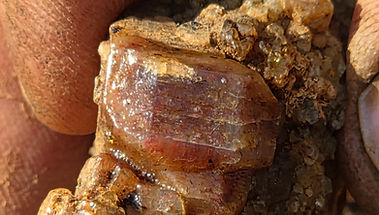
Bancroft titanite is most commonly beer bottle brown, grey, or reddish brown, often with a silvery or resinous luster. While not typically as vividly green or transparent as material from places like Pakistan or the Alps, Bancroft crystals are valued for their size, shape, and classic mineral associations.
What is the difference between titanite and anatase?
Titanite (CaTiSiO₅) can alter into anatase (TiO₂) when calcium and silica are removed by fluids. Visually, titanite is typically sharp, lustrous, and wedge-shaped, while anatase appears darker, duller, and often forms as fine coatings or small crystals. Partially altered specimens may show both minerals together.
How much is Bancroft titanite worth?
Value varies widely. Small or damaged pieces may be worth $25–$100, while larger, well-formed crystals on attractive matrix can reach $100–$300 or more. Exceptional specimens—large, sharp, and aesthetically balanced—can command several hundred dollars or higher among collectors.
Biography
Michael Gordon, Co- Founder, Dark Star Crystal Mines
Michael Gordon is a co-founder of Dark Star Crystal Mines, Bancroft, Ontario and a lifelong rockhound, mineral educator, and ethical crystal advocate. He has a degree in geography, a diploma in gemology and is a certified Diamond Grader. Michael is author of the 3-part Rockhound Series books and also curator of the popular you-tube channel - Caver461. Michael has several times been a speaker at the Bancroft gemboree and is considering that possibility again this coming year.
Mark Reis, Co-founder, Dark Star Crystal Mines
Mark is a co-founder of Dark Star Crystal Mines and he currently functions as the “Chief Extraction Officer”, specializing in calcium vein dykes, skarns and pegmatites. Mark is the business mind of Dark Star and he has a specialized gift for sniffing out crystal treasures. Prior experience as a rockhound was honed in local vein dyke occurrences and over the years he has become a consultant to others who are wondering about the value of their claims. Mark has self educated in geology over the years and is now a highly competent prospector of vein dykes, pegmatites and skarns.
Works cited:
Grice, Joel D. Famous Mineral Localities of Canada. Toronto: Mineralogical Association of Canada, 1989. https://www.mindat.org/locentry-1323333.html.
McDougall, Raymond. Mineral Highlights from the Bancroft Area, Ontario, Canada. Rocks & Minerals, 2019. https://www.researchgate.net/publication/334980903_Mineral_Highlights_from_the_Bancroft_Area_Ontario_Canada.
Ontario Geological Survey. Bancroft Nepheline Syenite and Regional Geology. Ontario Ministry of Northern Development, Mines and Forestry, 1980s–1990s. https://www.geologyontario.mndm.gov.on.ca/mndmfiles/mdi/data/records/MDI31F04SW00091.html.
Rothstein, Joe. “The Bancroft Area and Its Minerals.” Rocks & Minerals 43, no. 3 (1968): 145–152. https://www.researchgate.net/publication/339774772_The_Crystallinity_of_Apatite_in_Contact_with_Metamict_Pyrochlore_from_the_Silver_Crater_Mine_ON_Canada.
Sabina, Ann P. Rocks and Minerals for the Collector: Bancroft‑Parry Sound Area and Southern Ontario. Ottawa: Geological Survey of Canada, Miscellaneous Report 39, 1986. https://www.mindat.org/reference.php?id=12987207.
Hasler, Rudolf. 2013. “Best of Titanite.” Mindat.org Articles, October 2, 2013.https://www.mindat.org/a/best_titanite
Last Updated 2026

Below: Directly across from the Old Bear Lake Diggings we operate the South Claim of Dark star Crystal Mines and it is from there that we find amazing titanites in significant quantity. Back 20 years ago Bear Lake was the place for titanite, now its Dark Star Crystal Mines.

From the Fissure that we named "Hubbert's Hole", our clients found almost 200 titanites at last count.


Left and Right: This is the reality of titanite in Ontario, you dredge it from mud filled vein dykes and sometimes you have a treasure and at others a nice memento. The titanites to the right are about 5 inches across and I found them on top of a pile of tailings from a trench that had already been dug.
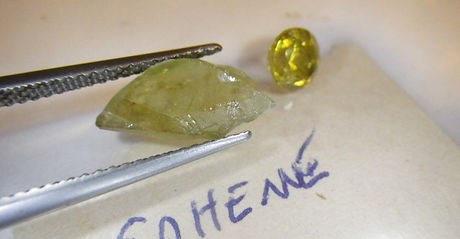
Above: I'm sure you can appreciate the difficulty in faceting such a thin bladed crystal.
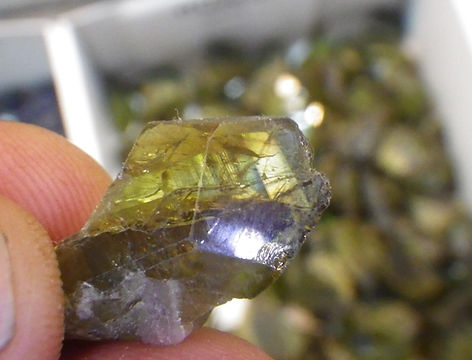
Right: Titanite from Pakistan

Left: Austrian, Italian and Pakistan titanite comes in unbeatable colors.
Below: Typical Ontario appearance, I call it "Beer bottle brown".

Left: Small apatite crystals embedded amongst a matrix of pyoxene is a great indicator of the potential for titanite.
Above: The finest crystals from hubbert's hole came up sharply defined and with this guava tinted feldspar.


Left: Thus far Bancroft titanites have been mineral specimens, varied in appearance and no doubt chemical composition. here you can see the decomposition under this crystal.
Right: this one was picked off the tailings pile. first and foremost its the luster that catches your eye.

Left: "Is this a keeper?" we were asked. I'll leave the answer to your imagination.
Below: Big excitement when Mark told the story and soon we were all headed to the far end of the claim to see it for ourselves.


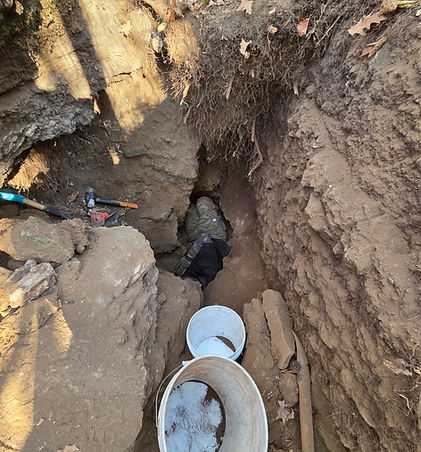
Above: Nad works the tailings and as expected he finds crystals that were missed at the initial extraction.
Right: Mark is deep in Hubbert's Hole - you can see him lying on his side in the bottom of the trench, shoulder deep in a pocket.

Right: Hubbert's Hole which extends onwards as a fissure in either direction for at least a hundred feet. There is only about a 40 foot section thats been dug.
Left: Lisa is digging a barren section that did not yield a great deal but we noted that the floor - about 15 feet down is still sloping deeper where she was.


Left: It's not exactly the most beautiful crystal but there certainly is a lot of weight there.
Above: Mark extracts one of seven crystals oddly exposed, but still in place on this rock wall down by the swamp.


Left: Mark brushes off a lump of calcite and finds 5 thumbnail sized titanites.
Right: Jason Hubbert at the beginning of his epic dig. He dominated this spot for at least 2 months and opened up a mineral bonanza that you might almost call a titanite rush, and sorry, if you are coming you need to dig further along the fissure with results that are not guaranteed. The titanites began appearing for Jason about 6 feet down. For Lisa they never came.

The finest titanite from the Bancroft region—part of the geologically complex Grenville Province—is defined by sharp, well-formed wedge-shaped crystals with high luster, deep reddish-brown to nearly black color, and strong internal optical depth. Top specimens are typically damage-free or nearly so, with crisp terminations and minimal edge wear, something that is rare due to their formation in tight fissures.
While size can enhance value, the highest-tier pieces prioritize crystal perfection, surface quality, and aesthetic balance over sheer scale.
Historically, the best titanite specimens are associated with the Bear Lake Diggings, which produced exceptionally refined, sharply defined crystals that set the standard for the region. These classic pieces are highly sought after not only for their quality but also for their provenance, as many were collected decades ago and are tied to well-documented collections. As a result, even smaller Bear Lake crystals can command significant interest if they exhibit the locality’s signature precision and luster.
Today, the highest-quality titanite that can still be actively collected comes from the Dark Star area and surrounding carbonatite systems. These localities can produce large, impressive crystals with strong associations such as calcite, pyroxene, and apatite, although they often show slightly more variation in form and surface quality compared to classic Bear Lake material. While Titanite Hill and other regional sites can yield good specimens, the combination of size, accessibility, and ongoing discovery makes the Dark Star area the most important modern source of top-tier Bancroft titanite.